
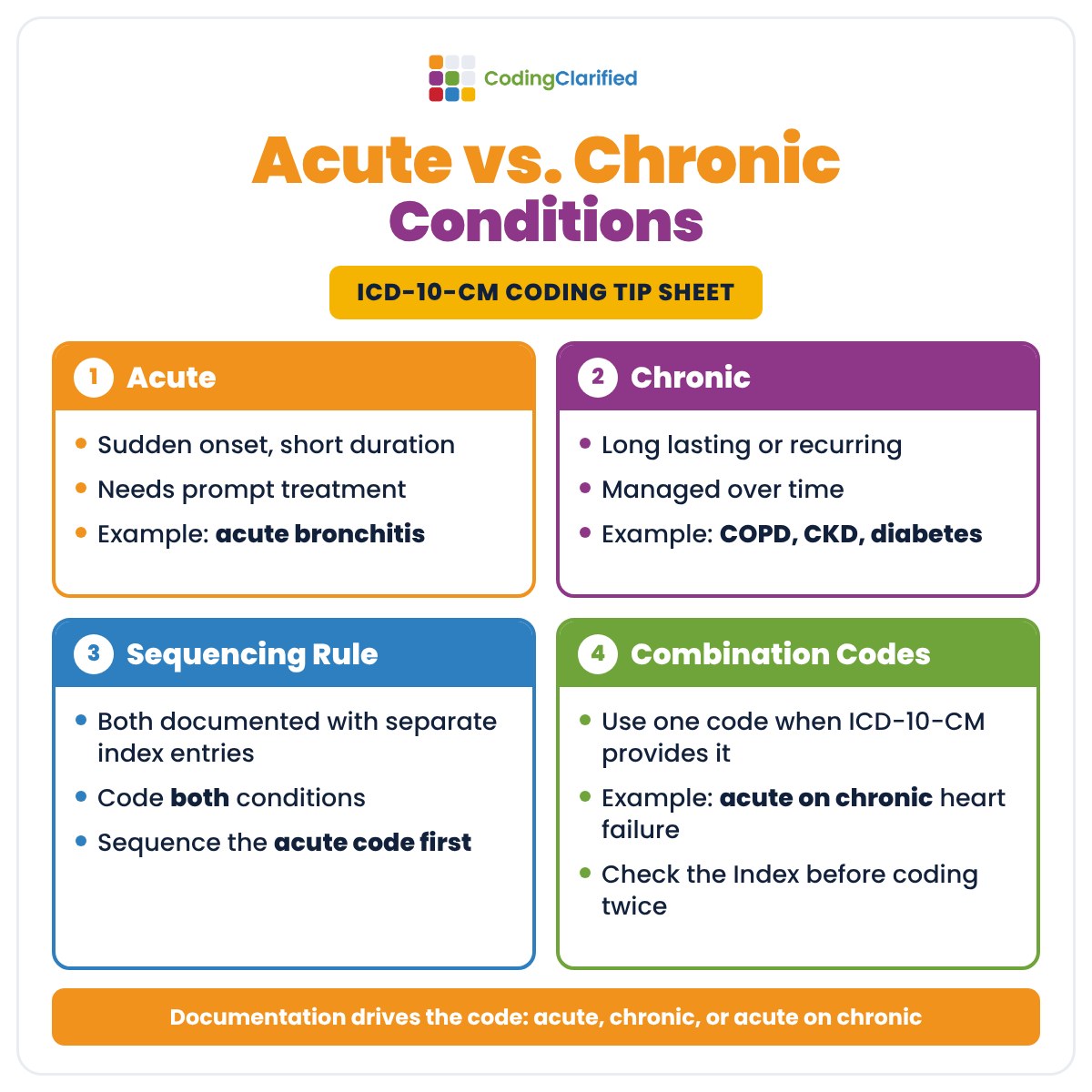
Quick answer: Acute conditions start suddenly and last a short time. Chronic conditions develop slowly and last a long time. Under ICD-10-CM guidelines, when the same condition is documented as both acute (or subacute) and chronic, and the Alphabetic Index lists separate subentries at the same level, code both and list the acute code first. Some conditions, such as acute exacerbation of COPD, use a single combination code instead.
How Do You Code Acute vs Chronic Conditions?
Accurate coding and billing make sure providers are paid correctly for their services. Telling acute conditions apart from chronic ones is a key part of that. It affects coding, billing, and clinical documentation.
What Is the Difference Between Acute and Chronic Conditions?
Before diving into the guidelines and tips, it’s important to understand what acute and chronic conditions are:
Acute Conditions: These conditions arise suddenly and have a short duration. They are typically severe but can be treated with interventions that lead to recovery. Examples include pneumonia, a heart attack, or a sprained ankle.
Chronic Conditions: These conditions develop over a long period and persist for months or even years. Chronic conditions may be manageable but often require ongoing treatment. Examples include diabetes, hypertension, and osteoarthritis.
Chronic Conditions Medical Coding for Chronic Conditions
What Are the ICD-10-CM Guidelines for Acute vs Chronic Conditions?
ICD-10-CM Codes:
Acute conditions are generally coded with acute disease codes in the ICD-10-CM (International Classification of Diseases, Tenth Edition, Clinical Modification) manual. These codes are specific to the type, location, and severity of the condition. For instance, pneumonia would be coded as an acute disease.
Chronic conditions, on the other hand, are coded under chronic disease codes. Many chronic conditions may need codes for both the condition and its complications, such as chronic kidney disease or diabetes with complications.
Secondary codes for complications: Some acute exacerbations have a combination code that covers both. For example, acute exacerbation of chronic obstructive pulmonary disease (COPD) is reported with J44.1 alone. When the Alphabetic Index lists separate acute and chronic subentries at the same level, code both and list the acute code first.
How Do You Sequence Acute and Chronic Conditions?
When the patient comes in for the acute problem, the acute condition is usually listed first, even if a chronic condition is also present.
If the chronic condition is the main focus, such as a routine diabetes follow-up, list it first.
Exacerbations or complications of chronic conditions should be coded according to whether the exacerbation or complication is acute and requires more immediate attention. For example, diabetic ketoacidosis is reported with one combination code that includes the diabetes, such as E11.10 (Type 2 diabetes mellitus with ketoacidosis without coma) or E10.10 for type 1.
Sequencing Sequencing in Medical Coding 2026
Use of Z Codes:
Z codes can add detail to chronic disease codes. For example, Z79.4 (Long-term (current) use of insulin) is added after the type 2 diabetes code to show ongoing insulin use.
Do not mix up encounter codes: Z51.81 is for therapeutic drug level monitoring, Z51.11 is for antineoplastic chemotherapy, and Z51.0 is for antineoplastic radiation therapy.
Modifier Codes:
Modifier codes such as Modifiers 25 (Significant, Separately Identifiable Evaluation and Management Service) or Modifier 59 (Distinct Procedural Service) may be necessary when acute and chronic conditions are treated together during the same visit. These modifiers provide additional details for accurate billing and reimbursement.
CPT Modifiers CPT Medical Modifiers
How Do You Bill Acute and Chronic Care?
Proper billing requires understanding the relationship between the patient’s condition and the treatment provided. Here are some key billing guidelines:
Acute Care Visits:
Acute care often pays more because of the services involved, such as testing, emergency care, and short-term treatment.
For acute conditions, the E/M (Evaluation and Management) code should reflect the complexity and time spent on care. If the patient is treated in an emergency department, level 1 to level 5 E/M codes may be applicable, depending on the severity of the acute condition.
Chronic Care Management (CCM) Services:
Chronic care management services involve continuous, non-acute treatment for ongoing conditions. These services may be billed under specific codes for long-term care or chronic care management (e.g., CPT codes 99490, 99439 for CCM).
For chronic conditions, know which long-term services are covered, such as medication management, lab work, and monitoring for complications.
Preventive Services for Chronic Conditions:
Code preventive services, such as screenings, checkups, and health risk assessments, separately from chronic care treatment.
Preventive care codes (e.g., CPT codes 99381–99397) should be used for routine health check-ups related to chronic conditions, whereas chronic disease management codes should be used for ongoing treatment or monitoring.
Billing for Exacerbations:
When an acute exacerbation of a chronic condition occurs, it can affect both coding and reimbursement. The billing must reflect the fact that the acute condition (exacerbation) requires immediate care.
Use a combination code when one exists, such as J44.1 for acute exacerbation of COPD. Otherwise, follow the Alphabetic Index and code both conditions when separate subentries are listed.
What Are Some Tips for Accurate Coding and Billing?
- Thorough Documentation: Always ensure that the clinical documentation provides clear and specific details of both acute and chronic conditions. This helps avoid coding errors and reduces the likelihood of claim denials.
- Stay Updated: Medical coding and billing rules change regularly, so it’s crucial to stay updated on any modifications to ICD-10, CPT, and HCPCS codes, especially those that pertain to acute and chronic conditions.
- Know the Guidelines for Exacerbations: When a patient’s chronic condition is complicated by an acute exacerbation, be sure to code both conditions properly and follow the correct sequencing guidelines.
- Educate Providers: Ensure that all healthcare providers are trained to document accurately and in detail. The more specific the diagnosis and treatment details, the easier it will be to apply the correct codes.
- Monitor Coding Audits: Regular audits of coded claims can identify any recurring issues with the coding of acute vs chronic conditions. Addressing these issues promptly can help avoid reimbursement issues.
- Use a Coding Specialist: A professional medical coder can help ensure that codes are accurate, compliant, and reflect the full scope of the patient’s condition and care.
The distinction between acute and chronic conditions is essential for accurate medical coding and billing. Following these guidelines helps providers get paid correctly and stay compliant. Precise documentation, correct codes, and proper billing keep the revenue cycle smooth and prevent costly denials.
AAPC AAPC: Reader Questions Defer To Your Doc When Determining Acute Vs Chronic 1
ncoa.org: Chronic Versus Acute Disease