Name: Bilateral Mammogram
Medical Specialty: Obstetrics / Gynecology
Description: Bilateral Mammogram (abnormal), additional views requested
(Medical Transcription Sample Report)EXAM: Mammographic screening FFDM
HISTORY: 40-year-old female who is on oral contraceptive pills. She has no present symptomatic complaints. No prior history of breast surgery nor family history of breast CA.
TECHNIQUE: Standard CC and MLO views of the breasts.
COMPARISON: This is the patient’s baseline study.
FINDINGS: The breasts are composed of moderately to significantly dense fibroglandular tissue. The overlying skin is unremarkable.
There is a tiny cluster of calcifications in the right breast, near the central position associated with 11:30 on a clock.
There are benign-appearing calcifications in both breasts as well as unremarkable axillary lymph nodes.
There are no spiculated masses or architectural distortions.
IMPRESSION: Tiny cluster of calcifications at the 11:30 position of the right breast. Recommend additional views; spot magnification in the MLO and CC views of the right breast.
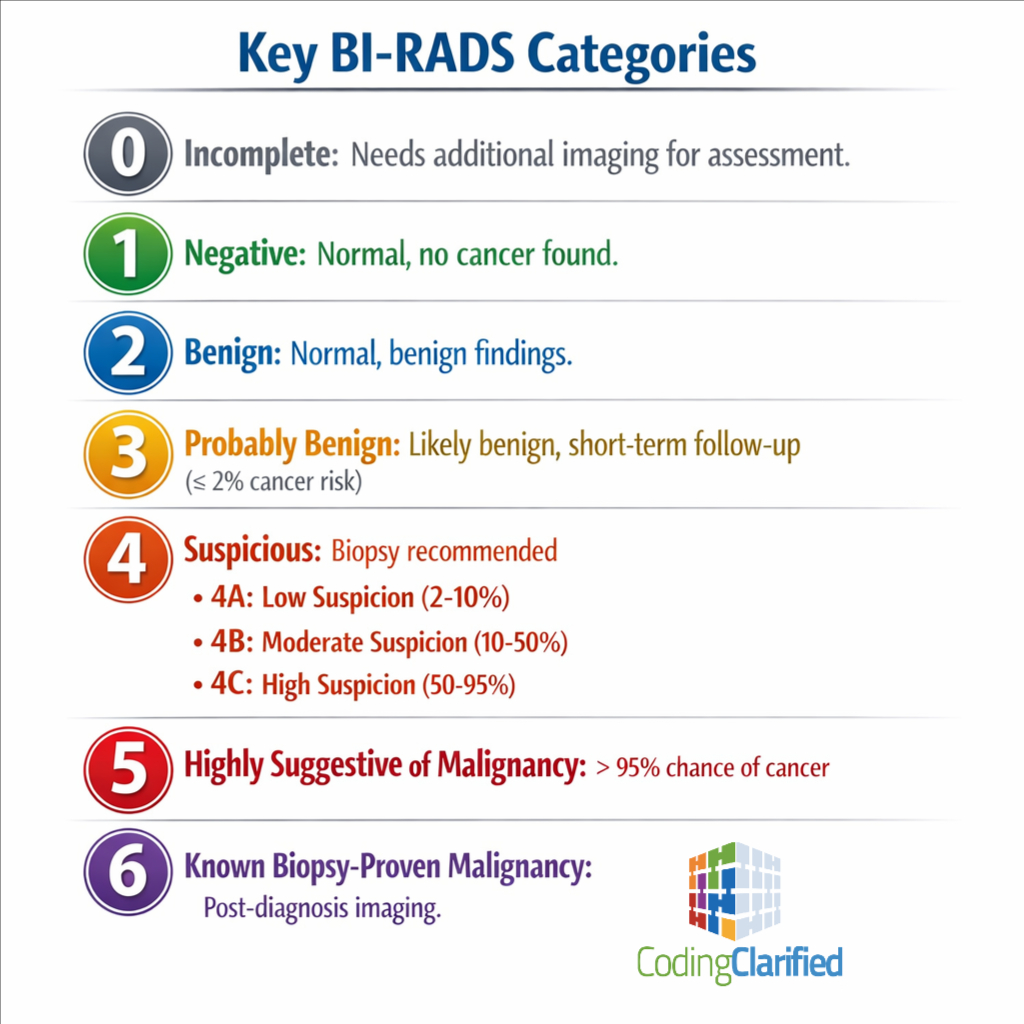
BIRADS Classification 0 – Incomplete
MAMMOGRAPHY INFORMATION:
1. A certain percentage of cancers, probably 10% to 15%, will not be identified by mammography.
2. Lack of radiographic evidence of malignancy should not delay a biopsy if a clinically suspicious mass is present.
3. These images were obtained with FDA-approved digital mammography equipment, and iCAD Second Look Software Version 7.2 was utilized.
Scenario Summary (Coding Context)
The patient is a 40-year-old female, and the encounter is a screening bilateral mammogram. During the screening, the radiologist finds a cluster of calcifications in the right breast and assigns BI-RADS 0 (incomplete). As a result, the radiologist recommends additional diagnostic views, which have not yet been performed.
CPT and HCPCS Procedure Codes
Code for This Encounter
77067 Screening mammography, bilateral (2-view study of each breast), including computer-aided detection (CAD) when performed
Rationale
The exam is explicitly documented as a screening mammogram (FFDM), and the patient is asymptomatic. In addition, she has no prior breast cancer, breast surgery, or family history. The radiologist performed bilateral CC and MLO views. Also, the CAD software (iCAD Second Look) is included in the code. Finally, BI-RADS 0 does not change the screening CPT code for this visit.
Codes Not Assigned for This Encounter
Do not code 77065 or 77066 (diagnostic mammography) yet, because the recommended additional views were not performed. Similarly, spot magnification views are not separately reportable, since they are bundled into the diagnostic mammogram when performed.
ICD-10-CM Coding for This Bilateral Mammogram
Primary Diagnosis (Screening Visit)
Z12.31 Encounter for screening mammogram for malignant neoplasm of breast
Rationale
The patient presents without symptoms, and the purpose of the exam was screening. Therefore, Z12.31 remains the first listed diagnosis for this visit.
Additional Diagnosis
R92.1 Mammographic calcification found on diagnostic imaging of breast
The ICD-10-CM guidelines for screening encounters state that when the provider discovers a condition during the screening, you may assign the code for that condition as an additional diagnosis. In this case, the radiologist documents a cluster of calcifications. Consequently, you can report R92.1 after Z12.31.
Diagnosis Codes Not Used
Do not report N63 (breast lump), because the record documents no palpable mass. Likewise, do not report Z80.3 (family history of breast cancer), since the documentation explicitly denies it.
BI-RADS 0 Coding Guidance (Important)
BI-RADS 0 means incomplete, which indicates a need for additional imaging. However, it does not convert the screening mammogram into a diagnostic exam. In other words, the screening CPT code remains correct for this encounter.
Future Encounter (When Additional Views Are Performed)
These codes are not billed today. Instead, we include them for coder clarity.
CPT
77065 Diagnostic mammography, unilateral (right breast), including CAD when performed
The follow-up will include additional spot magnification CC and MLO views, and the imaging will be limited to the right breast. Also, CAD is included in the code.
ICD-10-CM
R92.1 Mammographic calcification found on diagnostic imaging of breast
At the diagnostic visit, this code becomes the reason for the exam, because it reflects the calcifications identified on screening.
Final Coding Summary
- CPT 77067: Screening bilateral mammogram with CAD
- ICD-10-CM Z12.31: Screening mammogram encounter (first listed)
- ICD-10-CM R92.1: Mammographic calcification (additional)
- BI-RADS 0: Incomplete, additional imaging needed
Key Coding Takeaways
Screening stays screening, even with abnormal findings. Also, BI-RADS 0 does not make the exam diagnostic. However, you may add a code for a finding discovered during the screening as a secondary diagnosis. Finally, CAD is included in the mammography codes and is not separately billable.
Related Resources
Medical Coding Ultrasound
Medical Coding X Ray
CT Scans
Breast Cancer Coding
Medical Coding OBGYN\
Spotlight on GYN Surgery Coding: An In-Depth Look at the CPT GYN Anatomy and Procedures Series