Medical Coding Scholarships in Kentucky 2026: How to Get WIOA Funding for CPC Training
If you want to become a medical coder in Kentucky but are worried about paying for training, you may qualify for workforce funding that can reduce or potentially cover your training costs. In particular, the Workforce Innovation and Opportunity Act (WIOA) helps eligible job seekers access approved career training for in-demand occupations.
In 2026, Kentucky residents can work with their local Kentucky Career Center to determine whether they qualify for WIOA-funded training. Additionally, Kentucky maintains an Eligible Training Provider List (ETPL) of approved training providers and programs.
For someone pursuing the Certified Professional Coder (CPC) credential, this can create an important path into medical coding without relying entirely on student loans or paying the full training cost out of pocket.
However, WIOA funding is not automatically awarded to everyone who applies. Eligibility, available funding, local workforce priorities, training approval, and individual circumstances can all affect the final decision.
Therefore, understanding the process before you apply can save time and help you arrive at your Kentucky Career Center appointment prepared.
Key Takeaways: Kentucky Medical Coding Scholarships and WIOA Funding in 2026
- Kentucky residents may be able to use WIOA workforce funding for approved medical coding career training.
- Start by contacting your nearest Kentucky Career Center and requesting an eligibility screening for WIOA training assistance.
- WIOA is workforce-development funding, so approval is generally based on eligibility and career-training requirements rather than academic merit alone.
- Kentucky maintains an Eligible Training Provider List (ETPL) for WIOA-funded education and training programs.
- Students should verify that their selected training program remains eligible before enrolling because provider and program status can change.
- The medical coding program may be identified under CIP Code 51.0713 — Medical Insurance Coding Specialist/Coder.
- Do not pay for or begin a program assuming WIOA will reimburse you later. Instead, obtain approval from your workforce case manager first.
- CPC-focused training can prepare students for a nationally recognized professional coding credential and careers involving CPT, ICD-10-CM, and HCPCS Level II.
- Funding is not guaranteed. Local policies, eligibility, available funds, and individual circumstances may affect approval.
What Are Medical Coding Scholarships in Kentucky?
The phrase “medical coding scholarship” can refer to several different types of financial assistance. For example, students may find private scholarships, employer tuition assistance, military spouse benefits, traditional financial aid, state programs, or workforce grants.
For many Kentucky career changers, however, WIOA funding is especially important.
The Workforce Innovation and Opportunity Act supports employment and workforce-development services throughout the United States. Consequently, eligible participants may receive assistance for occupational training that can help them prepare for employment in a new career.
In Kentucky, the Kentucky Career Center system connects job seekers with workforce resources, training information, and local assistance. Furthermore, Kentucky maintains a list of approved WIOA training providers.
This makes WIOA different from a traditional college scholarship.
You generally are not competing based solely on grades or writing an essay to win an award. Instead, a workforce professional evaluates your eligibility, employment needs, training plan, career goals, and other applicable program requirements.
For a broader overview of funding options, read our Medical Coding Grants and Scholarships in 2026 guide.
Can WIOA Pay for Medical Coding Training in Kentucky in 2026?
Potentially, yes.
Kentucky states that education and training organizations on its Eligible Training Provider List are approved to receive WIOA funds to train eligible adults and dislocated workers. Additionally, Kentucky advises participants to review the provider list before enrolling to make sure the provider and program remain certified for WIOA Individual Training Account funding.
However, appearing on an approved provider list does not mean every applicant automatically receives funding.
Your local workforce office must determine whether you qualify. Moreover, local funding availability, program requirements, career goals, employment status, and workforce priorities can affect the decision.
For that reason, applicants should think of WIOA as potential career-training funding rather than guaranteed tuition assistance.
Most importantly, speak with your Kentucky Career Center before committing financially to a program.
What Is Kentucky’s Eligible Training Provider List?
Kentucky’s Eligible Training Provider List, or ETPL, is an important part of the WIOA process.
The state uses this list to identify education and training organizations that have met requirements for participation in WIOA-funded training. Additionally, Kentucky reports that the list is updated regularly.
The database can provide information such as program length, program cost, location, provider information, and performance data. Therefore, it gives prospective students and workforce case managers a way to research approved training options.
Kentucky specifically advises people using Individual Training Accounts to review the list before enrolling and to discuss their training selection with their local case manager.
That step matters because approval status can change over time.
2026 Tip: Never rely on an old screenshot, social media post, or outdated article as proof that a program is currently WIOA eligible. Instead, verify the current program directly through the Kentucky Career Center system and your case manager.
How to Apply for a Medical Coding Scholarship Through WIOA in Kentucky
The process can vary somewhat by local workforce area and applicant. Nevertheless, the following steps can help you prepare.
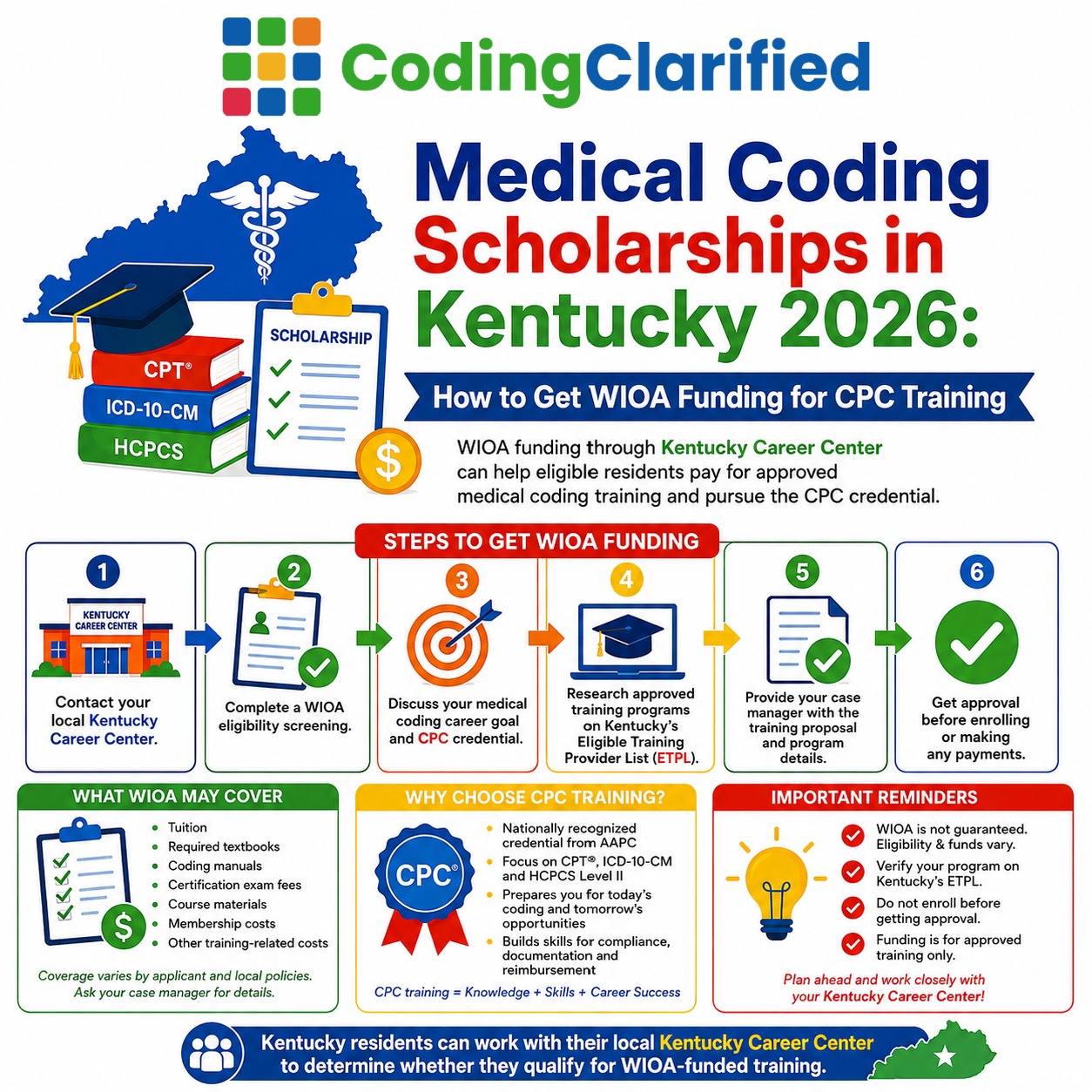
Step 1: Find Your Local Kentucky Career Center
Start with the Kentucky Career Center and locate the office serving your area.
Kentucky has workforce services throughout the state. Therefore, your local office should be your first contact when asking about WIOA training assistance.
Tell the representative that you are interested in career training for medical coding and would like information about WIOA eligibility.
Step 2: Request a WIOA Eligibility Screening
Next, ask whether you can complete an eligibility screening for WIOA-funded occupational training.
Your workforce representative may request information about your current employment, income, employment history, job-search situation, previous education, household circumstances, or other eligibility factors.
Requirements can differ based on the WIOA program and your local workforce area. Consequently, do not assume that another applicant’s experience will be identical to yours.
Ask your case manager exactly which documents you need.
Step 3: Explain Your Medical Coding Career Goal
Be prepared to explain why medical coding training supports your employment plan.
For example, you may be changing careers, returning to the workforce, unemployed, underemployed, or seeking training that leads to a recognized professional credential.
Additionally, explain the credential you intend to pursue.
The CPC, or Certified Professional Coder credential, is offered by AAPC and focuses heavily on professional-fee and physician-office coding. Students learn to work with CPT, ICD-10-CM, HCPCS Level II, anatomy, medical terminology, compliance, and reimbursement concepts.
AAPC currently describes the CPC as a highly recognized medical coding credential. Furthermore, its CPC exam contains 100 questions with a four-hour testing period, making thorough exam preparation important.
For a complete career roadmap, read How to Become a Medical Coder in 2026: 10 Steps to Start Your Career.
Step 4: Research Approved Medical Coding Training
Before enrolling, confirm that your training program meets the requirements established by your workforce office.
Kentucky’s ETPL allows participants to research eligible training providers and programs. Moreover, Kentucky recommends reviewing provider information with your local case manager before selecting training.
For medical coding, you may also see the program classified under:
CIP Code: 51.0713
Program: Medical Insurance Coding Specialist/Coder
This Classification of Instructional Programs category covers education related to medical coding, billing and insurance documentation, medical terminology, anatomy and physiology, medical records, software, and healthcare reimbursement documentation.
Still, give your case manager the exact information requested by your local office rather than relying only on the CIP number.
Step 5: Provide the Requested Training Proposal
Your case manager may need detailed information about the program before approving funding.
Coding Clarified provides a Proposal and Acceptance form that students can share when requested during the funding process.
Additionally, your case manager may need information about tuition, included materials, course length, certification preparation, employment goals, and other program details.
Providing complete information early can help prevent unnecessary delays.
Step 6: Wait for Approval Before Enrolling
This is one of the most important steps.
Do not assume WIOA will reimburse training that you purchased before receiving authorization.
Instead, follow your case manager’s instructions and obtain the necessary approval before enrolling or making payments.
Workforce programs have specific authorization and payment processes. Therefore, paying first and asking for reimbursement later can create problems.
What Can WIOA Funding Cover?
Coverage varies by applicant and local workforce program.
Depending on approval and applicable policies, WIOA training assistance may help with eligible costs connected to approved occupational training. However, students should never assume that every expense associated with becoming a medical coder will automatically be covered.
Ask your case manager whether the approved funding includes items such as:
- Tuition
- Required textbooks
- Coding manuals
- Certification exam fees
- Required course materials
- Membership costs
- Other training-related expenses
Kentucky notes that the costs displayed on its provider list may represent in-state or in-district tuition plus required books and fees, while additional expenses may apply.
Therefore, request a complete cost breakdown and determine exactly what your authorization covers before you start.
Why Choose CPC Training for a Medical Coding Career?
Medical coding requires much more than memorizing diagnosis codes.
Professional coders must understand documentation, anatomy, medical terminology, reimbursement rules, coding guidelines, payer requirements, compliance, and the relationships among different code sets.
In particular, CPC training prepares students to work with CPT, ICD-10-CM, and HCPCS Level II in professional coding environments.
AAPC states that CPC candidates need knowledge across areas including evaluation and management, anesthesia, surgery, radiology, pathology, medicine, anatomy, medical terminology, coding guidelines, and regulations.
Furthermore, completing qualifying coding education can play a role in progressing from the CPC-A apprentice designation after passing the CPC examination, subject to AAPC’s current requirements.
If you are comparing training formats, see our guide to Online Medical Coding Training in 2026.
Why Job-Ready Training Matters More in 2026
Medical coding continues to change.
AI-assisted coding, computer-assisted coding software, electronic health records, payer edits, and automated workflows are becoming more common. However, healthcare organizations still need people who can determine whether coding accurately reflects the medical record and complies with applicable rules.
As a result, students should look beyond programs that teach them only enough information to pass a multiple-choice examination.
Strong training should develop skills in documentation review, code research, coding guidelines, real-world scenarios, reimbursement, compliance, and problem-solving. Additionally, students should understand how coding decisions affect claims and healthcare revenue.
Certification is important, but certification plus practical skill can make a stronger foundation for employment.
Read Is Medical Coding a Good Career in 2026? for a closer look at salary, job outlook, remote work, AI, and career opportunities.
Common Mistakes When Applying for Kentucky WIOA Funding
Enrolling Before Receiving Approval
A training program may be eligible, but your individual funding still needs authorization. Therefore, wait until your case manager tells you that you can proceed.
Assuming WIOA Is a Guaranteed Scholarship
WIOA eligibility and funding depend on multiple factors. Additionally, funding availability can vary between workforce areas and over time.
Using Outdated Provider Information
Kentucky updates its Eligible Training Provider List regularly. Consequently, verify the current provider and program status before enrolling.
Not Preparing for Your Workforce Appointment
Bring the information your case manager requests. Moreover, be ready to discuss the training program, credential, cost, career objective, and how the training can improve your employment prospects.
Focusing Only on Working From Home
Medical coding can lead to remote opportunities, but new coders should build a broader career plan. For instance, physician offices, hospitals, billing organizations, insurance companies, revenue-cycle companies, and other healthcare organizations may employ people with coding skills.
Choosing a Program Based Only on Price
The cheapest program is not automatically the best value. Instead, compare certification preparation, books, instructor support, practical experience, exam preparation, career resources, and what the tuition actually includes.
Tips for Kentucky Students Preparing for CPC Training
Start studying medical terminology and anatomy before your coding course becomes difficult. In addition, become familiar with the structure of ICD-10-CM, CPT, and HCPCS Level II rather than trying to memorize thousands of individual codes.
Practice reading real-world documentation as soon as possible. Moreover, learn how to identify the diagnosis, procedure, approach, anatomy, laterality, documentation details, and coding guidelines that affect code selection.
Time management also matters. AAPC’s current CPC examination gives candidates four hours to complete 100 questions. Therefore, students need both coding knowledge and the ability to research efficiently under time pressure.
Finally, think beyond the exam. Your long-term goal should be to become a coder who can explain why a code is correct, not simply someone who can find a code in a book.
Other Ways to Pay for Medical Coding Training in 2026
WIOA is not the only possible source of training assistance.
Depending on your circumstances, you may also want to investigate employer tuition programs, military spouse education benefits, state workforce programs, private scholarships, payment plans, and other career-training grants.
For example, eligible military spouses may qualify for MyCAA education assistance. Coding Clarified became MyCAA approved in 2026, providing another potential funding path for qualifying military spouses.
Additionally, our Coding Clarified Medical Coding Scholarships resource explains how state-funded training opportunities can help qualified students pursue CPC education.
The best funding source depends on your individual situation. Therefore, investigate every program for which you may qualify before deciding that medical coding training is financially out of reach.
Authoritative Resources for Kentucky Medical Coding Students
For current WIOA and training-provider information, use the Kentucky Career Center and its Eligible Training Provider information.
Students preparing for professional certification can also review AAPC’s CPC certification information.
Additionally, the U.S. Department of Labor provides federal information about the Workforce Innovation and Opportunity Act.
Because workforce policies, provider eligibility, funding levels, and certification requirements can change, always confirm current requirements directly with the appropriate agency before making financial decisions.
Frequently Asked Questions About Medical Coding Scholarships in Kentucky
Can I get a scholarship for medical coding school in Kentucky in 2026?
Possibly. Kentucky residents may have access to WIOA workforce training assistance, scholarships, grants, military spouse benefits, or other programs. However, eligibility varies. Start by contacting your local Kentucky Career Center and asking about funding for approved medical coding training.
Will Kentucky WIOA pay for CPC training?
WIOA may fund approved occupational training for eligible participants. However, both the training program and the individual applicant must meet applicable requirements. Therefore, ask your Kentucky Career Center case manager to verify eligibility and funding before enrolling.
Do I have to be unemployed to qualify for WIOA?
Not necessarily. WIOA serves different categories of participants, and some employed or underemployed workers may qualify depending on their circumstances and applicable program requirements. Consequently, you should request an eligibility screening even if you currently have a job rather than assuming you are ineligible.
Is WIOA medical coding training completely free?
It can substantially reduce training costs for some approved participants, but you should not assume every expense will be covered. Funding amounts and covered costs can vary. Therefore, ask for a clear explanation of your approved funding before beginning training.
What is the Kentucky ETPL?
The Eligible Training Provider List (ETPL) identifies training providers and programs that have met requirements to participate in WIOA-funded training. Kentucky updates this information regularly. As a result, students should verify current eligibility before enrolling.
What is CIP Code 51.0713?
CIP Code 51.0713 identifies Medical Insurance Coding Specialist/Coder programs. The classification covers training related to medical coding, insurance documentation, medical terminology, anatomy and physiology, medical records, reimbursement documentation, and related skills.
What certification should I pursue for physician medical coding?
The Certified Professional Coder (CPC) credential from AAPC is widely recognized for professional-fee and physician-office coding. It tests knowledge of CPT, ICD-10-CM, HCPCS Level II, medical terminology, anatomy, coding guidelines, and related healthcare concepts.
What should I do first if I want Kentucky WIOA funding for medical coding?
Contact the Kentucky Career Center serving your area and ask for a WIOA eligibility screening for occupational training in medical coding. Next, gather the requested documentation and information about your proposed training program. Most importantly, wait for the required authorization before paying for or starting training.
Final Thoughts: Paying for Medical Coding Training in Kentucky in 2026
The cost of medical coding education should not automatically stop you from investigating a new healthcare career.
In 2026, Kentucky’s workforce system continues to provide access to WIOA-approved training providers for eligible participants. Therefore, prospective medical coding students should contact their local Kentucky Career Center, determine whether they qualify, research approved programs, and develop a clear career-training plan.
Preparation can make the process much easier.
Bring the requested documents. Know which credential you want to pursue. Research your training provider. Furthermore, understand the complete cost of the program and explain how the training connects to your employment goal.
Above all, get approval before enrolling or paying for training.
WIOA funding is not guaranteed, but for eligible Kentucky residents, it may provide an important pathway toward CPC training, professional certification, and a new career in medical coding.