Medical Coding Scholarships in California 2026: WIOA Grants for CPC Training
If you want to become a medical coder in California but are worried about the cost of training, you may have funding options available. In 2026, eligible California residents may be able to use Workforce Innovation and Opportunity Act (WIOA) funding or other workforce training assistance to help pay for approved medical coding education.
However, these opportunities are different from traditional academic scholarships. Instead of receiving a scholarship based mainly on grades, applicants generally work with a local workforce office to determine whether they qualify for career-training assistance.
For students interested in becoming an AAPC Certified Professional Coder (CPC), this can make professional medical coding training much more affordable. Additionally, Coding Clarified helps prospective students understand the California application process, prepare required training information, and identify the steps they need to discuss with their workforce caseworker.
This 2026 guide explains medical coding scholarships in California, WIOA medical coding grants, CalJOBS, ETPL-approved training, CPC certification preparation, and how to apply for funding step by step.
Key Takeaways
- California residents may qualify for WIOA funding or other workforce assistance for approved career training.
- WIOA funding is not automatically awarded to every applicant; therefore, your local workforce agency must determine your eligibility.
- California uses the Eligible Training Provider List (ETPL) to identify training providers and programs eligible for certain WIOA funding.
- Applicants should contact a local America’s Job Center of California (AJCC) or workforce office to request an eligibility screening.
- Coding Clarified provides online CPC medical coding training and guidance for students pursuing available workforce funding.
- Students should confirm their specific program and provider eligibility with their caseworker before enrolling.
- Medical coding students should plan for more than certification. In addition, practical coding experience, CPC exam preparation, résumé development, and job-search skills are important.
- Funding approval can take time. Consequently, students should begin the process before their desired training start date.
Are There Medical Coding Scholarships in California in 2026?
Yes. However, the word “scholarship” can cause some confusion.
Many California medical coding students are actually looking for career-training grants and workforce funding, rather than a traditional college scholarship.
One of the main programs to investigate is WIOA. The Workforce Innovation and Opportunity Act supports workforce development programs that can help eligible individuals obtain training for employment.
California also maintains an Eligible Training Provider List. Therefore, individuals approved for certain WIOA-funded training generally need to select an eligible training program that meets applicable state and local workforce requirements.
Funding decisions are made through the workforce system. Coding Clarified does not determine whether an applicant qualifies for WIOA or guarantee that an applicant will receive funding.
Nevertheless, if you qualify, workforce funding may significantly reduce the amount you need to pay personally for approved medical coding training.
What Is WIOA Funding for Medical Coding Training?
WIOA is a federal workforce law designed, in part, to help eligible job seekers develop skills needed for employment.
Depending on your circumstances and local workforce policies, WIOA training assistance may be available to people who are unemployed, underemployed, changing careers, affected by a layoff, or facing other barriers to employment.
However, eligibility varies. Your local workforce agency reviews your individual circumstances and determines whether training assistance is appropriate and available.
Additionally, funding amounts and requirements can vary by local workforce area. For that reason, one applicant’s experience may not be identical to another applicant’s experience elsewhere in California.
Do not assume you are ineligible simply because someone else was denied. Conversely, never assume you will receive funding because another student qualified.
The best first step is to request an official eligibility screening through your local workforce office.
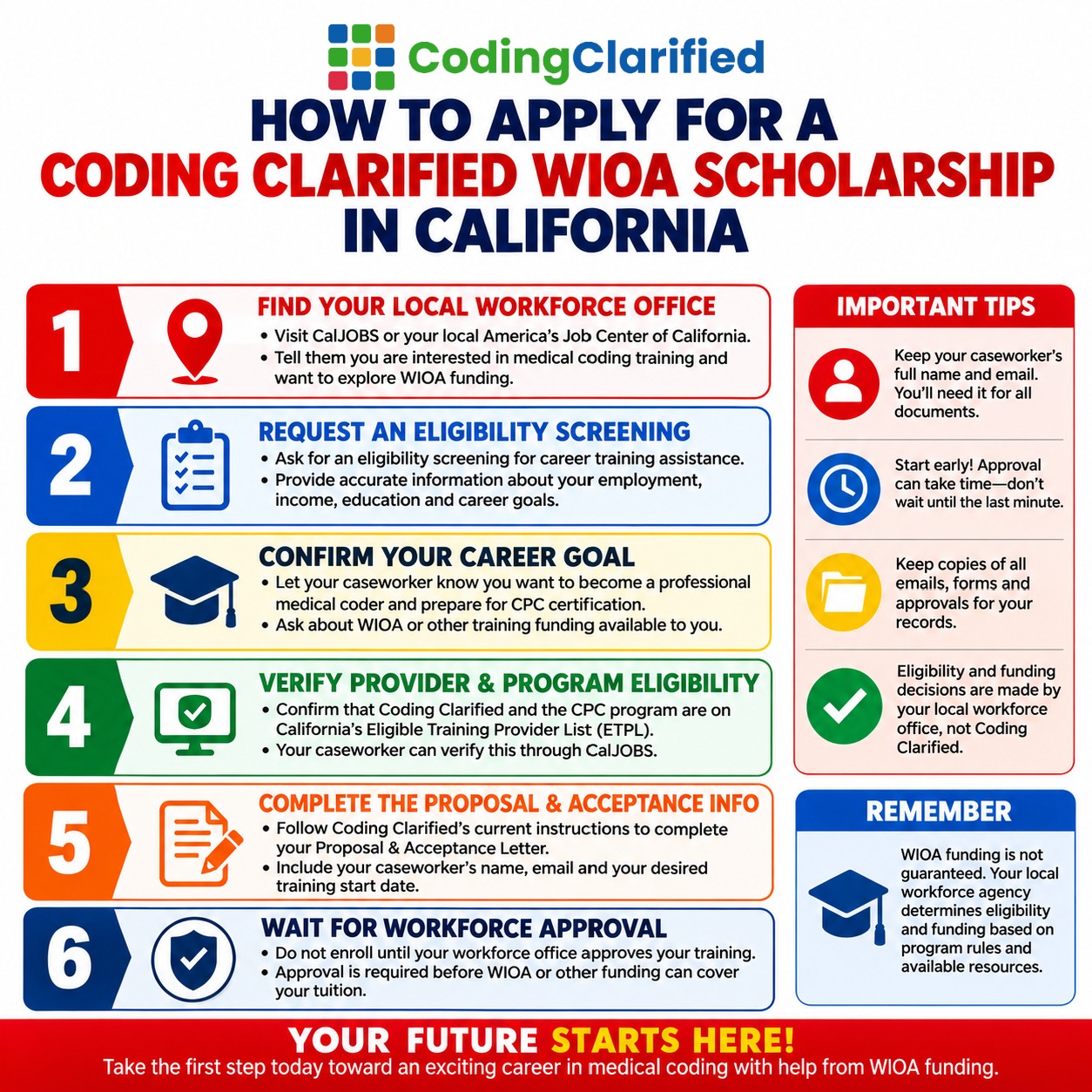
How to Apply for a Medical Coding Scholarship or WIOA Grant in California
The application process may vary somewhat by workforce area. However, California students can generally start with the following steps.
Step 1: Find Your Local California Workforce Office
Begin by visiting CalJOBS or locating an America’s Job Center of California near you.
These workforce centers help job seekers access employment and training services. Additionally, they can explain which programs are currently available in your area.
Tell the workforce representative that you are interested in medical coding career training and want to find out whether you qualify for WIOA or other available training assistance.
Be specific about your career goal. For example, explain that you want training that prepares you for professional medical coding and CPC certification.
Step 2: Request an Eligibility Screening
Next, ask your local workforce office for an eligibility screening for career-training assistance.
Your caseworker may ask about your employment status, income, previous work, education, career goals, household circumstances, or other factors required by the program.
Requirements can differ by program and workforce area. Therefore, provide complete and accurate information rather than relying on eligibility advice from social media or another applicant.
Also, keep your caseworker’s full name and email address. You may need that information when preparing your training documents.
Step 3: Tell Your Caseworker You Want Medical Coding Training
Make sure your caseworker understands the specific career path you want to pursue.
Medical coding is different from general healthcare administration, medical assisting, or basic medical billing. Therefore, explain that your goal is to learn professional coding and prepare for certification.
A CPC-focused program generally teaches students how to work with:
- CPT
- ICD-10-CM
- HCPCS Level II
- Medical terminology
- Anatomy and physiology
- Coding guidelines
- Modifiers
- Evaluation and management coding
- Surgical coding
- Compliance
- Reimbursement concepts
For a complete career roadmap, read our guide to How to Become a Medical Coder in 2026.
Step 4: Verify the Training Provider and Program
California maintains an Eligible Training Provider List (ETPL) for qualifying workforce training programs.
Before enrolling, confirm the current eligibility of the training provider and specific program with your workforce caseworker. Additionally, California’s Employment Development Department provides instructions for searching eligible providers through CalJOBS.
Coding Clarified’s scholarship information identifies CIP Code 51.0713 – Medical Insurance Coding Specialist/Coder for applicants and caseworkers when applicable.
Nevertheless, listings and program requirements can change. Always verify current information before making an enrollment decision based on anticipated workforce funding.
Step 5: Complete Your Proposal and Acceptance Information
After you have spoken with your workforce office and obtained your caseworker’s information, follow Coding Clarified’s current instructions for preparing your Proposal & Acceptance Letter.
You will generally need information such as your caseworker’s name and email address as well as your intended training start date.
Additionally, allow enough time for processing. Do not select an immediate start date when your workforce office still needs to review and approve the training.
Incomplete information can slow down the process. Therefore, double-check your paperwork before submitting it.
Step 6: Wait for Workforce Approval Before Assuming Your Training Is Funded
This step is extremely important.
Talking to a workforce office does not mean your tuition has been approved. Likewise, locating a program on an eligible provider list does not automatically guarantee that WIOA will pay for your training.
Your workforce agency must complete its process and authorize funding.
Therefore, follow your caseworker’s instructions and obtain the required approval before assuming your medical coding training will be covered.
What Does Coding Clarified’s CPC Medical Coding Program Include?
Students comparing medical coding scholarships should look beyond tuition alone. After all, the goal is not simply to enroll in a course. The goal is to become trained, prepare for certification, gain practical skills, and become more competitive when looking for work.
Coding Clarified’s CPC training program includes resources designed to support that process, including:
- An 80-clock-hour medical coding course
- 100% remote study
- AAPC online CPC training
- CPT, ICD-10-CM, and HCPCS Level II coding resources
- Instructor notes and video/audio learning resources
- One-on-one instructor support as needed
- AAPC membership
- Two CPC exam vouchers
- Three CPC practice exams
- Electronic CPC study guide
- CPC online review
- AAPC Practicode
- HCC internship opportunity after applicable requirements are completed
- Résumé support
- Job-search resources
Program inclusions and timing requirements should always be confirmed before enrollment because training packages can change.
If you are deciding whether online education fits your learning style, see Online Medical Coding Training in 2026: Advantages, Disadvantages, CPC Certification and How to Choose the Right Program.
Why CPC Certification Matters
Completing medical coding training and earning a professional certification are not the same thing.
Training teaches you how to code. Certification, meanwhile, demonstrates that you passed an examination from a professional credentialing organization.
The Certified Professional Coder (CPC) credential from AAPC is widely used for professional-fee and physician coding. Students preparing for the CPC learn to work with CPT, ICD-10-CM, HCPCS Level II, modifiers, medical terminology, anatomy, compliance, and coding guidelines.
However, passing the CPC exam should not be your only career goal.
Employers also look for candidates who can read documentation, research unfamiliar situations, apply coding guidelines, recognize errors, and explain why a coding decision is correct.
For more information, read our Ultimate Medical Coding AAPC CPC Certification Guide.
What Happens After You Become CPC Certified?
Certification is a major milestone. Still, new coders frequently discover that employers want practical experience.
For this reason, students should think about the experience gap before graduation.
Practicode, internships, apprenticeships, coding exercises, and healthcare-related positions can help you build practical skills. Additionally, these experiences can give you more meaningful information to include on your résumé.
Job searching also requires strategy. New coders should not limit themselves to positions with the exact title “medical coder.”
For example, related opportunities may appear under titles such as coding specialist, physician coder, professional fee coder, coding associate, risk adjustment coder, medical records specialist, charge capture specialist, denials specialist, or revenue-cycle specialist.
Remote coding positions are available as well. However, new coders may face stronger competition for work-from-home positions.
For a complete job-search strategy, see How to Find a Medical Coding Job in 2026.
Why Medical Coding Training Can Be Worth Pursuing in 2026
Healthcare organizations depend on accurate coded data for reimbursement, compliance, reporting, medical records, and many other functions.
At the same time, technology continues to change the profession. Artificial intelligence and computer-assisted coding tools can help automate parts of the coding process; however, skilled coders still need to understand documentation, coding guidelines, payer rules, compliance, and when a suggested code is incorrect.
Consequently, students should not train merely to become fast code look-up specialists.
Instead, focus on developing judgment, research skills, accuracy, compliance knowledge, and the ability to interpret complex documentation.
Medical coding can also create pathways into auditing, risk adjustment, compliance, revenue cycle, education, clinical documentation, specialty coding, and management.
If you are still deciding whether this career is right for you, read Is Medical Coding a Good Career in 2026? Salary, Job Outlook, Remote Work & How to Get Started.
Common Mistakes to Avoid When Applying for California Medical Coding Funding
Assuming “Scholarship” Means Automatic Free Tuition
Workforce funding is based on eligibility, program requirements, available funding, and approval by the appropriate workforce agency. Therefore, never enroll based solely on the assumption that WIOA will pay your tuition.
Enrolling Before Receiving Required Approval
Your caseworker may need to approve your training before it begins. Consequently, starting too soon could affect whether your costs qualify for reimbursement or funding.
Follow your workforce office’s instructions carefully.
Not Verifying the Current ETPL Information
Provider and program information can change over time. Therefore, verify the current training program and provider through California’s official resources and your caseworker.
Losing Your Caseworker’s Contact Information
Write down your caseworker’s full name, phone number, and email address when possible.
You may need those details for training proposals and follow-up communication. Additionally, keeping a simple folder for emails and documents can make the process much easier.
Submitting Incomplete Forms
Missing information can delay an application. Before submitting documents, therefore, check names, email addresses, dates, signatures, and any required supporting information.
Choosing Training Based Only on Price
A low tuition amount does not necessarily make a program a good value.
Instead, compare certification preparation, current coding materials, instructor support, exam resources, hands-on experience, and career assistance. Ultimately, your goal should be to become employable rather than simply obtain a course-completion certificate.
CPC Student Tips for California Scholarship Students
If workforce funding gives you the opportunity to attend medical coding training, use that opportunity strategically.
First, learn how to navigate your coding books rather than trying to memorize every code. Professional coders research and verify information regularly.
Next, practice coding complete scenarios. Real coding requires you to read documentation, identify relevant details, locate possible codes, review instructions, and confirm the final selection.
Additionally, keep up with annual code-set changes. Medical coding is not a subject you learn once and never revisit.
Practice under timed conditions before taking the CPC exam as well. Knowing the material matters; however, efficient research and time management are also important during certification testing.
Finally, start preparing for employment before you graduate. Build your résumé, develop practical experience, research employers, and learn which coding jobs are available in your area.
Other Ways to Pay for Medical Coding Training in California
Not every applicant will qualify for WIOA funding. Fortunately, a denial does not necessarily mean you must give up your medical coding career plans.
Depending on your situation, other possibilities may include employer education benefits, vocational rehabilitation programs, military spouse education benefits, workforce programs, scholarships, grants, or payment plans.
Military spouses should also investigate the current My Career Advancement Account (MyCAA) Scholarship program to determine whether they meet its eligibility requirements.
Additionally, Coding Clarified maintains a broader resource explaining Medical Coding Grants and Scholarships in 2026.
Always compare the full cost and terms of any financing arrangement before signing an agreement.
Authoritative Resources for California Medical Coding Students
Students should use official sources when verifying funding, certification, and workforce information.
California Employment Development Department (EDD): Use California’s official Eligible Training Provider List information and CalJOBS resources to research eligible career-training programs.
America’s Job Center of California: Contact your local workforce center to ask about eligibility for WIOA-funded career training.
AAPC: Review current information about CPC certification, exams, membership, and professional coding credentials directly through AAPC.
U.S. Department of Labor: Review federal information about the Workforce Innovation and Opportunity Act and workforce development programs.
Because funding rules, provider listings, and certification requirements can change, official sources should take priority over old blog posts, social media comments, or another student’s experience.
Final Thoughts: Medical Coding Scholarships in California for 2026
California residents interested in medical coding may have more funding options than they realize.
WIOA and other workforce programs can help eligible applicants access approved career training. However, funding is not automatic. Your local workforce agency determines eligibility, available assistance, and whether your chosen training meets its requirements.
Start by locating your local workforce office and requesting an eligibility screening. Next, discuss your goal of becoming a certified medical coder and verify the current training provider and program information.
After that, complete your required documents carefully and wait for the appropriate approval before assuming your tuition will be funded.
Most importantly, think beyond paying for school.
Choose medical coding training that prepares you for certification, teaches current coding rules, provides meaningful practice, and helps you develop the skills employers expect in 2026.
For California students who qualify, workforce funding can do more than lower the cost of education. It can provide an opportunity to train for a new healthcare career without taking on the full financial burden alone.
Frequently Asked Questions About Medical Coding Scholarships in California
Can I get free medical coding training in California in 2026?
Possibly. Eligible California residents may qualify for WIOA or other workforce training assistance that can cover some or all approved training costs. However, eligibility and funding are determined by the appropriate workforce agency. Therefore, no school can guarantee that you will receive free training.
Does WIOA pay for medical coding certification training?
WIOA may help eligible participants pay for approved occupational training. Medical coding programs may qualify when they meet applicable workforce and Eligible Training Provider List requirements. Nevertheless, applicants should confirm their specific program with their caseworker before enrolling.
How do I apply for a medical coding scholarship in California?
Start by locating an America’s Job Center of California or local workforce office and request an eligibility screening for career-training assistance. Next, tell your caseworker that you want medical coding training and follow the instructions for selecting an eligible program and submitting required documentation.
Do I have to be unemployed to receive WIOA funding?
Not necessarily. WIOA serves several groups, and some employed or underemployed individuals may qualify depending on their circumstances and applicable program rules. However, eligibility is individual. Your local workforce agency should determine whether you qualify.
What is an ETPL?
ETPL stands for Eligible Training Provider List. California uses its ETPL to identify approved providers and programs associated with WIOA-funded training. Because listings can change, verify your chosen provider and program before enrolling.
Can WIOA help me become CPC certified?
WIOA may fund eligible career training that prepares a student for an industry-recognized credential such as the CPC when the training and applicant meet applicable requirements. However, you should confirm exactly which costs your funding authorization covers.
Can I take medical coding training online if I live in California?
Yes. Online medical coding training can allow California students to study remotely. However, if you plan to use WIOA or another workforce grant, your caseworker must confirm that the specific online program qualifies under your funding authorization.
What should I do if I do not qualify for a California medical coding grant?
Ask your workforce representative whether another training program or funding source may apply to your situation. Additionally, research employer tuition assistance, MyCAA benefits for eligible military spouses, other scholarships or grants, vocational programs, and payment options. A WIOA denial does not necessarily mean there are no other ways to fund medical coding training.
California EDD specifically explains how students can search California EDD’s Eligible Training Provider List/CalJOBS guidance for WIOA-eligible providers and notes that eligible programs display a green checkmark.
Also a good resource U.S. Department of Labor’s WIOA resources
Apply today California Scholarships at Coding Clarified