
Medical Coding: Time-Based Coding Guidelines and Tips
Time-based medical coding is an essential concept in medical coding and billing that applies when the amount of time a provider spends with a patient determines the level of service reported. Understanding how to properly document and report time-based services helps ensure accurate reimbursement and compliance with payer guidelines.
What Is Time-Based Coding?
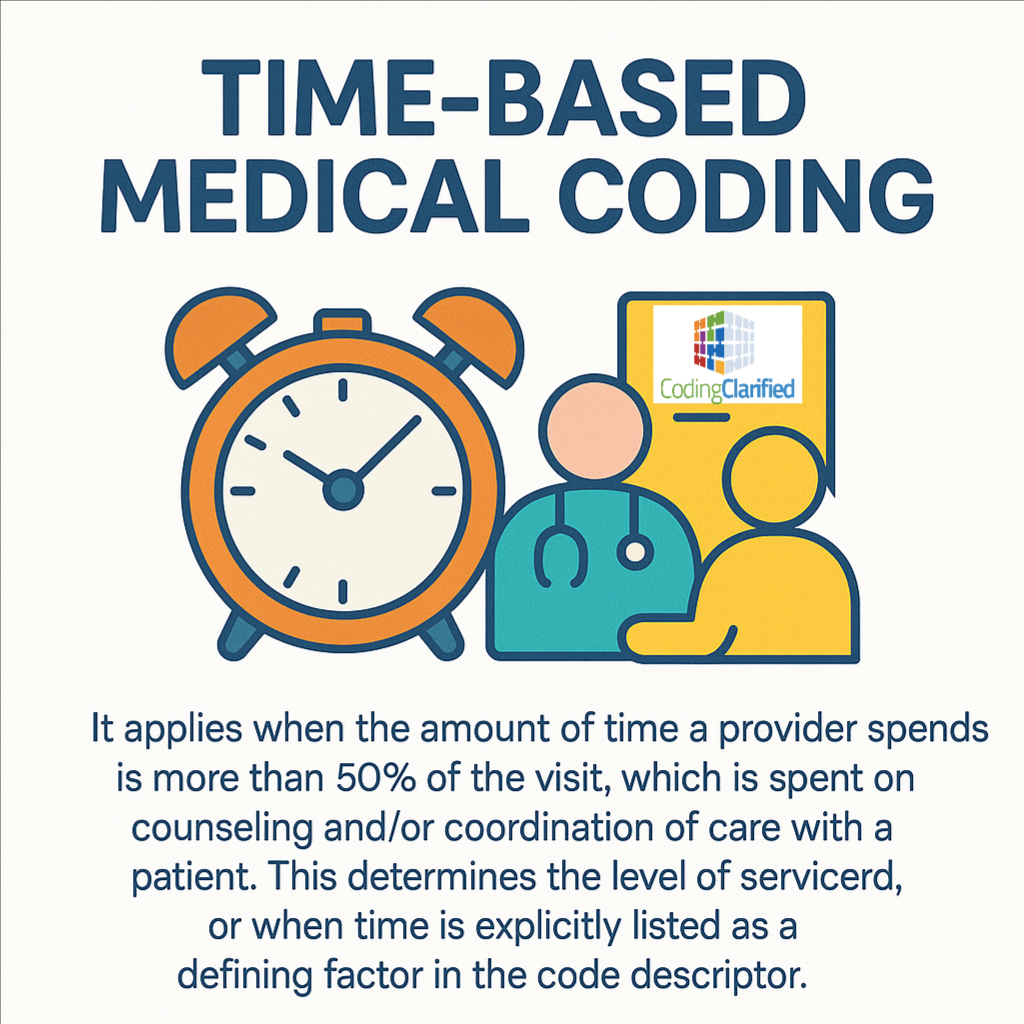
Time-based coding is used when time becomes the controlling factor in selecting a CPT® code. This typically applies when more than 50% of the visit is spent on counseling and/or coordination of care, or when time is explicitly listed as a defining factor in the code descriptor.
Common types of services that use time-based coding include:
-
Evaluation and Management (E/M) visits
-
Prolonged services
-
Critical care services
-
Behavioral health services
-
Care management services
When Can You Use Time as the Key Factor?
Time can be used to select a code when the medical record clearly documents:
-
Total time spent with the patient
-
Specific activities performed during that time
-
That at least 50% of the time was spent counseling or coordinating care (if required)
For 2021 and later office/outpatient E/M codes, time includes both face-to-face and non–non-face-to-face work performed by the provider on the date of service, such as:
-
Reviewing records
-
Ordering tests
-
Coordinating care
-
Documenting in the medical record
Time-Based Coding for E/M Services
With current office/outpatient E/M guidelines, code selection can be based on total time or Medical Decision Making (MDM).
Each CPT code has a defined time range. For example:
-
99202: 15–29 minutes
-
99203: 30–44 minutes
-
99204: 45–59 minutes
-
99205: 60–74 minutes
-
99212: 10–19 minutes
-
99213: 20–29 minutes
-
99214: 30–39 minutes
-
99215: 40–54 minutes
When coding by time, the total documented time must fall within the published time range for the selected code.
Prolonged Services and Time
Prolonged service codes may be reported when the physician’s time extends beyond the maximum time associated with the primary E/M code.
Important points for prolonged services:
-
Must clearly exceed the typical time for the base code
-
Documentation must support the medical necessity for the extended time
-
Different payers have different rules for reporting prolonged services
Critical Care and Time-Based Coding
Critical care codes are always time-based and require continuous attendance by the provider.
Critical care time:
-
Includes time spent directly at the patient’s bedside or unit
-
Cannot include time spent on separately reportable procedures
-
Must be clearly documented in the medical record
Documentation Requirements for Time-Based Services
Strong documentation is essential for compliant time-based coding. The provider should document:
-
Start and stop times (when required)
-
Total time spent on the date of service
-
Description of the work performed
-
Amount of time spent counseling or coordinating care (when applicable)
Example of acceptable documentation:
“Total time spent on today’s visit: 42 minutes, including reviewing labs, counseling the patient on treatment options, and documenting the encounter.”
Common Time-Based Coding Mistakes to Avoid
Medical coders should watch for these common errors:
-
Failing to document the total time
-
Not showing how the time was spent
-
Using the time when MDM should have been used
-
Rounding time incorrectly
-
Reporting prolonged service codes without meeting time thresholds
Practical Time-Based Coding Tips
Here are helpful tips for accurate time-based coding:
-
Always verify current CPT and payer-specific time thresholds
-
Look for explicit documentation of total time
-
Confirm whether time or MDM is being used to select the code
-
Make sure counseling and coordination times are clearly described
-
Avoid assumptions if time is not clearly documented
Why Time-Based Coding Matters
Accurate time-based coding ensures:
-
Proper reimbursement
-
Reduced audit risk
-
Clear communication of provider’s work
-
Compliance with Medicare and commercial payer rules
Time-based coding, when done correctly, reflects the true complexity and effort of patient care and supports the integrity of medical billing and reimbursement.