
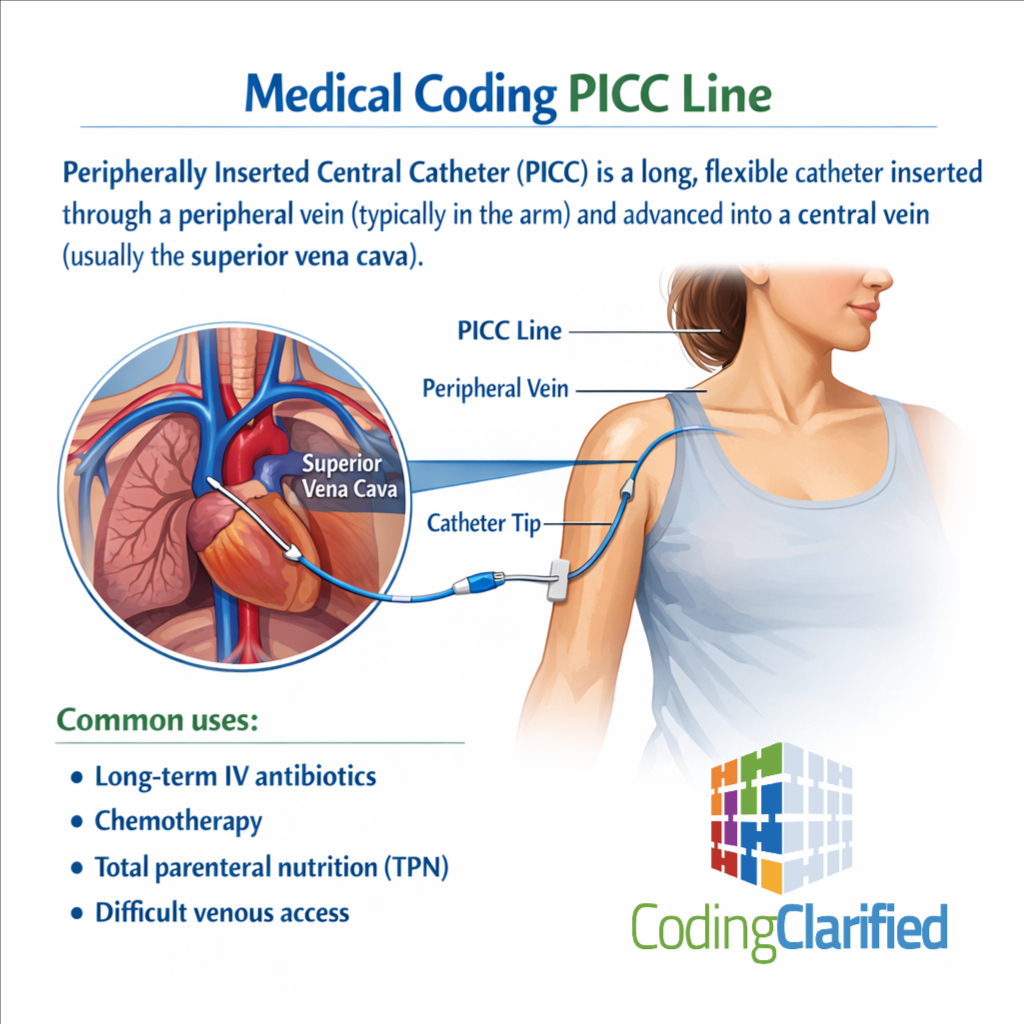
What is a PICC Line?
A Peripherally Inserted Central Catheter (PICC) is a long, flexible catheter inserted through a peripheral vein (typically in the arm) and advanced into a central vein (usually the superior vena cava).
Common uses:
- Long-term IV antibiotics
- Chemotherapy
- Total parenteral nutrition (TPN)
- Difficult venous access
Key Coding Concepts for PICC Lines
CPT Coding for PICC Line Insertion
PICC line placement codes depend on:
- Patient age
- Use of imaging guidance
- Type of service (insertion vs. replacement vs. removal)
Common CPT Codes:
- 36568 – PICC insertion, without imaging guidance, age <5
- 36569 – PICC insertion, without imaging guidance, age 5+
- 36572 – PICC insertion with imaging guidance, includes all radiological supervision and interpretation
Important Tip:
If imaging guidance is used and documented, do NOT separately code radiology—it is included in 36572.
Documentation Requirements
Accurate coding starts with strong documentation. Look for:
- Insertion site (e.g., basilic vein, cephalic vein)
- Catheter tip location (confirmation of central placement)
- Use of imaging guidance (ultrasound, fluoroscopy)
- Sterile technique
- Catheter type (single vs. double lumen)
- Reason for placement (medical necessity)
Coder Tip:
If documentation does not clearly state imaging guidance, default to non-imaging CPT codes.
Imaging Guidance & Bundling Rules
- 36572 includes:
- Ultrasound guidance
- Fluoroscopic guidance
- Radiological supervision & interpretation
Do NOT separately report:
- 76937 (ultrasound guidance)
- 77001 (fluoroscopic guidance)
This is a bundled service per CPT guidelines.
PICC Line Removal & Replacement
Removal:
- No specific CPT code for simple PICC removal
- Typically included in E/M service
Replacement:
- Report new insertion code if a new PICC is placed
- Do not assume replacement = separate code unless documented
ICD-10-CM Diagnosis Coding
Diagnosis coding should reflect medical necessity.
Common Diagnosis Categories:
- Infections (e.g., sepsis, osteomyelitis)
- Cancer (for chemotherapy access)
- Nutritional deficiencies (TPN)
- Vascular access issues
Example:
- Z45.2 – Encounter for adjustment and management of vascular access device
Coder Tip:
Always code the underlying condition first, then add device-related codes if applicable.
HCPCS Level II Coding
HCPCS may be required for:
- Supplies
- Catheters
- Home infusion services
Examples:
- A4223 – Infusion supplies
- A4221 – Supplies for maintenance of catheter
Important:
HCPCS usage varies by payer (Medicare vs. commercial)—always verify policy.
What is HCPCS in Medical Coding
Medical Coding HCPCS Medical Supplies
Modifier Use
Modifiers may apply depending on the scenario:
- -26 – Professional component (if applicable)
- -TC – Technical component TC/26 Modifiers
- -59 – Distinct procedural service (use cautiously and only when appropriate) CPT Modifiers
Coder Tip:
Avoid modifier misuse—many PICC services are already bundled.
CPC Exam Tips for PICC Line Coding
Know What’s Included
- Imaging guidance is included in 36572
- Do not double code radiology
Read the Entire Operative Note
- Do not code from the procedure title alone
- Confirm:
- Central placement
- Imaging use
- Technique
Watch for Bundling Edits
- PICC insertion + imaging = one code (36572)
- Check NCCI edits
Medical Coding Bundling and Upcoding
Focus on the “Real Ask”
- Is the question asking for:
- Insertion?
- Removal?
- Replacement?
Age Matters
- Under 5 vs. 5+ changes code selection
Common Coding Mistakes
- Coding imaging separately when already included
- Missing documentation of imaging guidance
- Coding from the header instead of the body of the report
- Assigning a removal code when none exists
- Forgetting to verify tip placement (central vs. peripheral)
Real-World Workflow for PICC Coding
Use this repeatable process:
- Identify procedure (insertion, removal, replacement)
- Confirm patient age
- Determine if imaging guidance was used
- Assign correct CPT code
- Review diagnosis for medical necessity
- Check for HCPCS supplies (if applicable)
- Run edits (NCCI, payer rules)
- Perform final QA
Coding Clarified Final Takeaway
PICC line coding may seem simple, but small documentation details drive big coding differences. For CPC students, mastering:
- Bundling rules
- Imaging inclusion
- Documentation review
…will significantly improve both exam performance and real-world accuracy.