
Chest Tube Insertion in ER
Medical Specialty: Emergency Room Reports
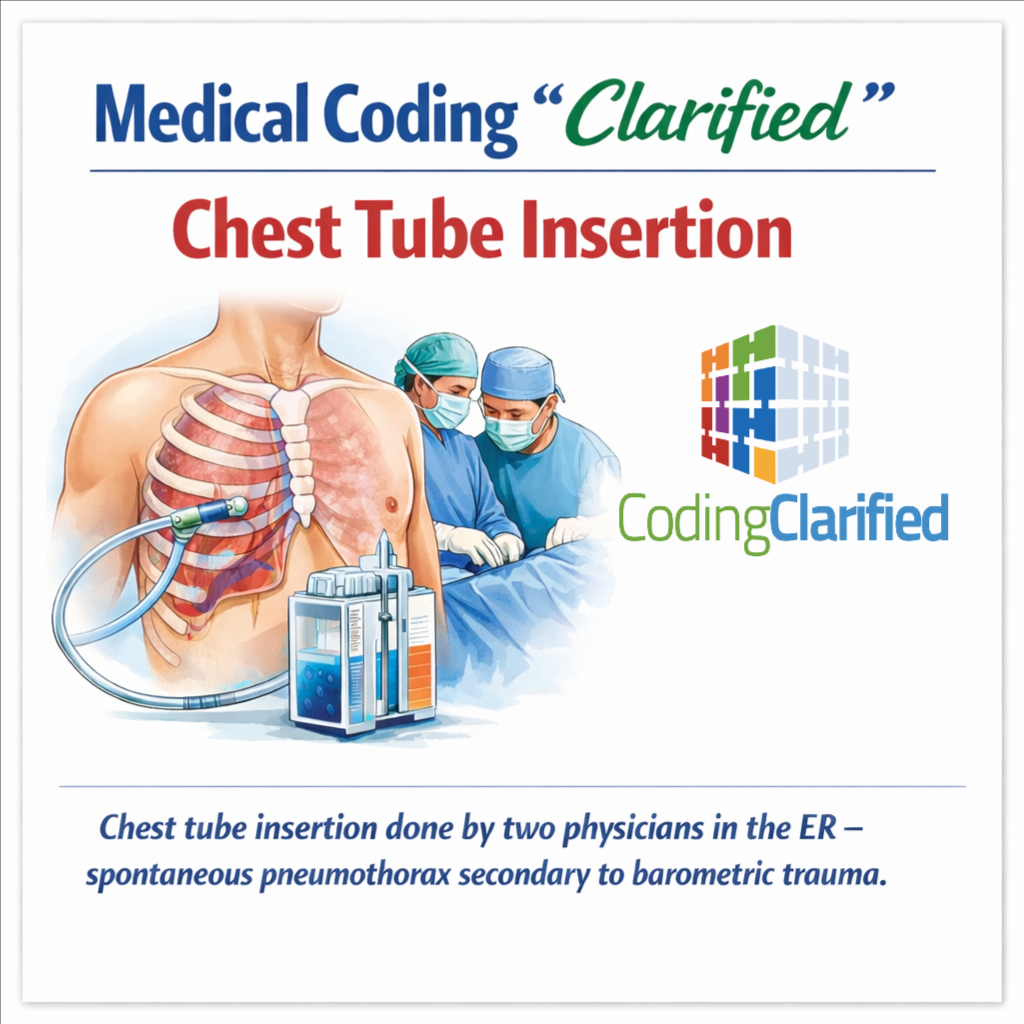
Description: Chest tube insertion done by two physicians in the ER – spontaneous pneumothorax secondary to barometric trauma.
PREOPERATIVE DIAGNOSES:
1. Right spontaneous pneumothorax secondary to barometric trauma.
2. Respiratory failure.
3. Pneumonia with sepsis.
POSTOPERATIVE DIAGNOSES:
1. Right spontaneous pneumothorax secondary to barometric trauma.
2. Respiratory failure.
3. Pneumonia with sepsis.
INFORMED CONSENT: Not obtained. This patient is obtunded, intubated, and septic. This is an emergent procedure with a 2-physician emergency consent signed and on the chart.
PROCEDURE: The patient’s right chest was prepped and draped in sterile fashion. The site of insertion was anesthetized with 1% Xylocaine, and an incision was made. Blunt dissection was carried out 2 intercostal spaces above the initial incision site. The chest wall was opened, and a 32-French chest tube was placed into the thoracic cavity, after examination with the finger, making sure that the thoracic cavity had been entered correctly. The chest tube was placed.
A postoperative chest x-ray is pending at this time.
The patient tolerated the procedure well and was taken to the recovery room in stable condition.
ESTIMATED BLOOD LOSS: 10 mL
COMPLICATIONS: None.
SPONGE COUNT: Correct x2. \
Chest Tube Insertion in the Emergency Room
Scenario Summary
A patient presents to the Emergency Room with a right spontaneous pneumothorax secondary to barometric trauma. The patient is critically ill with respiratory failure and pneumonia with sepsis.
Because the patient is obtunded and intubated, the physicians perform an emergency chest tube insertion (tube thoracostomy) to remove air from the thoracic cavity
Key Procedure in the Note
The operative note documents:
-
right chest prepped and draped
-
local anesthetic used
-
incision made
-
blunt dissection
-
The chest wall opened
-
32-French chest tube placed into the thoracic cavity
These details support an open chest tube insertion, not a simple needle aspiration.
CPT Coding
32551 — Tube thoracostomy (includes connection to drainage system), open
Rationale
The operative note describes:
-
Incision made in the chest
-
Blunt dissection performed
-
Entry into the thoracic cavity
-
Placement of a 32 French chest tube
These steps describe an open chest tube insertion, which is reported with CPT 32551.
Key Documentation Supporting the Code
-
Incision made
-
Blunt dissection
-
Thoracic cavity entered
-
Chest tube placed
These elements confirm open thoracostomy, not a percutaneous procedure.
ICD-10-CM Diagnosis Coding
Primary Diagnosis
J93.83 — Other pneumothorax
Rationale
The operative report documents:
“Right spontaneous pneumothorax secondary to barometric trauma.”
Because the documentation does not specify tension pneumothorax or traumatic pneumothorax, the safest supported code is J93.83.
Additional Diagnoses
T70.8XXA — Other effects of air pressure, initial encounter
Rationale
The pneumothorax is documented as secondary to barometric trauma, which is coded using a T70 category code.
A41.9 — Sepsis, unspecified organism
Rationale
The documentation states pneumonia with sepsis, but the organism is not identified.
Coding guideline:
When sepsis is documented without a specified organism, assign A41.9.
J18.9 — Pneumonia, unspecified organism
Rationale
The note confirms pneumonia but does not document the causative organism.
J96.90 — Respiratory failure, unspecified
Rationale
The documentation simply states respiratory failure without specifying:
-
Acute
-
Chronic
-
Hypoxic
-
Hypercapnic
Therefore, the unspecified respiratory failure code is used.
HCPCS Coding
None supported by this documentation
The procedure performed is fully reported using CPT 32551, and no separate HCPCS supply or medication codes are documented.
Final Code Summary
CPT
32551
Open chest tube insertion (tube thoracostomy)
ICD-10-CM
J93.83 — Other pneumothorax
T70.8XXA — Other effects of air pressure and water pressure, initial encounter
A41.9 — Sepsis, unspecified organism
J18.9 — Pneumonia, unspecified organism
J96.90 — Respiratory failure, unspecified
HCPCS
None
Why No HCPCS Code?
There is no separately supported HCPCS Level II code in this note.
Do not separately code:
-
chest tube supply
-
Xylocaine/local anesthetic
-
prep and drape
-
sponge count
-
estimated blood loss
-
pending chest x-ray
-
emergency consent
These are either bundled, incidental, or not separately billable from the documentation provided.
Sequencing Tips
A reasonable diagnosis sequence would be:
-
J93.83 — Other pneumothorax
-
T70.8XXA — Barometric trauma
-
A41.9 — Sepsis
-
J18.9 — Pneumonia
-
J96.90 — Respiratory failure
Why the pneumothorax may be listed first here
This procedure note is focused on the reason for the chest tube insertion, which is the right spontaneous pneumothorax. For procedural reporting, that is the diagnosis most directly tied to the CPT procedure.
Important inpatient/outpatient teaching point
If you are coding a full hospital claim, final sequencing can depend on:
-
The main reason for admission
-
whether the encounter is ED only, observation, or inpatient
-
official facility coding rules
So for procedure-to-diagnosis linking, pneumothorax is the key diagnosis here.
Query Opportunity
Watch for possible severe sepsis
The record documents:
-
sepsis
-
respiratory failure
-
pneumonia
But it does not clearly say the respiratory failure is due to the sepsis. The FY 2026 ICD-10-CM guidelines say severe sepsis should not be assigned unless the acute organ dysfunction is associated with the sepsis, and some cases require a provider query.
Query example:
“Can the respiratory failure be clinically linked to the documented sepsis?”
If the provider confirms the relationship, coding may change.
Student tip:
Do not automatically code severe sepsis just because sepsis and organ dysfunction both appear in the chart.
Modifier Tip: Two Physicians
The note says the procedure was done by two physicians, but that alone is not enough to report a modifier like:
-
62 co-surgeons
-
80/81/82 assistant surgeon
You would need clear documentation of each physician’s role and payer rules must support it.
Student tip:
Never assign a two-surgeon or assistant modifier just because two doctors are mentioned.
Important Student Coding Tips
Tip 1
For chest tube procedures, look carefully for words like:
-
incision
-
blunt dissection
-
The chest wall opened
Those support an open thoracostomy code
Always determine whether a chest tube insertion is open or percutaneous.
Open procedures involve:
-
incision
-
blunt dissection
-
direct entry into the thoracic cavity
This supports CPT 32551.
Tip 2
Do not code a more specific pneumothorax or respiratory failure type unless documented.
Always code the underlying cause when documented.
Here, the pneumothorax occurred due to barometric trauma, which is why T70.8XXA is added.
Tip 3
When sepsis and pneumonia are both documented, remember:
-
sepsis code first
-
localized infection next
Follow the sepsis coding guidelines carefully.
Do not assume severe sepsis without a documented link between sepsis and organ dysfunction.
The documentation states pneumonia with sepsis, so both conditions are coded.
If the provider had documented severe sepsis, an additional R65.2 code would be required.
Tip 4
Never assume specificity that is not documented.
For example:
The documentation does NOT specify:
-
acute respiratory failure
-
organism causing pneumonia
-
organism causing sepsis
Therefore, unspecified codes must be used.
How to Approach a Long Medical Coding Exam Scenario
Medical Coding Respiratory Failure