
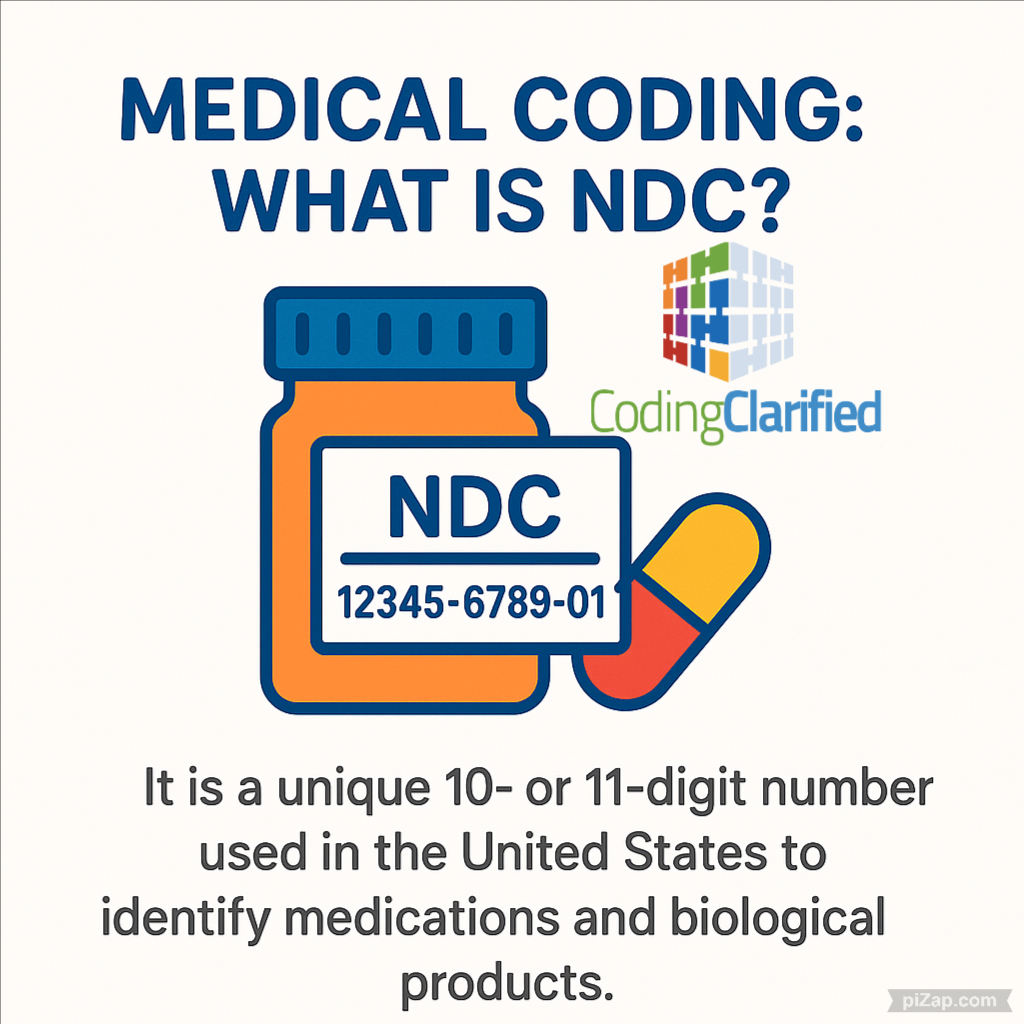
What Is the National Drug Code (NDC)?
The National Drug Code (NDC) is a unique 10- or 11-digit number used in the United States to identify medications and biological products. It is assigned and regulated by the U.S. Food and Drug Administration (FDA) and plays a critical role in medical billing, pharmacy processing, and healthcare claims submission.
In medical coding and billing, the NDC ensures that the exact medication administered or dispensed is properly identified for insurance reimbursement, reporting, and patient safety.
Structure of the NDC Code
The NDC is typically displayed in a 10-digit format on medication packaging but is converted to an 11-digit format for billing.
It is divided into three segments:
-
Labeler Code – Identifies the manufacturer, distributor, or repackager of the drug
-
Product Code – Identifies the specific drug’s strength, dosage form, and formulation
-
Package Code – Identifies package size and type
Example format:
12345-6789-00
When billed electronically, Medicare and Medicaid usually require the 11-digit version with no hyphens.
Why the NDC Is Important in Medical Coding
The NDC is essential for ensuring:
-
Accurate drug identification
-
Proper reimbursement
-
Fraud and abuse prevention
-
Tracking of drug usage and recalls
Unlike CPT® and HCPCS Level II codes, which describe services and procedures, the NDC identifies the exact drug product being used.
When NDC Codes Are Used in Medical Billing
NDCs are most commonly required on claims for:
-
Injectable medications
-
Infused drugs
-
Physician-administered drugs
-
Some outpatient hospital and clinic medications
-
Medicaid and Medicare Part B drug claims
Many private payers and nearly all state Medicaid programs require NDCs in addition to HCPCS J-codes.
NDC vs CPT and HCPCS Codes
| Coding System | What It Identifies |
|---|---|
| ICD-10-CM | Patient diagnoses |
| CPT® | Medical procedures and services |
| HCPCS Level II (J-codes) | Injectable and infused drugs |
| NDC | The exact drug product and packaging |
An NDC does not replace CPT or HCPCS codes—it supplements them for more precise drug reporting.
How NDCs Are Reported on Claims
For billing purposes, coders must:
-
Convert the 10-digit NDC to an 11-digit format
-
Use the correct unit of measure, such as:
-
UN – Unit
-
ML – Milliliter
-
GR – Gram
-
F2 – International Units
-
-
Report the quantity administered, not the package size
Accuracy is critical to prevent denials or recoupments.
Common NDC Coding Errors
Some of the most common mistakes include:
-
Using the wrong 11-digit format
-
Billing package size instead of the dose administered
-
Omitting required NDC units of measure
-
Using an expired or discontinued NDC
These errors frequently lead to claim denials or audits.
Why NDC Codes Matter for Medical Coders
Medical coders play a major role in ensuring:
-
Drugs are billed correctly
-
Documentation supports what was administered
-
NDCs match the drug listed in the medical record
Inaccurate NDC reporting can result in lost revenue or compliance risk.
The National Drug Code (NDC) system helps ensure accurate identification of medications, correct reimbursement, and safer patient care. For medical coders and billers, understanding how NDCs work is essential for proper claims processing, especially for injectable and infused drugs.