
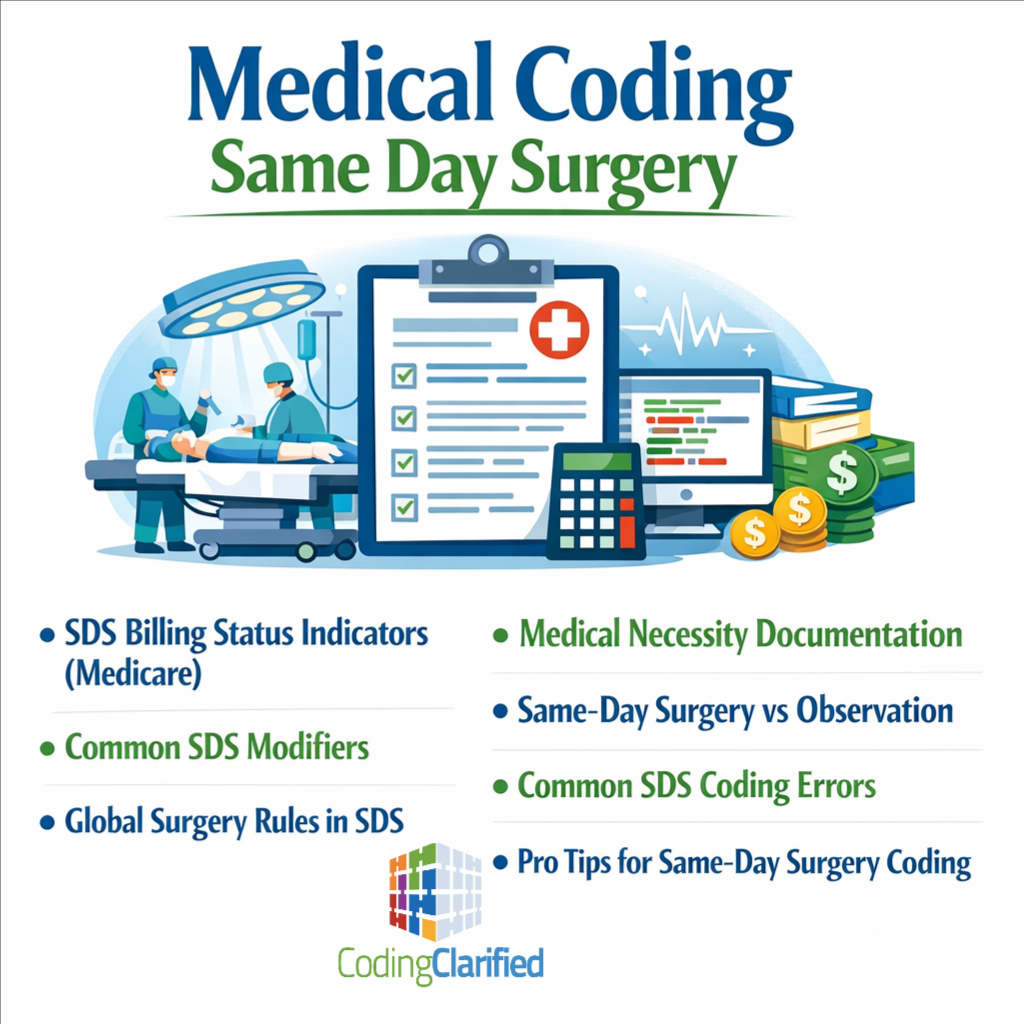
Medical Coding Guide: Same-Day Surgery (SDS) Guidelines & Practical Tips
Same-Day Surgery (SDS), also known as outpatient surgery or ambulatory surgery, allows patients to undergo surgical procedures and return home the same day. From a coding and billing perspective, SDS cases require careful attention to documentation, procedure classification, modifiers, and payer-specific rules.
This guide breaks down the most important SDS coding guidelines, compliance rules, and real-world tips to help coders avoid denials and ensure proper reimbursement.
What Is Same-Day Surgery (SDS)?
Same-Day Surgery refers to surgical procedures that do not require an overnight hospital stay. These services are commonly performed in:
-
Hospital outpatient departments (HOPDs)
-
Ambulatory Surgery Centers (ASCs)
-
Physician offices (in select cases)
Common SDS procedures include:
-
Cataract removal
-
Colonoscopy with biopsy
-
Arthroscopy
-
Hernia repair
-
Minor orthopedic and ENT surgeries
Key Coding Systems Used for SDS
Same-day surgery cases may require multiple code sets:
CPT (Physician & Facility Procedures)
-
Used to report surgical procedures and services
-
Facility and professional claims may use the same CPT code but bill separately
ICD-10-CM (Diagnosis Codes)
-
Medical necessity must be clearly supported
-
Use the most specific diagnosis available
HCPCS Level II
-
Used for supplies, DME, implants, drugs, and biologicals
Revenue Codes (Facility Billing)
-
Identify the department providing the service (e.g., OR, recovery, anesthesia)
SDS Billing Status Indicators (Medicare)
Medicare assigns status indicators to outpatient procedures under the Outpatient Prospective Payment System (OPPS):
| Status | Meaning |
|---|---|
| J1 | Comprehensive APC (primary procedure; all related services bundled) |
| T | Significant procedure (may affect payment ranking) |
| N | Packaged service (no separate payment) |
| S | Separately payable procedure |
Understanding status indicators helps coders determine:
-
What gets paid separately
-
What is bundled
-
What requires modifiers
Common SDS Modifiers
Correct modifier use is critical for outpatient surgery claims.
Modifier 25
Significant, separately identifiable E/M service on the same day as a procedure
Use when:
-
An office or hospital visit is distinct from the decision for surgery
Modifier 59
Distinct procedural service
Use when:
-
Procedures are normally bundled but were performed independently
-
Different sites, sessions, or lesions
Modifier -LT / -RT
Used for laterality when required by payer
Modifier 78
Unplanned return to the OR during the postoperative period
Modifier 79
Unrelated procedure during the postoperative period
Global Surgery Rules in SDS
Even though the patient goes home the same day, global surgery rules still apply.
| Global Period | Meaning |
|---|---|
| 0-Day | Minor procedure (no postop coverage) |
| 10-Day | Minor surgery with brief follow-up |
| 90-Day | Major surgery with full global package |
Included in the global package:
-
Post-op visits
-
Routine follow-up care
-
Typical recovery management
Not included:
-
Unrelated services
-
Complications requiring return to the OR
-
Separate E/M for new problems
Medical Necessity Documentation
Every SDS claim must clearly support medical necessity. Documentation should include:
-
Chief complaint and symptoms
-
Failed conservative treatment (when applicable)
-
Diagnostic findings
-
Operative report
-
Post-op diagnosis
If the diagnosis does not justify the procedure, the claim may be denied, even if the surgery was performed.
Same-Day Surgery vs Observation
Coders must distinguish between:
| SDS | Observation |
|---|---|
| Planned outpatient surgery | Monitoring after ED or procedure |
| Patient discharged the same day | May convert to inpatient |
| Surgical CPT codes billed | Observation CPT codes billed |
Do not confuse observation status with outpatient surgery.
Common SDS Coding Errors
Missing modifiers
Incorrect diagnosis sequencing
Reporting bundled services separately
Using inpatient-only CPT codes in an outpatient setting
Billing pre-op clearance visits incorrectly
Not verifying payer-specific rules
Pro Tips for Same-Day Surgery Coding
Always verify payer outpatient surgery policies
Check Medicare’s Inpatient-Only (IPO) list annually
Review NCCI edits before using modifier 59
Confirm laterality requirements
Validate medical necessity with LCDs and NCDs
Make sure operative notes support CPT selection
Same-Day Surgery coding requires a strong understanding of:
-
CPT and ICD-10-CM guidelines
-
OPPS status indicators
-
Global surgery rules
-
Modifier usage
-
Medical necessity standards
When coded correctly, the SDS claims process runs smoothly and reduces costly denials, audits, and rebilling.