Medical Coding Neurology: Guidelines, Common Codes, and CPC Exam Tips
Neurology coding can feel complex due to the wide range of conditions, diagnostic testing, and procedural services involved. For CPC students and medical coders, understanding how to accurately assign codes in this specialty is critical—not only for exam success but also for real-world coding accuracy and compliance.
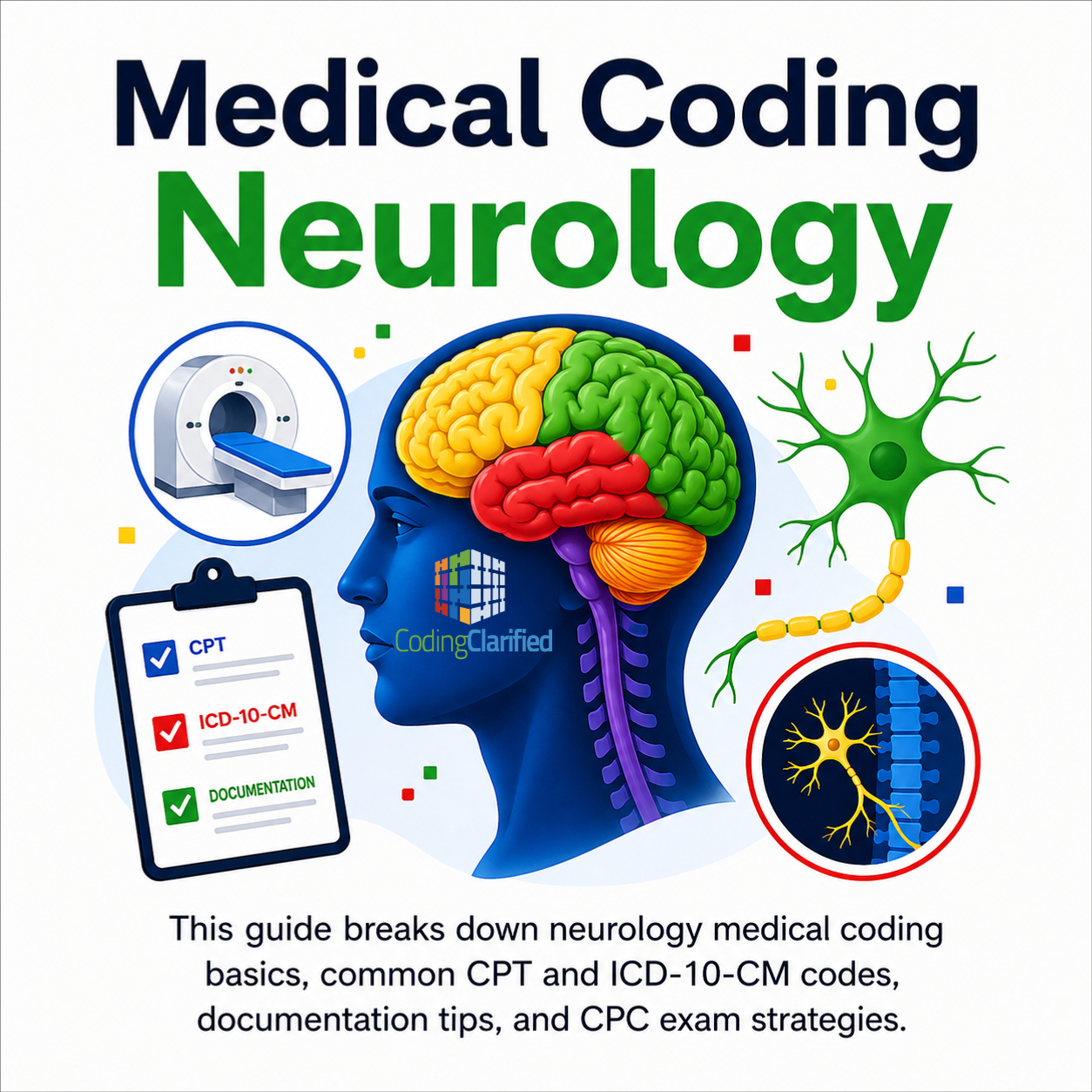
This guide breaks down neurology medical coding basics, common CPT and ICD-10-CM codes, documentation tips, and CPC exam strategies.
What Is Neurology Coding?
Neurology coding focuses on conditions affecting the brain, spinal cord, and nervous system. Coders must translate provider documentation into accurate CPT, ICD-10-CM, and sometimes HCPCS Level II codes.
Common neurology conditions include:
- Epilepsy and seizures
- Migraines and headaches
- Multiple sclerosis (MS)
- Parkinson’s disease
- Neuropathy
- Stroke and cerebrovascular diseases
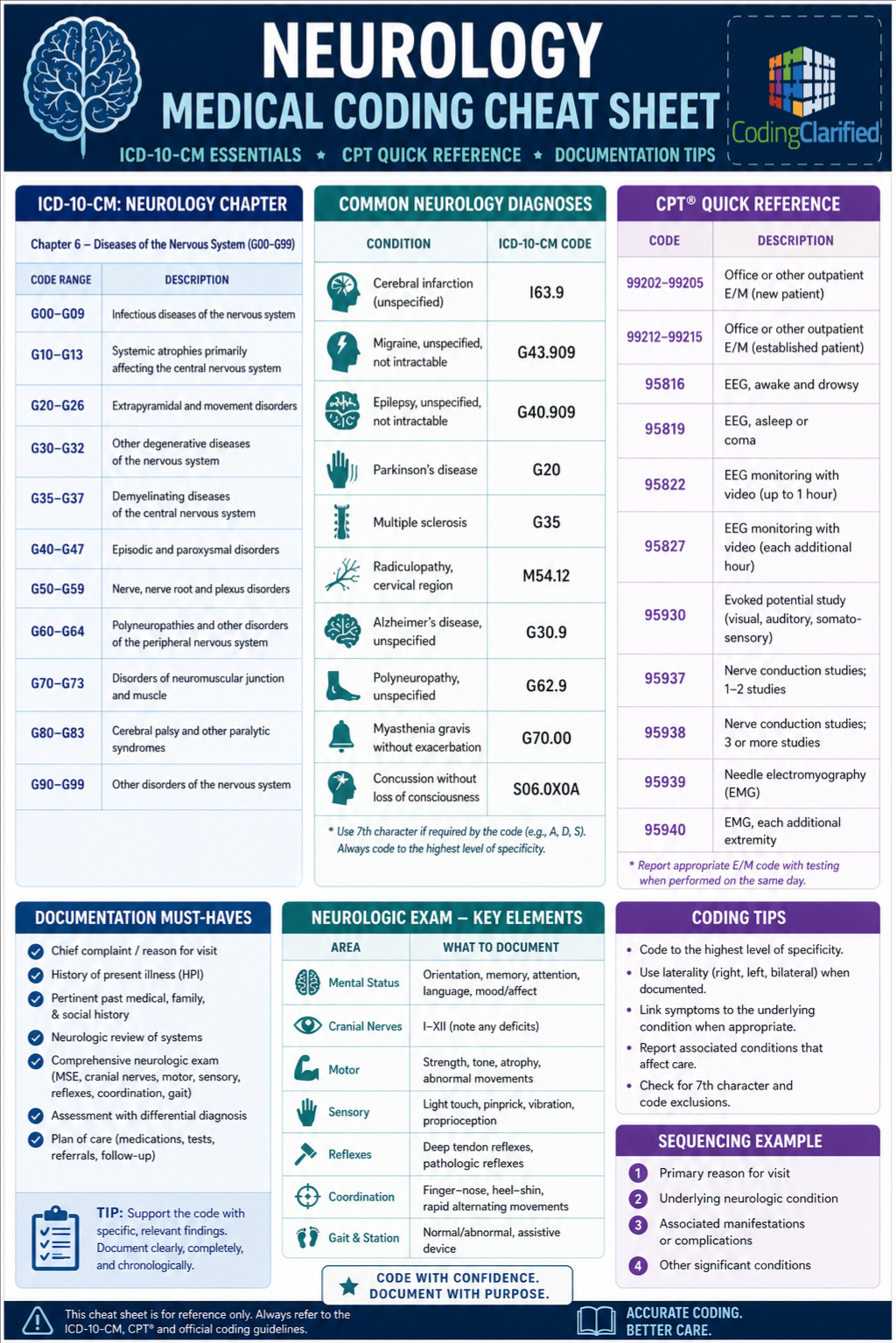
Common ICD-10-CM Codes in Neurology
Accurate diagnosis coding is essential in neurology due to specificity requirements.
Examples:
- G40.909 – Epilepsy, unspecified, not intractable
- G43.909 – Migraine, unspecified, not intractable
- G35 – Multiple sclerosis (note: newer updates may require more specificity based on phenotype and disease activity)
- G20 – Parkinson’s disease
- I63.9 – Cerebral infarction, unspecified
CPC Tip:
Do not default to unspecified codes when documentation supports more detail. Neurology coding often requires laterality, severity, and episode of care.
Common CPT Codes in Neurology
Neurology involves both evaluation and management (E/M) services and diagnostic procedures.
E/M Services:
- 99202–99205 – New patient visits
- 99211–99215 – Established patient visits
Diagnostic Testing:
- 95816–95819 – Electroencephalogram (EEG)
- 95907–95913 – Nerve conduction studies
- 95885–95886 – Electromyography (EMG)
Procedures:
- 62321–62323 – Epidural injections
- 64483–64484 – Nerve block injections
Key Documentation Requirements
Neurology coding is highly dependent on detailed provider documentation.
Ensure documentation includes:
- Specific diagnosis and symptoms
- Laterality (left, right, bilateral)
- Severity and type (e.g., intractable vs. non-intractable migraines)
- Diagnostic test details (what was performed and why)
- Medical necessity for procedures
CPC Tip:
If it is not documented, it cannot be coded. Always code based on provider documentation—not assumptions.
Neurology Coding Guidelines to Know
1. Signs and Symptoms vs. Confirmed Diagnosis
- Code symptoms (e.g., headache, dizziness) only if no definitive diagnosis is documented
2. Combination Codes
- Many neurological conditions include combination codes (e.g., migraine with aura)
3.Sequencing Matters
- Always code the underlying condition first, followed by manifestations if applicable
4. Use the Alphabetic Index First
- Then confirm in the Tabular List to ensure accuracy and compliance
Common Neurology Coding Mistakes
Avoid these frequent errors:
- Using unspecified codes when more detail is available
- Missing documentation for medical necessity
- Incorrect sequencing of stroke or neurological conditions
- Confusing EMG and nerve conduction study codes
- Not verifying CPT codes with documentation details
CPC Exam Tips for Neurology Coding
1. Focus on Terminology
Neurology questions often include complex terms. Break down words using prefixes, roots, and suffixes.
2. Watch for Keywords
Look for terms like:
- “Intractable”
- “With aura”
- “Acute vs. chronic”
These directly impact code selection.
3. Use Process Of Elimination
If unsure, eliminate answers that:
- Do not match anatomy
- Do not match documentation
- Conflict with coding guidelines
4. Manage Your Time
Neurology scenarios can be lengthy. If a question takes too long:
- Flag it
- Move on
- Return later
5. Know Your Diagnostics
Understand the difference between:
- EEG vs. EMG
- Nerve conduction vs. imaging
Coding Clarified Final Thoughts
Neurology coding is detail-oriented and requires strong knowledge of anatomy, terminology, and coding guidelines. For CPC students, mastering this specialty can significantly improve exam performance and confidence.
Focus on:
- Accurate documentation interpretation
- Proper code sequencing
- Understanding diagnostic procedures
With consistent practice and the right strategies, neurology coding becomes much more manageable—and even one of your strengths on the CPC exam.