
Irreversible Electroporation (IRE): Guidelines, Documentation Tips, and 2026 CPT Updates
Irreversible electroporation (IRE) is a minimally invasive, non-thermal ablation technique that uses short, high-voltage electrical pulses to create permanent pores in cell membranes. This destroys targeted tissue while better preserving surrounding structures such as vessels and ducts.
In interventional radiology and oncology, IRE is increasingly used for liver and prostate tumors, particularly when thermal ablation (radiofrequency ablation, microwave ablation, cryoablation) is too risky due to proximity to critical structures.
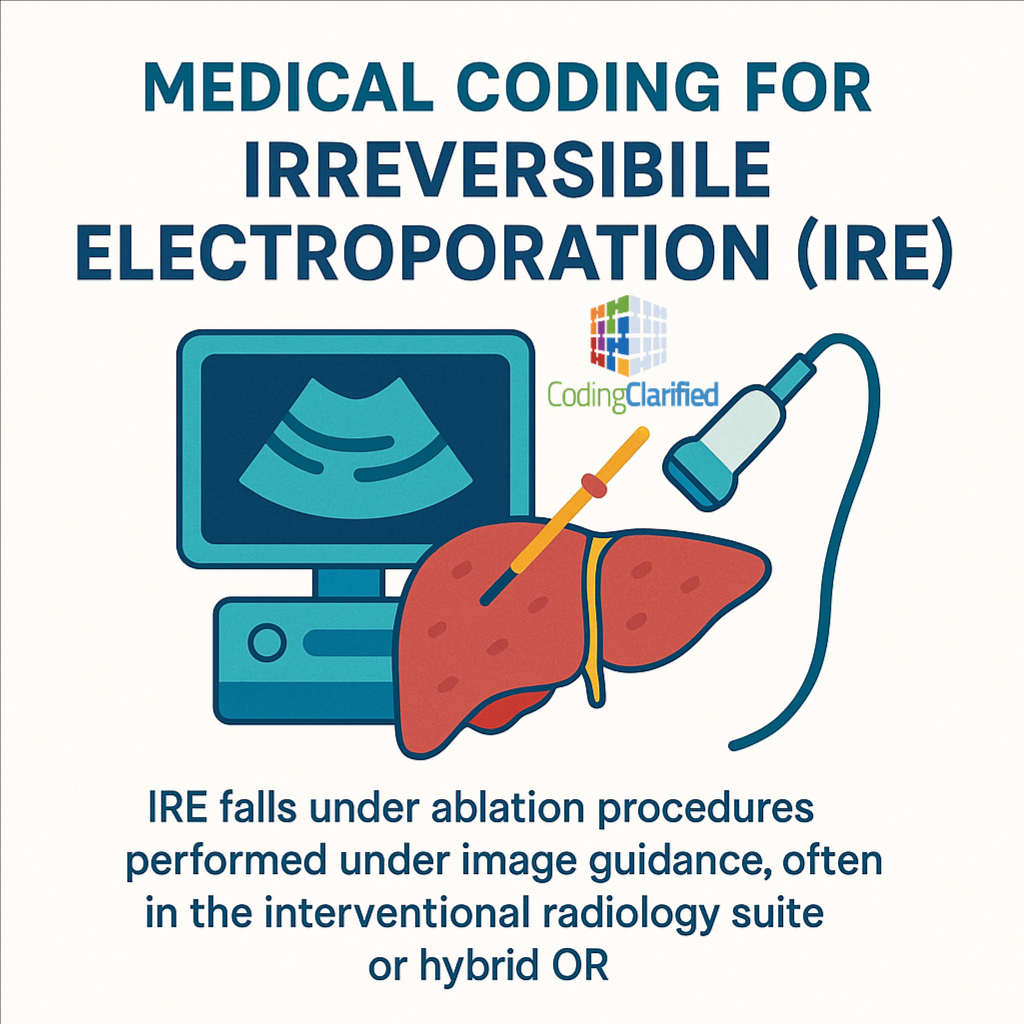
From a coding perspective, IRE falls under ablation procedures performed under image guidance, often in the interventional radiology suite or hybrid OR. As of 2026, new CPT codes and revised guidance make accurate documentation and code selection even more important.
Clinical Overview: Where Is IRE Used?
You’ll most commonly see IRE used for:
-
Liver lesions
-
Primary liver tumors (e.g., hepatocellular carcinoma)
-
Metastatic lesions near vessels or bile ducts, where thermal ablation is risky
-
-
Prostate lesions
-
Focal therapy for localized prostate cancer
-
Cases where nerve-sparing and functional preservation are major goals
-
Other potential uses (pancreas, kidney) may show up in research or limited practice, but the liver and prostate are the main targets referenced in CPT updates.
Key 2026 CPT Updates Impacting IRE
Beginning January 1, 2026, CPT introduces and restructures multiple code families that affect IRE and related interventional services:
-
New Category I Codes for IRE of Liver and Prostate
-
New codes specifically describe irreversible electroporation of the liver and irreversible electroporation of the prostate (rather than using unlisted or generic ablation codes).
-
These codes are expected to include details such as organ, approach, and imaging guidance within the descriptors.
-
Coders must delete any prior unlisted or temporary codes used for IRE and map to these new Category I codes starting in 2026.
-
-
Head & Neck CTA and CT Perfusion (CTP) Updates
-
New Category I codes for head and neck CTA and CT perfusion imaging (CTP) replace older Category III codes.
-
While not IRE themselves, these changes are part of a broader imaging and endovascular update that impacts how imaging is coded alongside interventional procedures.
-
-
Thoracic Branch Endograft Procedures
-
New codes and structured reporting options are introduced for thoracic branch endograft services.
-
These codes clarify how to report complex endovascular repairs and the associated imaging guidance.
-
These changes often intersect with embolization, occlusion, and other vascular interventions that might be performed in the same encounter as IRE or other advanced therapies.
-
-
Prostate Biopsy & Sacroiliac Arthrodesis Updates
-
Prostate biopsy codes are revised to better align with modern imaging-guided techniques (e.g., MRI/US fusion).
-
Sacroiliac joint arthrodesis codes are updated, reflecting newer minimally invasive approaches.
-
Coders need to be aware of these changes because the same patients undergoing advanced therapies (like IRE) often have related imaging, biopsies, or interventions that must be coded correctly under the 2026 rules.
-
-
Revised Guidelines for Vascular Embolization/Occlusion and Endovascular Therapy
-
The “vascular embolization/occlusion” and “endovascular therapy” guideline sections are revised to clarify:
-
When imaging guidance is included
-
When separate imaging codes may be reported
-
How multiple territories and approaches should be handled
-
-
This includes updated bundling instructions that affect how you report imaging guidance (e.g., some fluoroscopy/CT/ultrasound guidance codes may now be bundled into the new procedure codes).
-
Imaging Guidance, Bundling, and 2026 Changes
IRE almost always involves imaging guidance, and this is where many denials occur.
Bundling Changes to Watch
-
Expect expanded bundling of imaging guidance (fluoroscopy, CT, ultrasound) into the new IRE and endovascular codes.
-
Some familiar stand-alone imaging guidance codes—especially those used for neurointerventional work like 61624 / 61626—will be more tightly controlled, with clearer instructions on when they can vs cannot be reported separately.
-
New guidelines will emphasize:
-
Do not unbundle imaging that’s explicitly included in the code descriptor.
-
Report separate imaging codes only when:
-
They are truly independent diagnostic studies
-
They meet medical necessity and documentation standards
-
They are not designated as “included” in the parent procedure code or guidelines
-
-
Medical Coding Bundling and Upcoding
Coding Tip
Always verify which imaging modality was used and whether it’s separately reportable under 2026 rules.
Read the full code descriptors and parenthetical notes in the 2026 CPT manual to determine if fluoroscopy, ultrasound, or CT guidance is included.
Documentation Requirements for IRE in 2026
To assign the correct IRE code and any related imaging or embolization codes, documentation should clearly capture:
-
Target Organ and Lesion Details
-
Organ (e.g., liver, prostate)
-
Number and location of lesions treated
-
Size of lesions (if documented)
-
-
Approach and Access
-
Percutaneous vs open vs laparoscopic
-
Access site(s) (e.g., percutaneous transhepatic)
-
Any vascular access for combined endovascular therapy
-
-
Technique
-
Confirmation that the modality used is irreversible electroporation
-
Number of electrode/probe placements
-
Whether multiple lesions or sessions are treated in a single encounter
-
-
Imaging Guidance
-
Which modality was used (fluoroscopy, CT, ultrasound, MRI)
-
Whether imaging was diagnostic, interventional guidance, or both
-
If a diagnostic study is billed separately, documentation should support:
-
New or changing condition
-
Clinical decision-making is influenced by the findings
-
Clear distinction from imaging used solely for guidance
-
-
-
Concurrent Procedures
-
Embolization/occlusion procedures performed in the same session
-
Endovascular therapy (e.g., stent placement, angioplasty)
-
Any thoracic branch endograft procedures in the same setting
-
-
Devices and Equipment
-
Type of ablation system or generator (IRE device)
-
Type of electrodes or probes
-
Endograft or embolic materials if applicable
-
2026 Requirement
Coders must delete old codes and map to new ones effective January 1, 2026.
That means:
-
Discontinue use of any retired Category III or legacy codes for IRE.
-
Update charge masters, templates, and cheat sheets to reflect the new Category I IRE codes and related imaging/endovascular changes.
Coding Workflow Tips for IRE Encounters
To stay accurate and efficient when coding IRE procedures under the 2026 rules, consider this step-by-step approach:
-
Confirm the Procedure Type
-
Verify that the documented technique is irreversible electroporation, not RFA, microwave, cryoablation, or another modality.
-
Identify whether the target is the liver, prostate, or another organ.
-
-
Identify the Primary IRE Code
-
Use the 2026 CPT organ-specific IRE code for liver or prostate.
-
Check for add-on codes if multiple lesions, segments, or zones are treated (based on final descriptors in the code set).
-
-
Review Imaging
-
Determine if imaging guidance is included in the IRE code.
-
If separate diagnostic imaging (e.g., CTA, CTP, MRI) was performed and documented as medically necessary, report those codes with appropriate modifiers, if allowed.
-
-
Assess Embolization/Occlusion or Endovascular Work
-
If embolization or endovascular therapy was performed during the same session, use the updated vascular embolization/occlusion and endovascular therapy codes and guidelines.
-
Pay close attention to:
-
Vascular territory
-
Bundling rules
-
Whether multiple territories or separate sessions are involved
-
-
-
Check for Related Services
-
Prostate biopsy performed in the same episode? Use the revised prostate biopsy codes that align with current imaging methods.
-
For complex vascular work, make sure to capture any thoracic branch endograft procedures using the new structured reporting options.
-
-
Apply Modifiers Appropriately
-
Use modifiers (e.g., 26, TC, 59, X modifiers) only when supported by documentation and allowed by payers.
-
Be cautious with unbundling edits under NCCI and payer-specific policies.
-
Common Pitfalls in IRE Coding
Avoid these frequent errors:
-
Using retired or Category III codes after 2025
-
Failing to update to the new Category I IRE codes will lead to denials.
-
-
Unbundling imaging guidance
-
Reporting separate fluoroscopy, CT, or ultrasound guidance codes when they are included in the IRE or endovascular procedure descriptor.
-
-
Incomplete documentation of organ/territory
-
Missing details about which organ, which vascular territory, or which lesions were treated can result in under-coding or miscoding.
-
-
Ignoring updated embolization/endovascular guidelines
-
Not reviewing the revised 2026 instructions for “vascular embolization/occlusion” and “endovascular therapy” leads to incorrect code combinations and payer edits.
-
-
No linkage between imaging and intervention
-
Failing to clearly tie imaging findings to the decision to perform IRE, especially when diagnostic imaging is billed separately.
-
Best Practices for Coders and Practices
To stay compliant and minimize denials:
-
Train coding and clinical teams together
-
Review new IRE, imaging, embolization, and endovascular codes as a group.
-
Walk through sample operative notes and map them to the 2026 codes.
-
-
Update templates and macros
-
Work with providers to update procedure note templates to explicitly include:
-
Organ/lesion details
-
Approach
-
Imaging modality
-
Device type
-
Vascular territory (when applicable)
-
-
-
Refresh your cheat sheets and quick-reference tools
-
Replace 2025 and earlier IRE and embolization references with updated 2026 code sets and guidelines.
-
Highlight bundled vs separately billable imaging codes.
-
-
Monitor denials for patterns
-
Track denials related to IRE, imaging guidance, and endovascular services to identify documentation or coding gaps quickly.
-
Irreversible electroporation (IRE) has moved from niche to mainstream enough to justify new, organ-specific Category I CPT codes for liver and prostate starting January 1, 2026. These changes come alongside broader updates in:
-
Head and neck CTA and CT perfusion
-
Thoracic branch endograft services
-
Prostate biopsy coding
-
Sacroiliac arthrodesis
-
Vascular embolization/occlusion and endovascular therapy guidelines
For medical coders, success with IRE coding in 2026 hinges on:
-
Clear documentation of organ, lesion, approach, imaging, and vascular territory
-
Careful reading of the bundling rules for imaging guidance and embolization
-
Updating all systems and references to retire old codes and use the new ones
With the right preparation and attention to detail, you can confidently code IRE procedures under the 2026 CPT framework and help ensure accurate reimbursement and clean claims.