Medical Coding for Adenoidectomy (2026): CPT, ICD-10-CM, Documentation, and Coding Scenario Explained
Key Takeaways
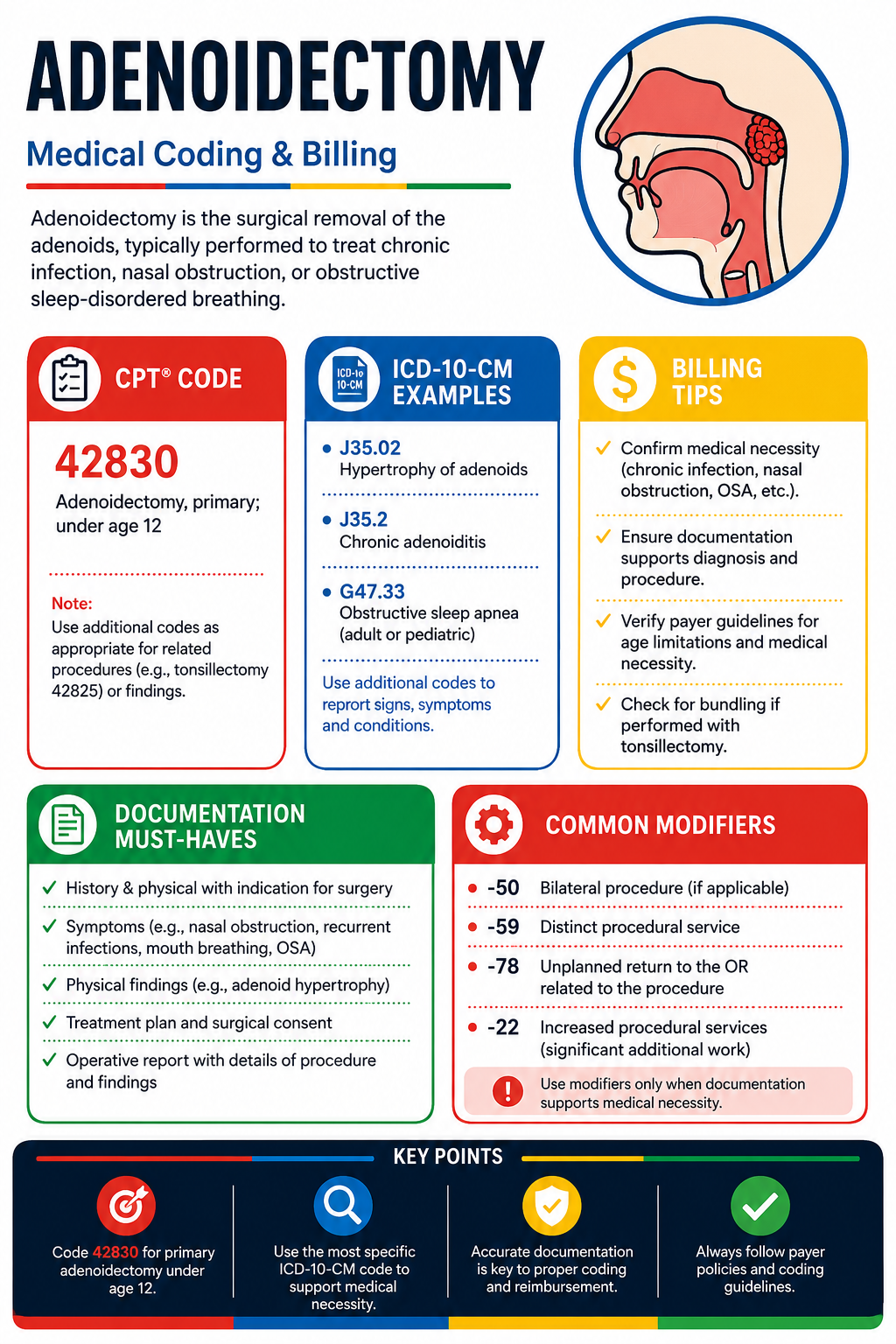
- An adenoidectomy performed without a tonsillectomy is most commonly reported with CPT® 42830 or 42831, depending on the patient’s age.
- Always verify the patient’s age because age determines the correct CPT code.
- The operative report must clearly document complete removal of the adenoid tissue.
- Documentation should support the medical necessity for surgery with the correct diagnosis.
- Coders should never assume recurrent infections or obstruction unless documented by the physician.
- Proper documentation helps prevent denials and supports accurate reimbursement in 2026.
Medical Coding for Adenoidectomy (2026): Complete CPT & ICD-10-CM Guide
Adenoidectomy remains one of the most frequently performed pediatric ENT procedures. Although the surgery itself appears straightforward, selecting the correct CPT code requires careful attention to the patient’s age and the exact procedure performed.
Moreover, coders must distinguish between an isolated adenoidectomy and procedures that include a tonsillectomy. Small documentation differences can lead to coding errors, claim denials, or incorrect reimbursement.
This blog walks through a real operative report, explains the correct coding, highlights common documentation pitfalls, and provides CPC exam tips for students preparing for certification in 2026.
Operative Scenario
Procedure Performed
Adenoidectomy
Operative Summary
The surgical team brought the patient to the operating room and administered general anesthesia through an endotracheal tube.
Their surgeon inserted a Crowe-Davis mouth gag after completing the standard sterile preparation, and suspended the palate using a red rubber catheter passed through the right nostril.
Next, the surgeon visualized the adenoid pad with a mirror. An adenoid curette was positioned against the vomer. The surgeon completely removed the adenoid tissue.
Afterward, the nasopharynx was packed for hemostasis. Once the packing was removed, several bleeding sites were controlled using electrocautery. The surgeon irrigated the operative field. The mouth gag was removed, and the patient tolerated the procedure well.
Step 1: Identify the Procedure
This operative report documents only:
- Adenoidectomy
- No tonsillectomy
- No revision surgery
- No additional ENT procedures
Coders should report only an isolated adenoidectomy.
Step 2: CPT Coding
The correct CPT code depends entirely on the patient’s age.
| Patient Age | CPT Code | Description |
|---|---|---|
| Under age 12 | 42830 | Adenoidectomy, primary; younger than age 12 |
| Age 12 or older | 42831 | Adenoidectomy, primary; age 12 or over |
Which CPT Code Fits This Scenario?
The operative report does not document the patient’s age.
Because age determines code selection, the coder cannot automatically assign either code.
If the patient is younger than 12:
Report:
CPT: 42830
If the patient is 12 years or older:
Report:
CPT: 42831
This is an excellent CPC exam reminder that every required coding element must be documented.
Step 3: ICD-10-CM Coding
The operative note does not provide the medical diagnosis.
Instead, it only documents that an adenoidectomy was performed.
Therefore, additional documentation is needed before assigning the diagnosis code.
Common diagnoses that support an adenoidectomy include:
| ICD-10-CM Code | Description |
|---|---|
| J35.2 | Hypertrophy of adenoids |
| J35.3 | Hypertrophy of tonsils with hypertrophy of adenoids |
| J35.02 | Chronic adenoiditis |
| G47.33 | Obstructive sleep apnea (when documented and supported) |
| H65.23 | Chronic serous otitis media (when related and documented) |
Most Likely Diagnosis
If documentation states enlarged adenoids, the most likely diagnosis would be:
ICD-10-CM: J35.2
However, coders should never assume enlargement simply because surgery occurred.
Always code only documented conditions.
Final Coding (Assuming Typical Documentation)
CPT
42830 (if younger than age 12)
OR
42831 (if age 12 or older)
ICD-10-CM
J35.2 — if hypertrophic adenoids are documented
HCPCS Coding
Coders do not report a separate HCPCS Level II code.
General anesthesia, surgical supplies, and routine operating room services are typically included in the facility billing methodology and are not separately reported by the physician.
Why This Coding Matters
Many coders focus only on identifying the surgery. However, ENT coding often requires careful review of several factors, including:
- Patient age
- Primary versus revision procedure
- Tonsillectomy performed or not
- Medical necessity
- Complete operative documentation
Consequently, overlooking any of these details can result in incorrect code selection.
Documentation Review
This operative report successfully documents:
- General anesthesia
- Visualization of the adenoid pad
- Complete removal
- Hemostasis
- Irrigation
- Completion of surgery
However, several important coding elements are missing.
These include:
- Patient age
- Medical diagnosis
- Indication for surgery
- History of chronic infections
- Airway obstruction
- Sleep-disordered breathing
Without these details, coders must obtain additional documentation before final code assignment.
CPC Student Tips
Students frequently see adenoidectomy questions on the CPC exam.
Remember these important points:
- Always verify the patient’s age first.
- Never assume a diagnosis.
- Read every operative report from beginning to end.
- Watch for combined tonsillectomy procedures.
- Confirm whether the surgery is primary or secondary.
- Review the CPT parenthetical notes before selecting a code.
Coding Rationale
The operative report documents a primary removal of the adenoid tissue.
There was no revision procedure occurred.
Tonsils were not removed.
No additional nasal or sinus procedures were performed.
Therefore, only an isolated adenoidectomy code applies.
The final CPT code depends solely on patient age.
Common Mistakes to Avoid
One of the biggest mistakes is selecting CPT 42830 without verifying the patient’s age. Always confirm whether the patient is younger than 12 years old because age determines the correct code.
Another frequent error is assigning ICD-10-CM J35.2 simply because an adenoidectomy was performed. Instead, code only the diagnosis documented by the provider.
Many new coders also confuse an isolated adenoidectomy with a combined tonsillectomy and adenoidectomy. Review the entire operative report to ensure no tonsil tissue was removed.
Additionally, do not report separate codes for routine surgical hemostasis, packing, irrigation, or electrocautery when they are integral to the procedure.
Finally, remember that anesthesia services are reported separately by the anesthesia provider and are not coded by the surgeon as part of the adenoidectomy procedure.
2026 Coding Updates
For 2026, coders should continue to verify the most current CPT®, ICD-10-CM, and payer-specific guidance before submitting claims. While the CPT code structure for adenoidectomy remains stable, annual updates to coding guidelines, National Correct Coding Initiative (NCCI) edits, and payer policies can affect reporting and reimbursement. Reviewing the latest resources each year helps maintain compliance and reduces the risk of denials.
Related Coding Clarified Articles
Continue building your ENT and surgery coding knowledge with these additional Coding Clarified resources:
- Coding Clarified Blog
- Emergency Dept Services
- Coding Clarified Resource Library
- Medical Coding OP Reports
- Medical Coding Path and Lab
These related articles provide additional coding examples, documentation guidance, and CPC exam tips that complement the concepts covered in this adenoidectomy scenario.
Authoritative Resources
For the latest coding guidance and official references, review these trusted sources:
Frequently Asked Questions
What CPT code is used for a primary adenoidectomy?
A primary adenoidectomy is reported with CPT 42830 for patients younger than 12 years old or CPT 42831 for patients 12 years of age or older.
Does patient age affect adenoidectomy coding?
Yes. Age is one of the most important factors because it determines whether CPT 42830 or CPT 42831 is reported.
What ICD-10-CM code is commonly used for enlarged adenoids?
When documented by the provider, ICD-10-CM J35.2 (Hypertrophy of adenoids) is commonly reported.
Can I code hypertrophic adenoids if the surgeon does not document the diagnosis?
No. Coders must assign diagnosis codes based only on provider documentation. The performance of surgery alone does not establish the diagnosis.
Is electrocautery reported separately during an adenoidectomy?
No. Electrocautery used to achieve routine hemostasis is included in the surgical procedure and is not separately reportable.
Should anesthesia be coded with the surgeon’s claim?
No. The anesthesia provider reports anesthesia services separately. The surgeon reports only the surgical procedure.
What is the biggest coding mistake with adenoidectomy?
The most common mistake is choosing the CPT code without confirming the patient’s age or assigning a diagnosis that is not documented in the medical record.
Coding Clarified Summary
Correct coding for an adenoidectomy begins with identifying whether the procedure was isolated or combined with a tonsillectomy, confirming the patient’s age, and selecting the appropriate diagnosis based on provider documentation. For this operative scenario, the correct CPT code is 42830 for patients younger than 12 years or 42831 for patients aged 12 years or older. When documented, ICD-10-CM J35.2 is a common diagnosis for hypertrophic adenoids. Careful documentation review and adherence to 2026 coding guidelines help improve claim accuracy, support medical necessity, and prepare CPC students for exam success.