Medical Coding and Billing for Consultations in 2026: CPT, ICD-10-CM, Documentation, and Reimbursement Guide
By Janine Mothershed CPC, CPC-I
Consultation services continue to play an important role in modern healthcare. However, consultation coding remains one of the most misunderstood areas of medical coding and billing. As a result, coders frequently encounter denials, documentation deficiencies, and payer-specific challenges when reporting consultation services.
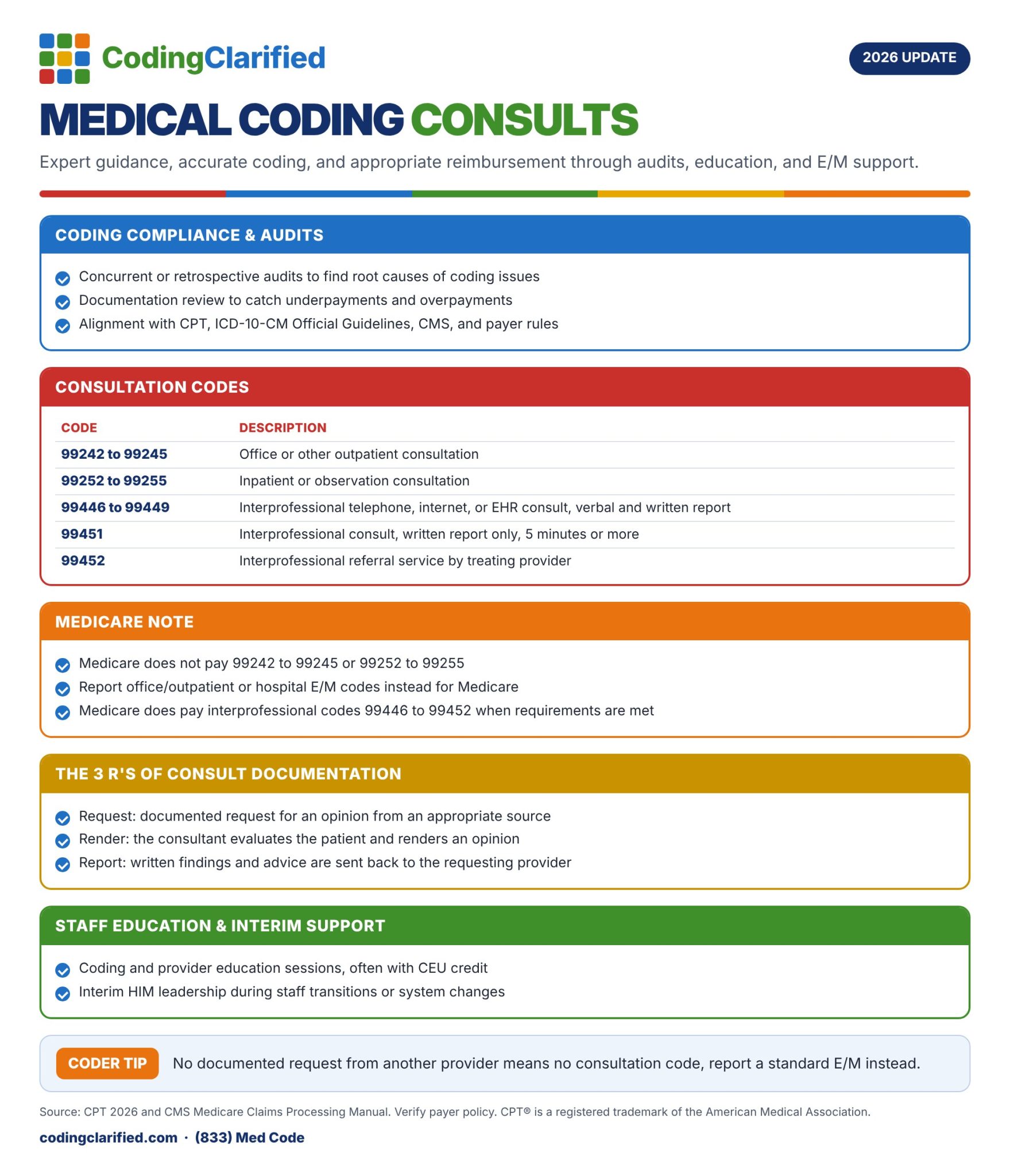
In 2026, understanding consultation coding is more important than ever. Although Medicare generally does not recognize consultation CPT® codes, many commercial insurers still reimburse consultation services when documentation requirements are met. Therefore, coders must understand both CPT® guidelines and payer-specific policies before submitting claims.
Furthermore, healthcare organizations are facing increased scrutiny regarding medical necessity and documentation compliance. Consequently, providers and coders must ensure that every consultation clearly supports the reason for the request, the consulting provider’s findings, and the recommendations communicated back to the requesting provider.
Whether you are a seasoned medical coder, healthcare provider, biller, or CPC student preparing for certification, understanding consultation coding can help improve compliance, reduce claim denials, and support accurate reimbursement.
Key Takeaways
-
- Consultation services require a documented request from another qualified healthcare provider.
- Medicare generally requires E/M coding instead of consultation CPT® codes.
- Many commercial payers still recognize consultation codes.
- Documentation must support the request, opinion rendered, and report back to the requesting provider.
- Deleted consultation codes should not be reported in 2026.
- Accurate ICD-10-CM coding helps establish medical necessity.
- Verification of payer policies remains essential before claim submission.
Table of Contents
- What Is a Medical Consultation?
- Consultation vs. Referral: Understanding the Difference
- CPT® Codes for Consultations
- Medicare Rules for Consultation Coding
- ICD-10-CM Coding for Consultations
- Documentation Requirements
- Billing Guidelines for 2026
- Common Consultation Coding Mistakes
- CPC Exam Tips
- Additional Resources
- Frequently Asked Questions
What Is a Medical Consultation?
A medical consultation occurs when one physician or qualified healthcare professional requests the opinion, advice, or expertise of another provider regarding the diagnosis or management of a patient. In other words, the requesting provider seeks specialized guidance to assist with patient care.
For example, a primary care physician may request a cardiology consultation for a patient experiencing chest pain. Similarly, an endocrinologist may be consulted regarding uncontrolled diabetes, or a nephrologist may be asked to evaluate worsening kidney function.
Importantly, consultations differ from referrals. While a consultation focuses on obtaining an expert opinion or recommendation, a referral often involves transferring ongoing patient management to another provider. Therefore, understanding this distinction is critical for accurate code selection.
Additionally, consultation services may occur in multiple healthcare settings, including physician offices, outpatient clinics, hospitals, skilled nursing facilities, and other healthcare environments. Regardless of the setting, documentation requirements remain a key component of successful reimbursement.
Consultation vs. Referral: Why the Difference Matters
One of the most common coding mistakes involves confusing a consultation with a referral. Although these terms are often used interchangeably in everyday conversation, they represent very different services from a coding perspective.
Consultation
A consultation generally includes:
- A documented request from another provider
- An evaluation of the patient
- Medical expertise or recommendations
- Communication of findings back to the requesting provider
Referral
By contrast, a referral typically involves:
- Transfer of patient care
- Ongoing management by the receiving provider
- No expectation that recommendations will be returned to the requesting provider
Consequently, not every specialist visit qualifies as a consultation. Instead, coders must carefully review the documentation to determine whether consultation requirements are met.
CPT® Codes for Consultations
Although consultation codes are not recognized by Medicare, they still exist in the CPT® code set and may be accepted by certain commercial insurers.
Office or Other Outpatient Consultation Codes
| CPT® Code | Description |
|---|---|
| 99242 | Straightforward consultation |
| 99243 | Low level consultation |
| 99244 | Moderate level consultation |
| 99245 | High level consultation |
Note: CPT® code 99241 was deleted effective January 1, 2023.
Inpatient Consultation Codes
| CPT® Code | Description |
| 99252 | Straightforward inpatient consultation |
| 99253 | Low level inpatient consultation |
| 99254 | Moderate level inpatient consultation |
| 99255 | High level inpatient consultation |
Note: CPT® code 99251 was deleted effective January 1, 2023.
2026 Coding Update
Many older coding resources still reference 99241 and 99251. However, both codes have been deleted and should not be reported in 2026.
This is a common CPC exam trap and a frequent source of claim denials.
Medicare Rules for Consultation Coding
One of the most important consultation coding rules involves Medicare.
Beginning January 1, 2010, Medicare stopped recognizing consultation CPT® codes and instructed providers to report appropriate E/M services instead.
Medicare Outpatient Services
Providers typically report:
- 99202
- 99203
- 99204
- 99205
- 99211
- 99212
- 99213
- 99214
- 99215
Medicare Hospital Services
Providers typically report:
- 99221
- 99222
- 99223
or
- 99231
- 99232
- 99233
depending on the service provided.
Therefore, coders must always verify whether the payer follows Medicare rules or allows consultation codes.
ICD-10-CM Coding for Consultations
There are no consultation-specific ICD-10-CM diagnosis codes.
Instead, coders assign diagnosis codes that describe the condition prompting the consultation.
Examples include:
- I10 – Essential (primary) hypertension
- E11.9 – Type 2 diabetes mellitus without complications
- N18.30 – Chronic kidney disease, stage 3 unspecified
- M54.50 – Low back pain, unspecified
- F32.0 – Major depressive disorder, single episode, mild
- R07.9 – Chest pain, unspecified
- G47.33 – Obstructive sleep apnea
Documentation Tip
Always code the condition being evaluated rather than simply documenting that a consultation occurred.
The diagnosis establishes medical necessity for the service.
Documentation Requirements for Consultation Services
Proper documentation remains the foundation of successful consultation billing.
1. Request for Consultation
Documentation should identify:
- Requesting provider
- Reason for consultation
- Clinical concern requiring expertise
The request may be written, electronic, or documented within the medical record.
2. History and Examination
The consulting provider should document:
- Relevant history
- Examination findings
- Diagnostic studies reviewed
- Clinical assessment
3. Medical Decision-Making
Documentation should support:
- Complexity of the condition
- Risk assessment
- Data reviewed
- Differential diagnoses
4. Recommendations
The consulting provider should clearly communicate recommendations regarding:
- Treatment options
- Diagnostic testing
- Follow-up care
- Medication adjustments
5. Report Back to Requesting Provider
A true consultation requires communication of findings and recommendations.
Failure to document this communication may result in denial of consultation services.
Billing Guidelines for Consultation Services in 2026
Step 1: Verify Payer Requirements
Before coding the encounter:
- Confirm whether consultation codes are accepted
- Review payer-specific policies
- Verify documentation requirements
Step 2: Select the Correct CPT® Code
Choose the code based on:
- Medical decision-making
- Time (when applicable)
- Payer requirements
Step 3: Assign Appropriate ICD-10-CM Codes
Diagnosis coding should support medical necessity and accurately reflect the patient’s condition.
Step 4: Review Documentation
Ensure documentation includes:
- Request
- Reason
- Findings
- Recommendations
- Communication back to requesting provider
Step 5: Submit and Monitor Claims
Track:
- Denials
- Underpayments
- Medical necessity edits
- Payer-specific consultation policies
Common Mistakes to Avoid
Using Deleted CPT® Codes
Avoid reporting:
- Deleted 99241
- Deleted 99251
Confusing Referrals With Consultations
Not every specialist visit qualifies as a consultation.
Missing Consultation Requests
If the request is not documented, the consultation may not be supported.
Failing to Report Findings
Documentation should include recommendations communicated back to the requesting provider.
Ignoring Medicare Rules
Medicare generally requires E/M coding instead of consultation coding.
Choosing ICD-10-CM Codes That Lack Specificity
Whenever documentation supports greater specificity, avoid unspecified diagnoses.
CPC Student Tips
Learn the Deleted Consultation Codes
The CPC exam may test your understanding of deleted codes and coding updates.
Understand Medicare’s Position
Know that Medicare generally does not recognize consultation CPT® codes.
Memorize the Three R’s
- Request
- Render Opinion
- Report Findings
Review E/M Guidelines
Consultation coding frequently overlaps with E/M concepts.
Strong E/M knowledge will improve coding accuracy.
Focus on Documentation
Many CPC exam questions center on determining whether documentation supports the code selection.
Related Coding Clarified Articles
For additional coding guidance, explore:
- Medical Coding E/M Prolonged Services
- Medical Coding E/M Prolonged Services
- Evaluation and Management (E/M) Guidelines for 2026: The Complete Guide
- The AMA CPT® Assistant
- Medical Coding Errors and How to Prevent Them
These resources can help reinforce coding fundamentals and improve claim accuracy.
Additional Authoritative Resources
Final Takeaway
Consultation coding continues to be a challenging area for medical coders because payer requirements, CPT® guidelines, and Medicare policies do not always align. As a result, understanding the difference between a true consultation, a referral, and a standard Evaluation and Management (E/M) service is essential for accurate coding and reimbursement.
In 2026, coders should remember that consultation services require a documented request, the rendering of an opinion or recommendation, and communication of findings back to the requesting provider. Furthermore, while many commercial insurers may still recognize consultation CPT® codes such as 99242–99245 and 99252–99255, Medicare generally requires the use of appropriate E/M services instead.
Additionally, proper documentation remains the key to avoiding denials. The medical record should clearly support the reason for the consultation, the provider’s assessment, the medical decision-making performed, and the recommendations provided. Without these elements, even a medically necessary consultation may not withstand payer scrutiny.
For CPC students, consultation coding is an excellent topic to master because it reinforces core concepts involving E/M services, medical necessity, documentation requirements, and payer-specific guidelines. Understanding these principles not only helps with certification exam preparation but also improves real-world coding accuracy.
Ultimately, successful consultation coding requires careful review of payer policies, thorough documentation, accurate ICD-10-CM code selection, and proper CPT® reporting. By staying current with 2026 coding updates and following consultation guidelines, healthcare organizations can improve compliance, reduce claim denials, and support appropriate reimbursement for the valuable expertise consulting providers deliver.
Frequently Asked Questions
Does Medicare pay for consultation CPT® codes in 2026?
Generally, Medicare does not recognize consultation codes and instead requires providers to report appropriate E/M services.
What is the difference between a consultation and a referral?
A consultation involves an opinion or recommendation, while a referral typically transfers ongoing patient care to another provider.
Are consultation codes still active CPT® codes?
Yes. Consultation codes remain in the CPT® code set and may be accepted by some commercial insurers.
Was CPT® 99241 deleted?
Yes. 99241 was deleted effective January 1, 2023.
Was CPT® 99251 deleted?
Yes. 99251 was deleted effective January 1, 2023.
What documentation is required for a consultation?
Documentation should include the request for consultation, reason for the consultation, findings, recommendations, and communication back to the requesting provider.
Can a specialist bill a consultation and then continue treating the patient?
Possibly. However, documentation must support that the initial service met consultation requirements before ongoing management begins.
What ICD-10-CM code should be used for a consultation?
There is no consultation diagnosis code. Coders should report the condition or symptoms that prompted the consultation.