Medical Coding and Billing Guidelines for Infusion Services in 2026: Complete CPT, HCPCS, Documentation, and Reimbursement Guide
By Janine Mothershed CPC, CPC-I
Key Takeaways
- Infusion coding depends on the type of service, administration method, and total infusion time.
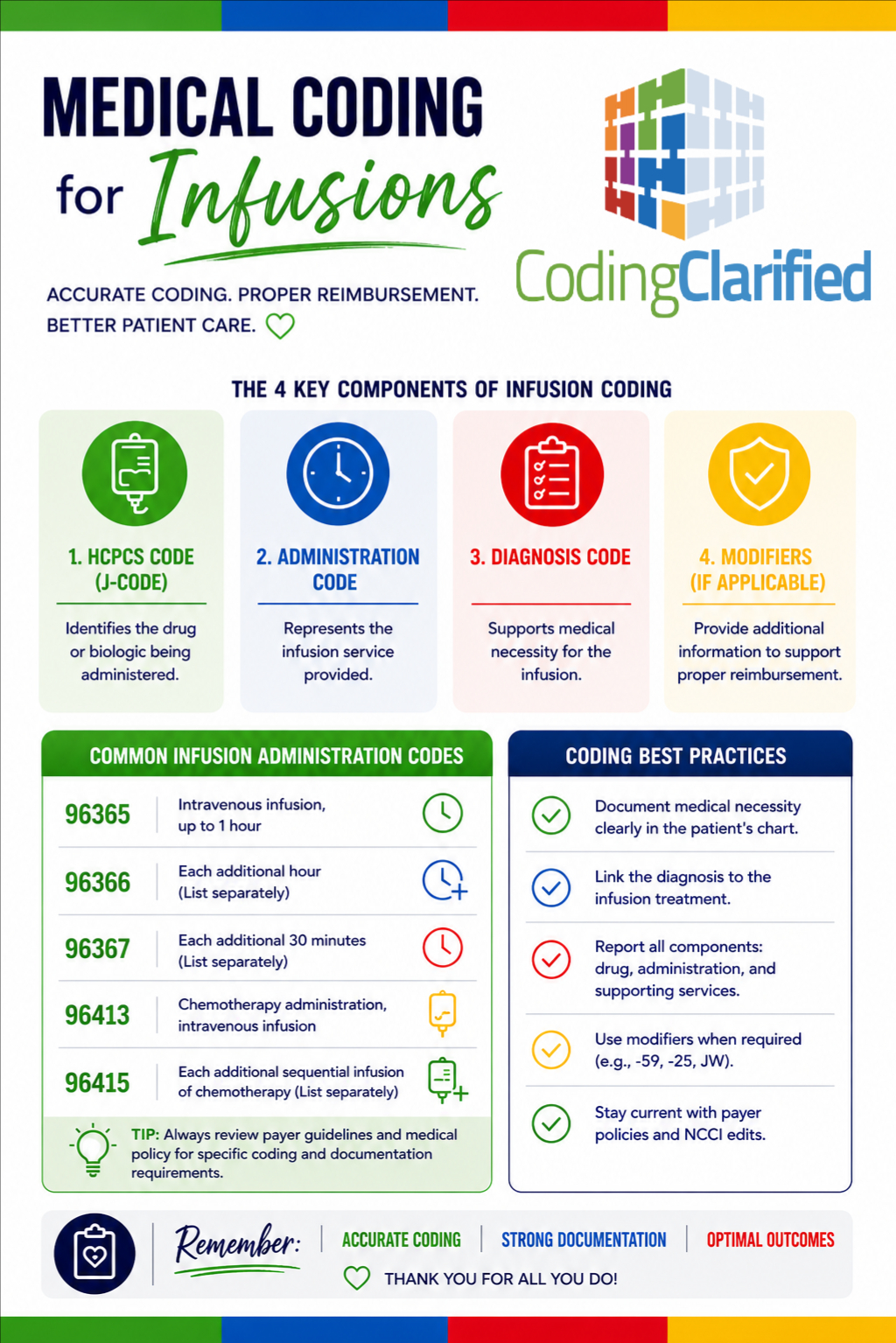
- CPT codes 96360–96379 are commonly used for hydration, therapeutic, prophylactic, diagnostic, and chemotherapy infusion administration.
- HCPCS Level II J-codes are required to report the drugs and biologics administered during infusion therapy.
- Accurate start and stop time documentation is essential for compliant billing.
- Coders must understand hierarchy rules for infusion, injection, hydration, and chemotherapy administration.
- Medicare and commercial payer policies continue to evolve in 2026, making ongoing education critical.
- Proper documentation helps prevent denials, underpayments, and audit risk.
Medical Coding and Billing Guidelines for Infusion Services in 2026
Infusion therapy remains one of the most frequently performed outpatient services across hospitals, physician offices, infusion centers, and specialty clinics. Consequently, accurate medical coding and billing for infusion services are essential for compliance, reimbursement, and revenue cycle success.
Because infusion services often involve expensive medications, biologics, chemotherapy agents, and hydration therapies, coding errors can quickly lead to claim denials, lost revenue, and audit exposure. Therefore, medical coders must understand not only CPT® infusion administration codes but also HCPCS drug codes, documentation requirements, National Correct Coding Initiative (NCCI) edits, and payer-specific billing rules.
This comprehensive 2026 guide explains everything medical coders, billers, CPC students, and healthcare providers need to know about coding and billing infusion services correctly.
What Are Infusion Services?
Infusion therapy involves administering medications, fluids, blood products, biologics, or nutrients directly into a patient’s body over a specified period of time.
Most commonly, infusion therapy occurs through intravenous (IV) administration. However, certain therapies may be delivered through other routes depending on the treatment plan.
Common infusion categories include:
- Hydration infusions
- Therapeutic infusions
- Prophylactic infusions
- Diagnostic infusions
- Chemotherapy infusions
- Immunotherapy infusions
- Biologic infusions
- Blood and blood product transfusions
Because each category has different coding requirements, identifying the purpose of the infusion is the first step in selecting the correct CPT code.
Types of Infusion Services
Intravenous (IV) Infusions
IV infusions deliver medications or fluids directly into a vein over a period of time.
Examples include:
- Antibiotic therapy
- Biologic treatments
- Chemotherapy
- Hydration therapy
- Iron infusions
- Immunoglobulin infusions
Subcutaneous Infusions
Subcutaneous infusions deliver medications beneath the skin for slower absorption.
Examples include:
- Insulin therapies
- Specialty biologics
- Pain management medications
Blood and Blood Product Transfusions
Blood transfusions require separate administration codes and often involve additional documentation requirements.
Examples include:
- Packed red blood cells
- Platelets
- Plasma
- Cryoprecipitate
CPT Codes for Infusion Administration
The CPT infusion administration section ranges primarily from 96360 through 96379.
Hydration Infusion Codes
| CPT Code | Description |
|---|---|
| 96360 | Initial hydration infusion, 31 minutes to 1 hour |
| 96361 | Each additional hour |
Important: Hydration services lasting 30 minutes or less generally are not separately reportable.
Therapeutic, Prophylactic, or Diagnostic Infusion Codes
| CPT Code | Description |
| 96365 | Initial infusion, up to 1 hour |
| 96366 | Each additional hour |
| 96367 | Additional sequential infusion |
| 96368 | Concurrent infusion |
These codes are frequently used for:
- Antibiotics
- Iron infusions
- Steroid infusions
- Specialty medications
Injection Codes
| CPT Code | Description |
| 96372 | Therapeutic injection, subcutaneous or intramuscular |
| 96374 | Initial intravenous push |
| 96375 | Additional IV push of new substance |
| 96376 | Additional IV push of same substance |
Chemotherapy and Highly Complex Drug Administration Codes
Chemotherapy administration follows a separate coding hierarchy because of the increased physician work and monitoring requirements.
Common chemotherapy administration codes include:
| CPT Code | Description |
| 96413 | Chemotherapy infusion, initial hour |
| 96415 | Each additional hour |
| 96417 | Sequential chemotherapy infusion |
| 96409 | Chemotherapy IV push |
Importantly, chemotherapy administration takes precedence over therapeutic and hydration services when determining the initial service hierarchy.
HCPCS Coding for Infused Drugs
Infusion administration CPT codes report the professional service of administering the drug.
However, coders must also report the medication itself using HCPCS Level II codes.
Common examples include:
| HCPCS Code | Drug |
| J0881 | Epoetin alfa |
| J1756 | Iron sucrose |
| J1745 | Infliximab |
| J9312 | Rituximab |
For additional HCPCS drug coding guidance, see our related article:
Because many infused medications cost thousands of dollars per dose, selecting the correct HCPCS code and units is critical for reimbursement.
Understanding the Infusion Hierarchy Rules
One of the most commonly tested CPC exam topics is infusion hierarchy.
When multiple services occur during the same encounter, CPT requires coders to determine the primary service based on hierarchy rather than chronology.
The hierarchy generally follows:
- Chemotherapy Services
- Therapeutic, Diagnostic, and Prophylactic Infusions
- Hydration Services
For example, if a patient receives chemotherapy and hydration during the same encounter, chemotherapy becomes the initial service even if hydration began first.
Therefore, coders should never assume the first service performed is automatically the initial CPT code.
Documentation Requirements for Infusion Coding
Proper documentation remains the foundation of compliant infusion billing.
Providers should document:
- Medical necessity
- Diagnosis supporting treatment
- Drug name
- Drug dosage
- Route of administration
- Start time
- Stop time
- Total infusion time
- Complications or adverse reactions
- Supervising provider
Furthermore, incomplete time documentation remains one of the leading causes of infusion claim denials.
Without documented start and stop times, many infusion administration services cannot be reported accurately.
Common Mistakes to Avoid When Coding Infusions
Failing to Document Start and Stop Times
Without complete time documentation, coders may be unable to bill additional hours appropriately.
Reporting Hydration When Medical Necessity Is Not Documented
Hydration services require medical necessity documentation and are not automatically billable simply because fluids were administered.
Incorrectly Reporting Sequential vs Concurrent Infusions
Many denials occur because coders misunderstand the difference between sequential and concurrent administration.
Incorrect HCPCS Units
Drug reimbursement often depends on correct HCPCS unit reporting. Even small errors can result in significant payment discrepancies.
Ignoring Infusion Hierarchy Rules
Selecting the wrong initial service remains one of the most common infusion coding errors identified during audits.
CPC Student Exam Tips for Infusion Coding
If you are preparing for the CPC exam, focus heavily on:
- Infusion hierarchy rules
- Sequential versus concurrent infusions
- Hydration coding guidelines
- Initial versus additional hour reporting
- Chemotherapy administration coding
- Drug administration CPT code selection
- Modifier usage
- Time-based coding requirements
A useful exam strategy is to create a quick hierarchy chart inside your CPT manual for easy reference during testing.
Additionally, practice identifying the initial service from multiple coding scenarios.
2026 Infusion Coding Updates and Trends
In 2026, healthcare organizations continue to experience increased utilization of:
- Biologic therapies
- Specialty pharmacy services
- Immunotherapy treatments
- Home infusion services
- Remote monitoring associated with infusion care
As a result, payer scrutiny surrounding documentation and drug administration reporting continues to increase.
Consequently, coders should regularly review guidance from CMS and professional coding organizations.
Authoritative Resources:
CMS Infusion Billing Guidance:
AAPC CPT Coding for Drug Administration
Related Coding Clarified Articles
Continue your infusion coding education with:
HCPCS Coding for Drugs
CT Scan CPT Coding Guide
Guidelines for Coding and Billing Diabetes in 2026
Frequently Asked Questions About Infusion Coding
What CPT codes are used for infusion administration?
The most commonly reported infusion administration codes include CPT 96360, 96361, 96365, 96366, 96367, 96368, and chemotherapy administration codes beginning with 964xx.
What is the difference between hydration and therapeutic infusion coding?
Hydration infusions involve fluid replacement, while therapeutic infusions involve administering medications, biologics, antibiotics, or other treatments.
Can hydration and drug infusion be billed together?
Yes. However, coders must apply CPT hierarchy rules and determine which service qualifies as the initial service.
Are start and stop times required for infusion billing?
Yes. Accurate start and stop times are essential because infusion administration codes are time-based services.
What HCPCS codes are used for infusion drugs?
Most infused medications are reported using HCPCS Level II J-codes, although some outpatient facility settings may use C-codes.
What is the infusion hierarchy?
The infusion hierarchy prioritizes chemotherapy services first, therapeutic/prophylactic/diagnostic services second, and hydration services third.
What modifiers are commonly used with infusion services?
Modifier 25 and Modifier 59 are commonly reported when documentation supports separately identifiable services.
What is the biggest infusion coding mistake?
The most common error is selecting the wrong initial service due to misunderstanding CPT hierarchy rules.
Coding Clarified Final Thoughts
Accurate infusion coding requires far more than selecting a CPT code. Coders must understand administration hierarchy, drug reporting requirements, documentation standards, payer policies, and medical necessity guidelines. By following current CPT, HCPCS, and CMS guidance, healthcare organizations can improve compliance, reduce denials, and optimize reimbursement for infusion therapy services in 2026.