
Medical Coding and Billing for Menopause in 2027 (FY2027): ICD-10-CM, CPT®, HRT Documentation, and Reimbursement Guidelines
Author: Janine Mothershed CPC, CPC-I
Quick answer: Symptomatic menopause, including menopausal hot flashes, is coded to N95.1 (menopausal and female climacteric states), with additional codes for associated symptoms. Use Z78.0 for asymptomatic menopause, E89.41 for symptomatic surgical menopause, and Z79.890 for hormone replacement therapy.
FY2027 update: This guide reflects the FY2027 ICD-10-CM code set, effective October 1, 2026. Codes N95.0 through N95.9, Z78.0 and Z79.890 did not change for FY2027.
New to medical coding? See how our CPC Training gets you certified.
Menopause affects millions of women annually and remains one of the most frequently discussed topics in women’s healthcare. As women live longer and remain active well beyond their reproductive years, healthcare providers are increasingly managing menopausal symptoms and related conditions. Consequently, accurate medical coding and billing have become more important than ever. Today, providers commonly evaluate concerns such as hot flashes, night sweats, insomnia, vaginal dryness, mood changes, and osteoporosis risk. Furthermore, many patients seek guidance regarding hormone replacement therapy (HRT), preventive screenings, and long-term symptom management. Because of these factors, coders must understand how to accurately assign ICD-10-CM diagnosis codes, CPT® procedure codes, and supporting documentation. Additionally, payers continue to emphasize medical necessity and coding accuracy, making proper diagnosis-to-procedure linkage essential. Therefore, this guide reviews current FY2027 coding guidelines, billing considerations, documentation requirements, common coding mistakes, and CPC exam tips related to menopause care.
For FY2027, coders must understand the distinction between asymptomatic menopause, symptomatic menopausal disorders, preventive services, and problem-oriented visits. Furthermore, proper documentation and diagnosis linkage are critical to avoid denials and support medical necessity.
Whether you are a medical coder, biller, provider, or CPC student, this guide explains the ICD-10-CM diagnosis codes, CPT® procedure codes, documentation requirements, billing considerations, and common coding mistakes associated with menopause-related services.
Key Takeaways
- Menopause is coded primarily using ICD-10-CM category N95 when symptoms are present.
- Use Z78.0 only for asymptomatic menopausal status.
- Long-term hormone replacement therapy is reported with Z79.890 when applicable.
- Office visits are typically reported using CPT® 99202-99215.
- Preventive services may be reported using CPT® 99381-99397 when appropriate.
- Bone density screening frequently involves CPT® 77080.
- Documentation must clearly identify menopausal status, symptoms, treatment plans, and counseling provided.
- Modifier -25 may be appropriate when a significant separately identifiable E/M service is performed during a preventive visit.
What Is Menopause?
Menopause is the permanent cessation of menstruation resulting from the loss of ovarian follicular activity. Typically, it occurs between ages 45 and 55; however, menopause may occur naturally or surgically following oophorectomy.
From a coding perspective, menopause itself is not always considered a disease process. Instead, coding depends largely upon whether the patient is experiencing symptoms, receiving treatment, or undergoing preventive screening.
Common menopause-related symptoms include:
- Hot flashes
- Night sweats
- Insomnia
- Mood changes
- Vaginal dryness
- Dyspareunia
- Fatigue
- Decreased libido
- Cognitive complaints
- Osteoporosis risk
Consequently, coders must review documentation carefully to determine whether a symptom-based diagnosis or a status code is appropriate.
What ICD-10-CM codes are used for menopause?
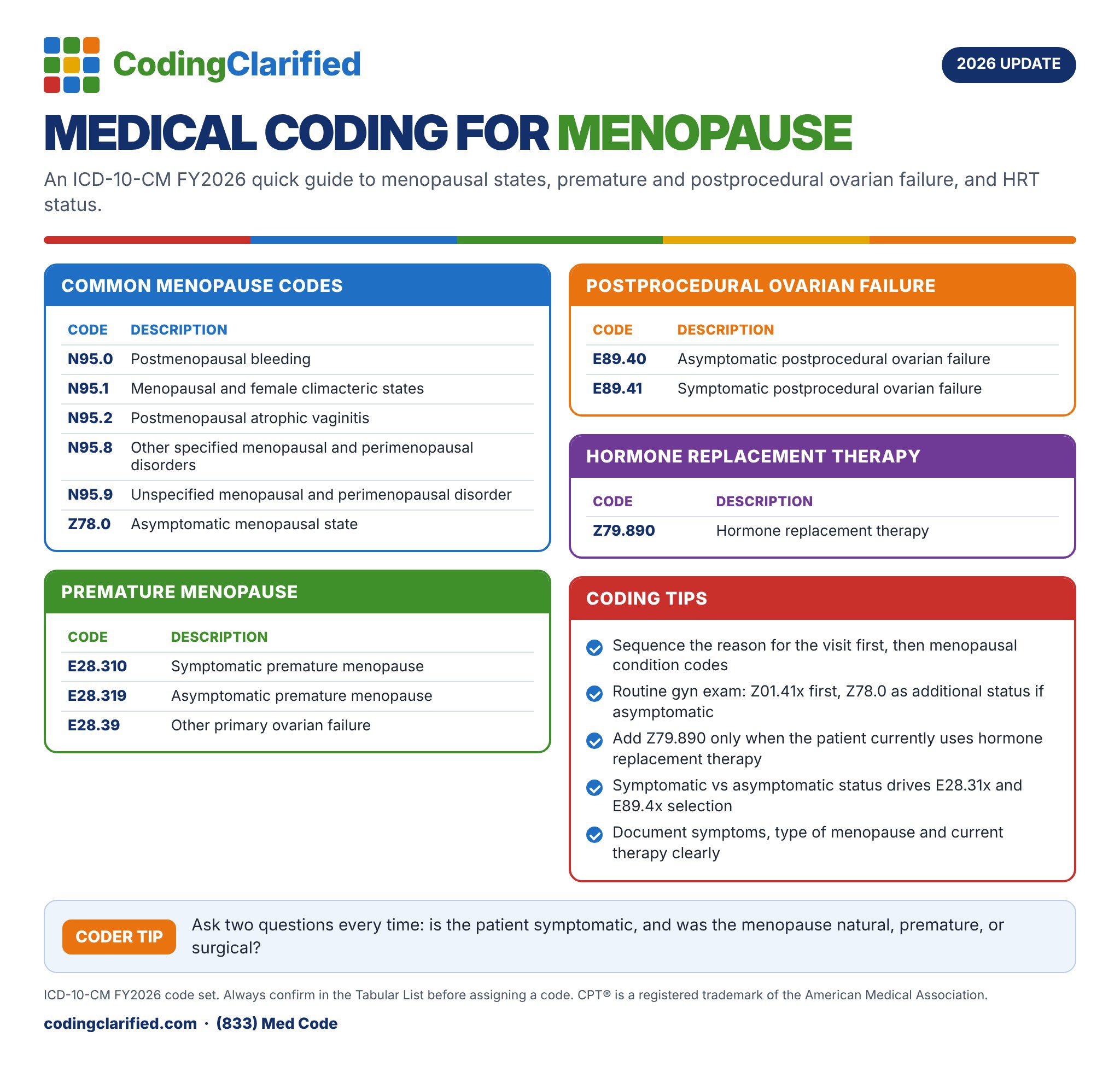
Most menopause-related diagnoses are found within ICD-10-CM category N95.
Common Menopause Diagnosis Codes
| ICD-10-CM Code | Description |
|---|---|
| N95.0 | Postmenopausal bleeding |
| N95.1 | Menopausal and female climacteric states |
| N95.2 | Postmenopausal atrophic vaginitis |
| N95.8 | Other specified menopausal and perimenopausal disorders |
| N95.9 | Unspecified menopausal and perimenopausal disorder |
| Z78.0 | Asymptomatic menopausal state |
| Z79.890 | Hormone replacement therapy |
When to Use Z78.0
Use Z78.0 when documentation states the patient is menopausal but does not have symptoms requiring evaluation or treatment.
Examples include:
- Routine wellness examinations
- Preventive screenings
- Historical documentation of menopause
However, once symptoms are documented, a more specific N95 diagnosis should generally be assigned.
How do you code surgical or premature menopause?
Menopause caused by surgery or radiation, such as a bilateral oophorectomy, is not coded to N95.1. Report it from category E89.4-:
- E89.41 – Symptomatic postprocedural ovarian failure (surgical menopause with symptoms such as hot flashes or sleeplessness)
- E89.40 – Asymptomatic postprocedural ovarian failure
Symptoms of premature menopause are reported with E28.310 (symptomatic premature menopause).
Coding rule: N95.1 carries an Excludes1 note for E89.41, E28.310 and Z78.0. Never report N95.1 together with any of those codes. Choose the one code that matches the documented cause of menopause.
How do you code menopausal symptoms like hot flashes?
Many providers document specific symptoms associated with menopause. Therefore, coders should determine whether the symptom itself, the menopausal condition, or both should be reported.
Examples include:
| Condition | ICD-10-CM Code |
|---|---|
| Hot flashes associated with menopause | N95.1 |
| Postmenopausal bleeding | N95.0 |
| Vaginal atrophy | N95.2 |
| Insomnia due to menopause | N95.1 plus additional symptom code when supported |
| Hormone replacement therapy management | Z79.890 with underlying menopausal diagnosis |
Always follow ICD-10-CM Official Guidelines and payer-specific reporting requirements.
What CPT codes are used for menopause visits?
Generally, most menopause-related encounters are reported using office and outpatient E/M services. However, the appropriate code selection depends upon the complexity of medical decision-making or total provider time. Therefore, documentation must clearly support the level of service reported. Additionally, coders should verify that all diagnoses are properly linked to the services performed.
Office Visit CPT® Codes
| CPT® Code Range | Description |
|---|---|
| 99202-99205 | New patient office visits |
| 99211-99215 | Established patient office visits |
E/M code selection remains based on:
- Medical decision making (MDM)
- Total provider time on the date of service
Therefore, documentation must support whichever method is used.
Example
A patient presents with severe hot flashes, insomnia, and vaginal dryness. The physician reviews treatment options, discusses HRT risks, orders laboratory testing, and develops a treatment plan.
Appropriate reporting may include:
- 99214
- N95.1
assuming documentation supports moderate MDM.
For a complete E/M review, see:
Evaluation and Management (E/M) Guidelines for 2026: The Complete Guide
How are preventive visits coded for menopausal patients?
Many menopausal patients present for annual wellness examinations.
Preventive Medicine CPT® Codes
| CPT® Code | Description |
|---|---|
| 99381-99387 | New patient preventive visits |
| 99391-99397 | Established patient preventive visits |
If significant menopause symptoms are evaluated separately during the preventive visit, an additional E/M service may be reported with modifier -25 when supported by documentation.
Example
Annual wellness exam plus:
- Evaluation of severe hot flashes
- HRT counseling
- Medication management
Possible coding:
- 99396
- 99213-25
- N95.1
Documentation must clearly separate preventive services from problem-oriented care.
How do you code hormone replacement therapy (HRT)?
Among available treatment options, hormone replacement therapy (HRT) remains one of the most commonly prescribed interventions for menopausal symptoms. However, providers must carefully evaluate patient-specific risks and benefits before initiating treatment. Additionally, ongoing monitoring is often necessary. Therefore, documentation should clearly reflect the medical necessity of therapy as well as the patient’s response to treatment.
When managing HRT, documentation should include:
- Symptoms being treated
- Risks discussed
- Benefits reviewed
- Alternative treatments considered
- Medication adjustments
- Follow-up recommendations
Common Diagnosis Coding
- N95.1 – Menopausal and female climacteric states
- Z79.890 – Hormone replacement therapy
Additionally, office visit levels may be selected by total time on the date of the encounter when the provider spends significant time counseling or coordinating care. Counseling does not need to dominate the visit; total time is counted whether or not counseling is involved.
What tests are commonly ordered for menopause?
Several diagnostic services are commonly ordered during menopause evaluations.
Frequently Reported CPT® Codes
| CPT® Code | Description |
|---|---|
| 77080 | DXA bone density study |
| 84443 | Thyroid stimulating hormone (TSH) |
| 81002 | Urinalysis, non-automated |
| 88141-88175 | Cervical cytology/Pap testing |
| 77067 | Screening mammography, bilateral |
| 77063 | Breast tomosynthesis screening add-on |
Providers often order these services when evaluating symptoms that may overlap with other conditions such as thyroid disease or osteoporosis.
How is osteoporosis screening coded after menopause?
One of the most important preventive measures during menopause involves osteoporosis screening.
Patients may qualify for:
- Bone mineral density testing
- Fracture risk assessment
- Preventive counseling
Common diagnosis codes may include:
- Z13.820 – Encounter for screening for osteoporosis
- Z78.0 – Asymptomatic menopausal state
Procedure code:
- 77080 – DXA scan
Because osteoporosis risk increases after menopause, documentation supporting screening necessity is particularly important.
What documentation supports menopause coding?
Accurate coding begins with complete documentation.
Providers should document:
Menopausal Status
- Natural menopause
- Surgical menopause
- Perimenopause
- Postmenopause
Symptoms
- Hot flashes
- Night sweats
- Vaginal dryness
- Mood disturbances
- Sleep difficulties
Medical Decision Making
- Treatment options discussed
- Diagnostic testing ordered
- Medication management
- Risk assessment
Hormone Therapy Details
- Medication prescribed
- Dosage changes
- Counseling provided
- Follow-up plan
Strong documentation improves coding accuracy while reducing audit risk.
What are common menopause coding mistakes?
Even experienced coders make mistakes when reporting menopause-related services.
1. Reporting Z78.0 When Symptoms Exist
If symptoms are documented, use the appropriate N95 diagnosis rather than an asymptomatic status code.
2. Forgetting Z79.890
Patients receiving long-term hormone replacement therapy may require reporting of Z79.890.
3. Billing Preventive and Problem Visits Incorrectly
Preventive visits and E/M services must be separately identifiable when both are billed.
4. Missing Time-Based E/M Opportunities
Counseling-heavy visits may qualify for higher-level E/M services when properly documented.
5. Failing to Link Diagnoses Properly
Always connect procedures and services to the diagnosis supporting medical necessity.
CPC Student Tips for Menopause Coding
If you are preparing for the CPC exam, remember these high-yield concepts:
CPC Tip #1
Know the difference between:
- Z78.0 (asymptomatic)
- N95.1 (symptomatic menopause)
This distinction frequently appears in exam questions.
CPC Tip #2
Understand preventive medicine coding versus office E/M coding.
CPC Tip #3
Learn when modifier -25 is appropriate.
CPC Tip #4
Review long-term drug therapy coding, including Z79.890.
CPC Tip #5
Pay close attention to documentation supporting hormone replacement therapy management.
Current Coding Trends for Menopause Care
Healthcare organizations continue focusing on:
- Women’s health quality initiatives
- Osteoporosis prevention programs
- Appropriate hormone replacement therapy management
- Risk-adjusted documentation accuracy
- Expanded preventive care services
Additionally, payers continue scrutinizing medical necessity documentation, making accurate diagnosis selection more important than ever.
Frequently asked questions
What is the ICD-10 code for hot flashes due to menopause?
Menopausal hot flashes are coded to N95.1. The Alphabetic Index lists hot flashes, menopausal, under N95.1, and the code instructs you to use additional codes for associated symptoms.
When do you use Z78.0 instead of N95.1?
Use Z78.0 when the patient is menopausal without symptoms. Once menopausal symptoms are documented, report N95.1 instead. The two codes are never reported together.
What is the ICD-10 code for surgical menopause?
Symptomatic surgical menopause is reported with E89.41, symptomatic postprocedural ovarian failure. Asymptomatic surgical menopause is E89.40. Do not report N95.1 with E89.41.
What is the ICD-10 code for hormone replacement therapy?
Report Z79.890, hormone replacement therapy, along with the menopausal diagnosis being treated.
Did menopause codes change for 2027?
No. The N95 codes, Z78.0 and Z79.890 did not change in the FY2027 update effective October 1, 2026.
Additional Coding Clarified Resources
You may also find these Coding Clarified articles helpful:
- Evaluation and Management (E/M) Guidelines for 2026: The Complete Guide
- Medical Coding for Long-Term Drug Therapy in 2027: ICD-10-CM Z79 Codes, Documentation Guidelines, and CPC Exam Tips
- Medical Coding Deep Infiltrative Endometriosis (DIE)
- Coding Clarified Blog
- Coding Clarified Resource Library
Authoritative Resources
For the most current guidance, review:
- CDC Womens Health
- Healthcare .gov Preventive care benefits for women
- AAPC Codify CPT Codes Lookup
- FY2027 ICD-10-CM Guidelines PDF
- AAPC OBGYN Coding Alert
Frequently Asked Questions (FAQ)
What ICD-10 code is used for symptomatic menopause?
The most commonly reported diagnosis is N95.1 (Menopausal and female climacteric states) when symptoms such as hot flashes, mood changes, or night sweats are documented.
What ICD-10 code should be used for asymptomatic menopause?
Use Z78.0 (Asymptomatic menopausal state) when the patient is menopausal but has no symptoms requiring evaluation or treatment.
Can menopause counseling support a higher E/M level?
Yes. Providers may select office visit levels based on total time on the date of the encounter, which includes time spent counseling, when the total time is documented. Counseling does not need to make up more than half of the visit.
When should Z79.890 be reported?
Report Z79.890 when the patient is receiving long-term hormone replacement therapy and documentation supports ongoing treatment.
Can preventive visits and problem visits be billed together?
Yes. A preventive service and a separate E/M service may both be reported when documentation supports a significant, separately identifiable problem-oriented service. Modifier -25 is generally required on the E/M code.
What CPT® code is used for bone density screening?
The most common code is 77080 for a DXA bone density study.
What documentation is required for hormone replacement therapy management?
Documentation should include symptoms, treatment goals, risks discussed, benefits reviewed, medication management decisions, and follow-up recommendations.
Is menopause considered a disease for coding purposes?
Not necessarily. Menopause itself is a normal biological process. However, symptomatic menopausal conditions, complications, and treatments often require diagnosis coding and medical management.
Ready to code like this for a living?
Coding Clarified’s AAPC licensed CPC program takes you from beginner to certified, with an internship and a job board for graduates.
You may qualify for WIOA funding in 30+ states. Check your eligibility.