Understanding MRI Procedures for Accurate CPT Coding
Medical imaging plays a crucial role in diagnosing and treating various health conditions. Magnetic Resonance Imaging (MRI) is a common diagnostic tool that provides detailed images of internal organs and structures. However, translating these imaging procedures into accurate Current Procedural Terminology (CPT) codes can be complex. This article aims to demystify the process of CPT MRI Coding procedures, ensuring accurate reimbursement and compliance with healthcare regulations.
MRI CPT Codes Quick Reference
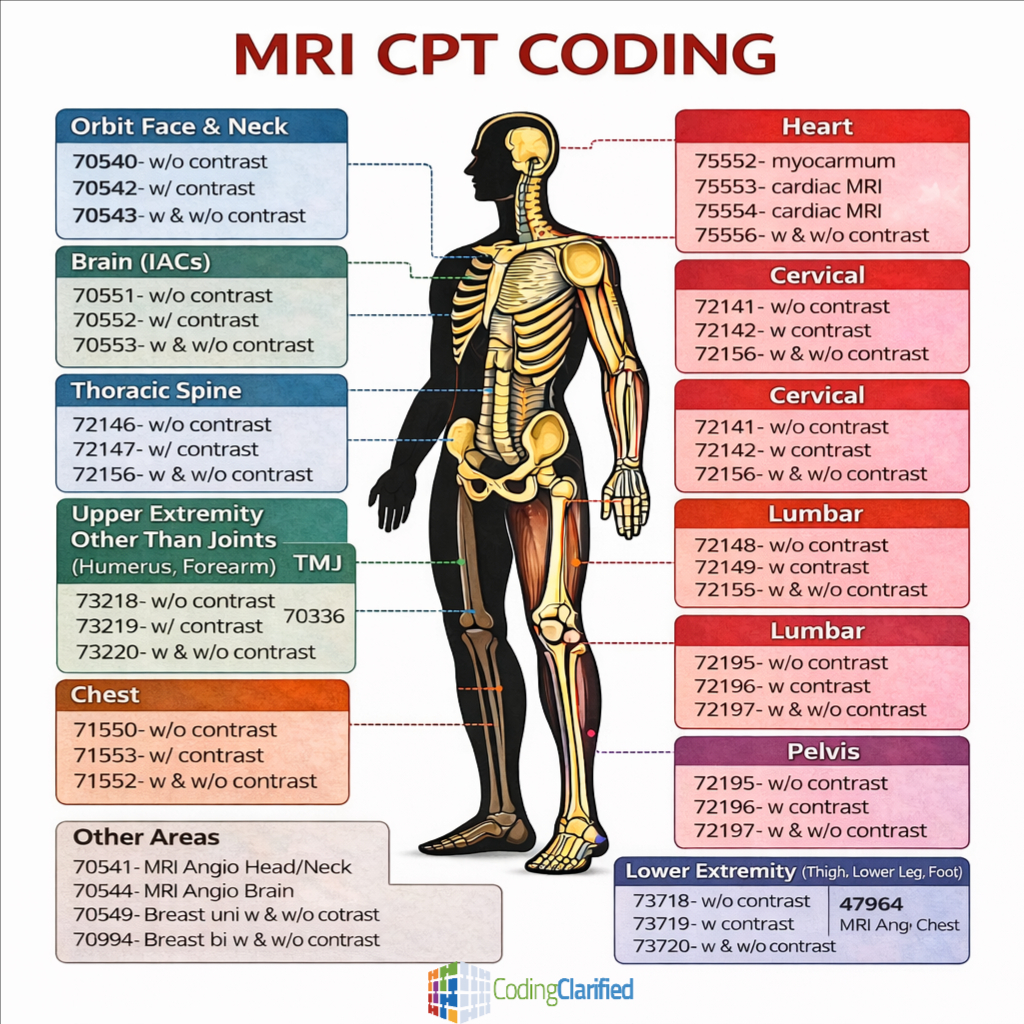
First, here is the short answer most coders need. MRI CPT codes are chosen by body area and by contrast: without contrast, with contrast, or without and then with contrast. For example, the CPT code for MRI brain without contrast is 70551, with contrast is 70552, and with and without contrast is 70553.
| Body area | Without contrast | With contrast | Without, then with contrast |
|---|---|---|---|
| Brain (head) | 70551 | 70552 | 70553 |
| Orbit, face, or neck | 70540 | 70542 | 70543 |
| Chest | 71550 | 71551 | 71552 |
| Cervical spine | 72141 | 72142 | 72156 |
| Thoracic spine | 72146 | 72147 | 72157 |
| Lumbar spine | 72148 | 72149 | 72158 |
| Pelvis | 72195 | 72196 | 72197 |
| Upper extremity, other than joint | 73218 | 73219 | 73220 |
| Upper extremity joint (shoulder, elbow, wrist) | 73221 | 73222 | 73223 |
| Lower extremity, other than joint (thigh, leg, foot) | 73718 | 73719 | 73720 |
| Lower extremity joint (hip, knee, ankle) | 73721 | 73722 | 73723 |
| Abdomen (liver, kidneys, pancreas) | 74181 | 74182 | 74183 |
In addition, MR elastography is reported with 76391, and an MRI with no specific code, such as a whole body MRI, is reported with unlisted code 76498. Also, add modifier RT or LT for extremity studies when the payer requires laterality. Finally, confirm each code in the current CPT code book before billing.
Understanding MRI Procedures
Before diving into CPT coding, it’s essential to grasp the basics of MRI procedures. MRI uses magnetic fields and radio waves to generate detailed images of the body’s internal structures. It is commonly used to diagnose conditions such as neurological disorders, musculoskeletal injuries, and tumors.
What are the Key Components of MRI Coding
Coding for MRI procedures involves several key components that influence the selection of CPT codes:
- Body Region: MRI procedures can target various body regions, including the brain, spine, joints, abdomen, and pelvis. The specific body region being imaged is crucial for selecting the appropriate CPT code.
- Contrast Administration: Some MRI studies require the administration of contrast agents to enhance image quality. Contrast-enhanced MRI procedures may have distinct CPT codes compared to non-contrast studies.
- Sequences and Views: MRI protocols often involve multiple sequences and views to capture different aspects of the anatomy. Each sequence may require separate coding, depending on the complexity of the study.
- Anatomical Details: CPT codes for MRI procedures may vary based on the anatomical details captured in the images. For example, different codes may apply to routine imaging versus specialized studies focusing on specific anatomical structures.
MRI CPT Coding Guidelines and Documentation
Accurate coding relies on thorough documentation of the MRI procedure. Healthcare providers should ensure that the medical record includes detailed information such as:
- Indication for the MRI study
- Body region imaged
- Use of contrast agents, if applicable
- Specific sequences and views performed
- Any additional findings or complications encountered during the procedure
Failure to document these details accurately can lead to coding errors and potential denials of reimbursement.
What are the Most Common CPT Codes for MRI Procedures?
Several CPT codes are commonly used for billing MRI procedures, including:
- 70551: MRI Brain without Contrast
- 72141: MRI Cervical Spine without Contrast
- 73221: MRI Upper Extremity Joint without Contrast
- 74181: MRI Abdomen without Contrast
- 76377: 3D Rendering with MRI
Healthcare providers should carefully review the descriptors and guidelines for each CPT code to ensure accurate coding and billing. Partnering with a specialized team that offers radiology billing services can further help practices improve claim accuracy, streamline revenue cycle workflows, and reduce denials.
Coding Challenges and Compliance
Coding for MRI procedures can present challenges due to the complexity of imaging protocols and evolving healthcare regulations. Healthcare providers must stay updated on coding changes and guidelines to maintain compliance and avoid billing errors.
Accurate CPT coding for MRI procedures is essential for ensuring appropriate reimbursement and compliance with healthcare regulations. By understanding the key components of MRI coding, healthcare providers can navigate the complexities of medical imaging and optimize revenue cycle management in clinical practice. Thorough documentation and adherence to coding guidelines are critical for achieving coding accuracy and mitigating compliance risks in medical imaging services.
MRI CPT Code FAQs
What is the CPT code for MRI brain with and without contrast?
The CPT code is 70553. However, report 70551 when no contrast is given and 70552 when the study is done with contrast only.
What is the CPT code for MRI of the foot and ankle?
The foot is reported with 73718, because it is a lower extremity area other than a joint. However, the ankle is a joint and is reported with 73721. Both codes are for studies without contrast. Also, add RT or LT for the side, and check payer bundling edits when both are imaged in one session.
What is the CPT code for MRI of the shoulder or knee?
A shoulder MRI without contrast is 73221, the upper extremity joint code. Similarly, a knee MRI without contrast is 73721, the lower extremity joint code. In addition, add LT or RT to show the left or right side.
What is the CPT code for MRI of the lumbar or cervical spine?
Lumbar spine MRI without contrast is 72148. Similarly, cervical spine MRI without contrast is 72141, and with and without contrast is 72156. For a thoracolumbar study, report the thoracic and lumbar codes separately when both regions are documented.
What is the CPT code for MRI of the sacrum?
MRI of the sacrum is usually reported with the pelvis MRI codes, 72195 to 72197, based on contrast.
Does an open MRI have a different CPT code?
No. The type of MRI machine does not change the code. Therefore, an open MRI is reported with the same CPT code as a closed MRI of the same body area.
Expand Your Coding Knowledge with More Resources
As you embark on mastering MRI CPT coding, remember that continuous learning and adherence to coding guidelines are essential. For more insights and resources on medical coding, explore the following articles:
- CPT Allergy Coding
- A Comprehensive Guide to the Certified Professional Coding Exam
- How to Pass the AAPC CPC Exam
- The Importance of Formal Instruction in Medical Coding
- Everything You Need to Know About the CPC Exam
- How to Get a Medical Coding Internship
For those interested in advancing their skills further, consider joining our Medical Coding Certification Program at Coding Clarified. This comprehensive training program is designed to equip you with the knowledge and skills needed to excel in the field of medical coding.
Enhance your expertise and advance your career by enrolling in our Medical Coding Program today!