
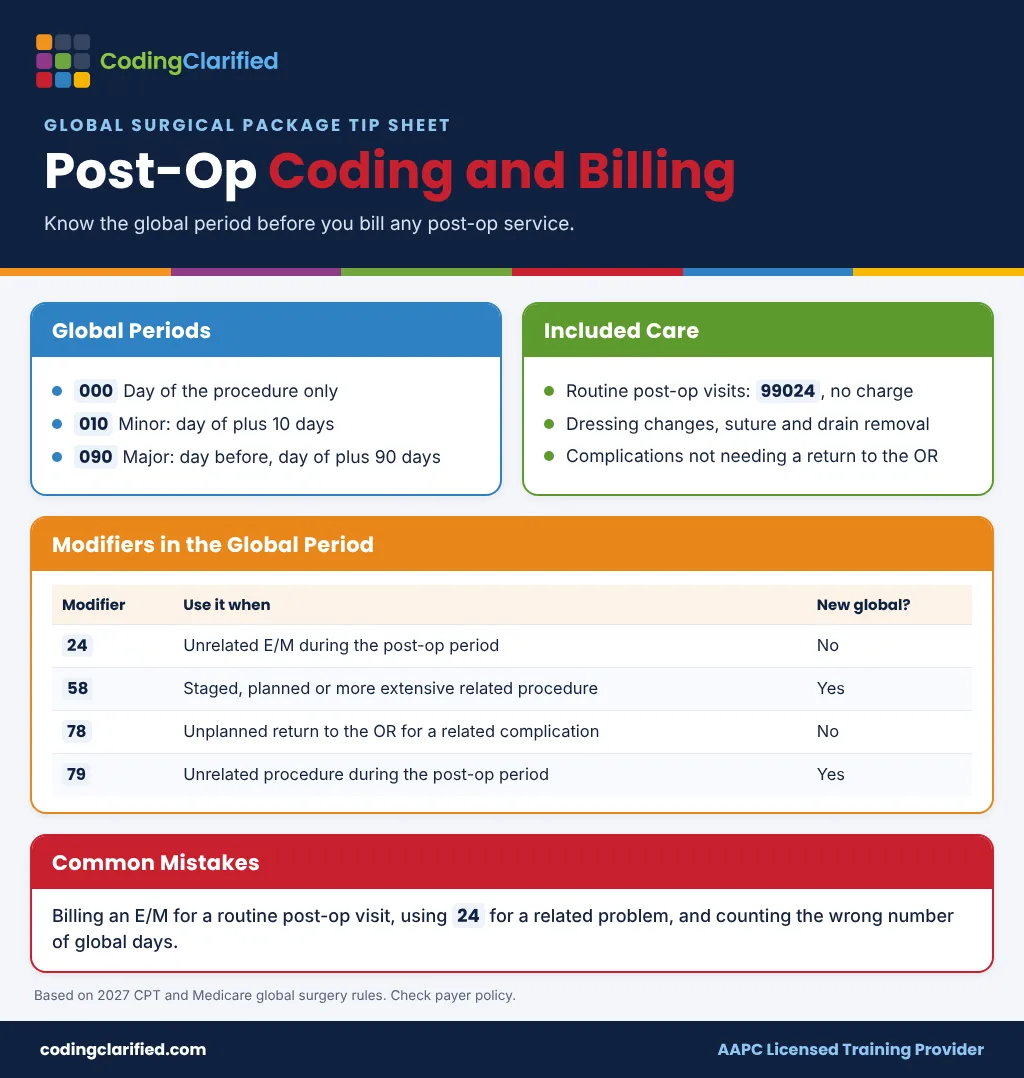
Post-Op Coding and Billing Guidelines: A Comprehensive Guide
In medical coding and billing, post-operative care and services are integral to the financial accuracy of the healthcare system. Proper medical coding for post-op procedures helps providers receive appropriate reimbursement for their care. It also helps them meet compliance standards.
Post-operative coding covers the care a patient receives after a surgical procedure. This includes follow-up visits, complications, and any other services related to the surgery. This blog provides a comprehensive overview of the post-op coding and billing guidelines.
Overview of Post-Operative Care in Medical Coding
Post-operative care encompasses a range of services provided after surgery, such as follow-up visits, management of complications, and wound care. This care can span from a few days to several weeks. The length depends on the complexity of the surgery and the patient’s recovery.
In medical coding, post-operative care falls into two primary categories:
- Routine postoperative care: This includes standard follow-up visits, wound checks, and any necessary bandage changes.
- Unanticipated post-operative care: This involves unexpected complications, such as infections, post-surgical hemorrhages, or complications requiring additional procedures or interventions.
Important CPT Codes for Post-Operative Care
The CPT (Current Procedural Terminology) coding system is essential for billing purposes. It’s important to differentiate between codes for pre-operative, intra-operative, and post-operative care. Here are some key guidelines for post-operative coding:
Global Surgical Package
Providers bill most surgeries under the global surgical package. For Medicare, this package includes related services from the day before a major surgery (or the day of a minor surgery) through the end of the global period. The global surgical package encompasses:
- Pre-operative visits (evaluation and management services on the day before or the day of the surgery, after the decision for surgery)
- Intra-operative services (the surgery itself)
- Post-operative visits (routine follow-up care during the global period)
The global package for surgery typically falls into these types:
- Minor surgeries and endoscopies: Surgeries with a 0-day or 10-day global period.
- Major surgeries: Surgeries with a 90-day global period.
As a result, payers do not separately reimburse post-operative visits or care within the specified global period. Instead, the surgical fee includes them.
CPT Codes for Post-Op Care
Here are some examples of CPT codes related to postoperative care:
- 99212-99215: Evaluation and management (E/M) codes. Use them in the global period only for visits unrelated to the surgery (with modifier 24), not for routine post-operative visits.
- 99024: Post-operative visit code that reports the routine follow-up visit provided within the global surgical package. It indicates that the provider performed a post-operative visit that has no separate reimbursement.
Return to the OR for Complications (Modifier 78)
Sometimes a patient has a complication related to the surgery and must return to the operating room during the global period. In that case, report the CPT code for the procedure performed with modifier 78. Examples include drainage of a wound, control of bleeding, or reoperation. Use an unlisted code only when no CPT code describes the procedure.
Billing Guidelines for Post-Operative Care
For post-operative care and billing, follow these guidelines to ensure proper reimbursement:
Services Within the Global Period
Do not bill post-operative services within the global period (10 days for minor surgeries or 90 days for major surgeries) separately unless:
- The care involves a related complication that requires a return to the operating room (modifier 78).
- The patient requires a visit unrelated to the surgery, such as a condition outside the post-op recovery.
- The procedure is unrelated to the original surgery (modifier 79), or it was planned or staged (modifier 58).
Report routine post-op visits within the global period with 99024, at no charge. Note that Medicare includes complications that do not require a return to the operating room in the global package.
You may also find our article on coding pre-op visits helpful.
Medical Coding and Billing and the Global Period Medical Coding and Billing and the Global Period
Separate Billing for Unanticipated Complications
If the patient has a complication related to the original surgery that requires a return to the operating room, report the procedure code with modifier 78. These scenarios include:
- Post-surgical infections: If an infection requires a return to the operating room, such as incision and drainage, report that procedure with modifier 78. For Medicare, office treatment of the infection stays in the global package.
- Additional surgical procedures: If complications require another procedure in the operating room, such as wound debridement or revision surgery, report those procedures with modifier 78.
ICD-10 Codes should specify the nature of the complication or reason for the follow-up procedure.
Modifier 24 – Unrelated E/M Services
Use modifier 24 when a patient needs a visit for an issue unrelated to the surgery during the post-operative global period. For example, a patient may have a follow-up visit for a routine illness unrelated to the surgery. In that case, apply modifier 24 to the E/M code.
- Example: A patient has undergone an appendectomy. During the post-op period, the patient returns to the clinic for treatment of a cold. The provider should bill the E/M service with the appropriate CPT code (e.g., 99212). Then append modifier 24 to show that the visit is unrelated to the surgery.
Modifier 58 – Staged or Planned Procedure
Use modifier 58 if the provider planned or staged the post-operative procedure as part of the surgical treatment. In other words, the provider performs a subsequent procedure during the postoperative period that the treatment plan expected.
- Example: A patient undergoes a two-stage breast reconstruction following a mastectomy. The provider plans and performs the second stage within the global period. Therefore, append modifier 58 to the second-stage surgery code.
CPT Modifiers CPT Medical Modifiers
Common Mistakes to Avoid in Post-Op Billing
Accurate post-operative billing is crucial for compliance and proper reimbursement. Common mistakes include:
- Misuse of Global Period: Payers do not separately reimburse routine post-op services in the global period. Report them with 99024 instead.
- Inappropriate Modifier Use: Apply modifiers like 24, 25, 58, 78, and 79 correctly to show whether the post-operative service is related, unrelated, or staged.
- Incorrect Coding for Complications: When complications occur, the provider needs correct documentation and coding to receive payment for extra care.
- Failing to Document Complications: Providers should document any post-surgical complications in detail to justify additional treatment codes.
Post-operative coding and billing can be complex. However, providers who follow the correct guidelines and use the appropriate modifiers and codes can ensure accurate reimbursement. Successful post-op billing depends on several essential elements. These include understanding the global surgical package and using E/M codes properly. They also include modifiers for unrelated or staged procedures and clear documentation of complications. By adhering to these guidelines, healthcare providers can avoid denials, reduce audit risks, and maintain financial health.
Always stay updated with the latest coding and billing updates, as healthcare regulations and reimbursement guidelines are subject to change.
E/M Links: