
Different Types of Payers in Medical Coding
In medical coding and billing, a payer is the organization or entity responsible for paying healthcare claims. Understanding the different types of payers helps medical coders assign the correct codes, follow the right billing rules, and reduce claim denials.
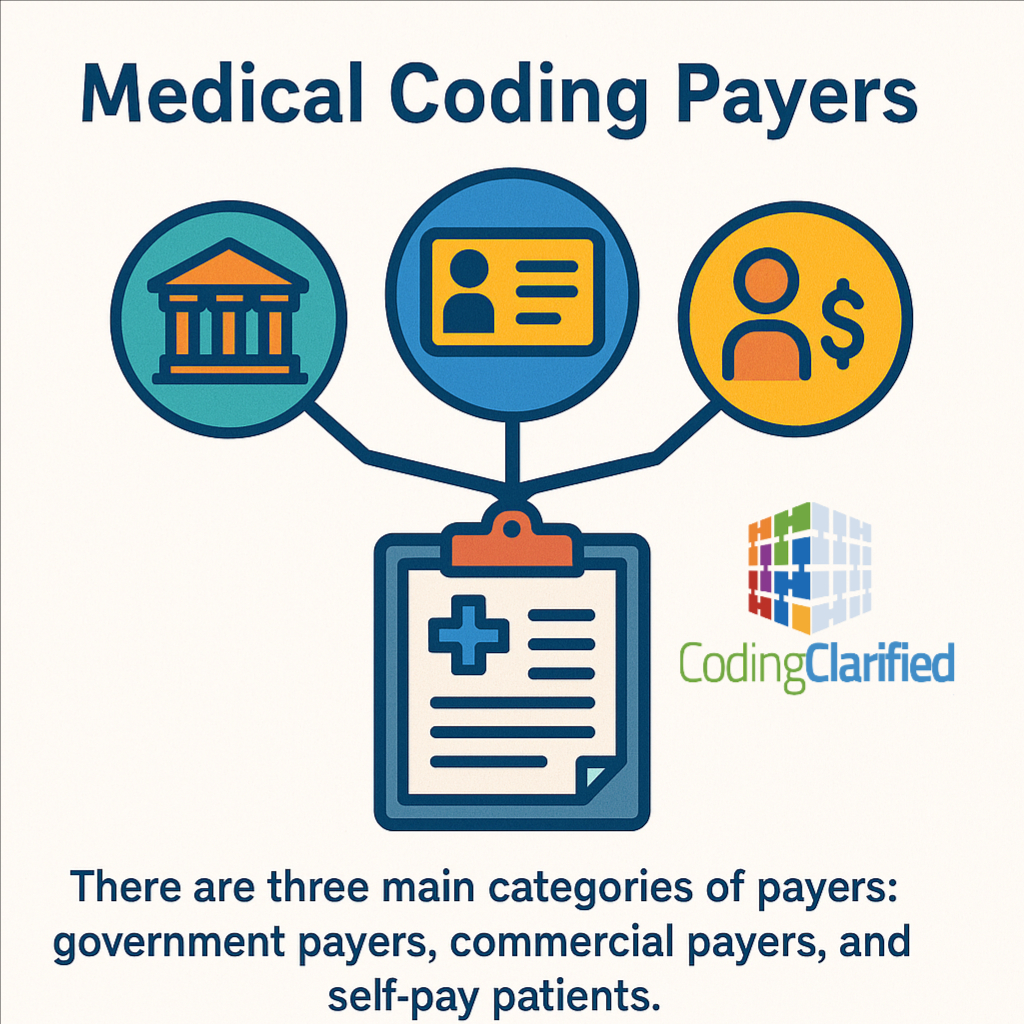
There are three main categories of payers: government payers, commercial payers, and self-pay patients.
Government Payers
Government payers are funded and managed by the federal or state governments. These programs have strict coding and documentation rules and are heavily regulated.
Medicare
Medicare is a federal health insurance program primarily for people age 65 and older, as well as certain younger people with disabilities or end-stage renal disease. Medicare is divided into:
-
Part A – Hospital insurance (inpatient hospital stays, skilled nursing, hospice)
-
Part B – Medical insurance (physician services, outpatient care, preventive services)
-
Part C – Medicare Advantage plans (offered by private insurance companies but governed by Medicare rules)
-
Part D – Prescription drug coverage
Medicaid
Medicaid is a joint federal and state program that provides health coverage to low-income individuals and families. Each state manages its own Medicaid program, so coverage rules, eligibility, and coding requirements can vary by state.
TRICARE
TRICARE provides healthcare coverage for active-duty military members, retirees, and their families.
VA (Veterans Affairs)
The VA healthcare system serves eligible veterans and often uses its own internal billing and documentation rules.
Medical Coding and Billing for Medicare
Commercial (Private) Payers
Commercial payers are private health insurance companies. These plans are typically offered through employers or purchased individually.
Employer-sponsored plans
These are group health plans provided as part of employee benefits packages.
Individual and family plans
These are policies purchased directly from insurance companies or through healthcare marketplaces.
Popular commercial insurance carriers include:
-
Blue Cross Blue Shield
-
Aetna
-
Cigna
-
UnitedHealthcare
-
Humana
Commercial payers follow general coding guidelines but often have their own policies for pre-authorizations, medical necessity, and claim submission.
Self-Pay and Uninsured Patients
Some patients do not have health insurance coverage. These patients are considered self-pay.
Self-pay includes:
-
Patients who are uninsured
-
Patients who choose not to use their insurance
-
Services not covered by their insurance
In these cases, the patient is financially responsible for the entire bill.
Workers’ Compensation
Workers’ compensation is a special type of payer that covers medical services for work-related injuries and illnesses. These claims follow separate rules and often require detailed documentation that connects the injury directly to the workplace.
Liability and No-Fault Insurance
These payers are associated with accidents and injuries.
Liability insurance
Covers injuries or damages when another party is at fault, such as car accidents or personal injury cases.
No-fault insurance
Used in certain states for auto accidents, where each person’s insurance covers their own medical expenses regardless of fault.
Why Payer Types Matter in Medical Coding
Understanding payer types is essential because each payer may have:
-
Different coverage rules
-
Specific documentation requirements
-
Unique billing and claim submission processes
-
Different reimbursement rates
Accurate coding helps ensure clean claims, faster payments, reduced denials, and legal compliance.
Knowing the different types of payers is a core skill for every medical coder. It allows coders to select the correct codes, apply proper guidelines, and support smooth claim processing across all healthcare settings.