
What is the Career Outlook for the future of medical coding
The future of medical coding—often under the broader umbrella of health information management—is bright. For those entering the profession, mid-career coders, and educators alike, the year 2026 and the years beyond offer strong opportunities. Below is a breakdown of why the demand remains solid, how the role is evolving (especially with AI), and what aspiring coders must do to succeed.
Strong Career Outlook
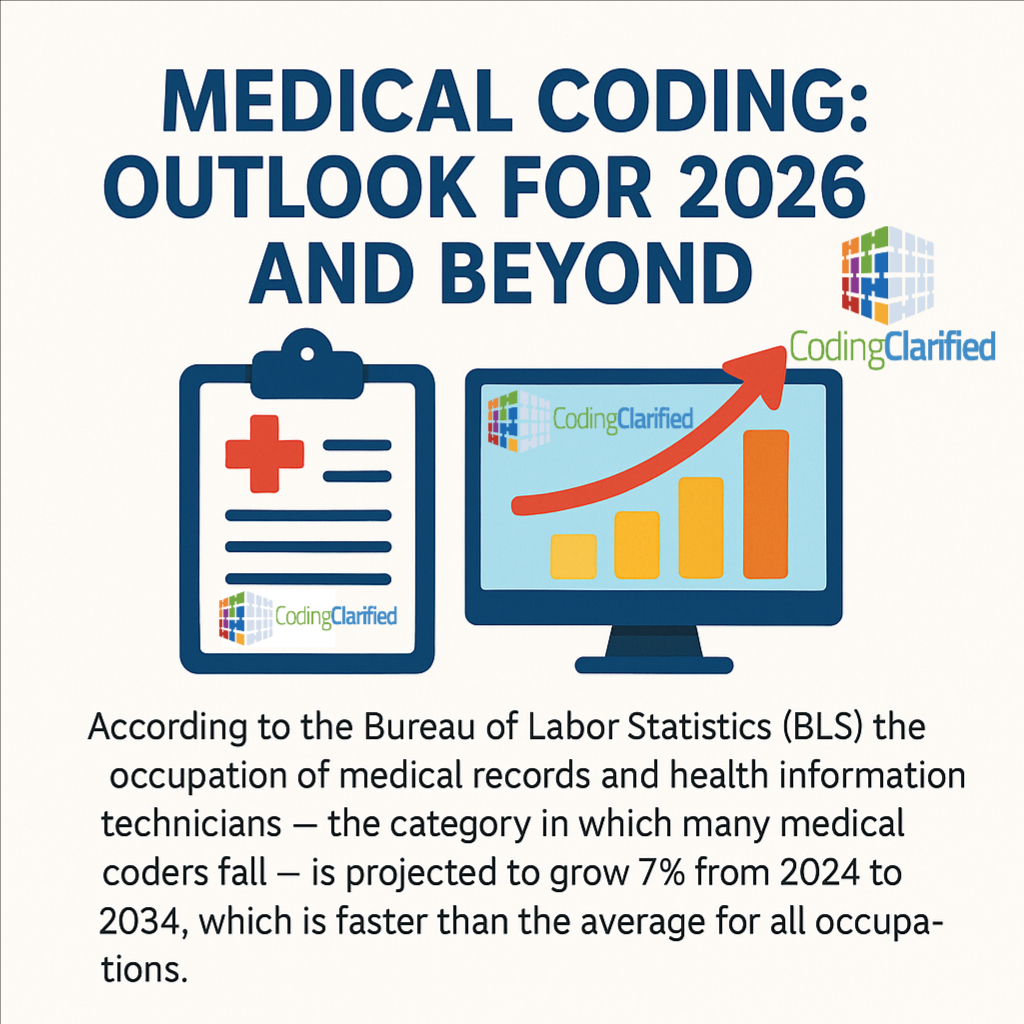
According to the Bureau of Labor Statistics (BLS) the occupation of medical records and health information technicians — the category in which many medical coders fall — is projected to grow 7 % from 2024 to 2034, which is faster than the average for all occupations. Bureau of Labor Statistics+1
That said, a related category — health information technologists and medical registrars — is projected even more strongly: 15 % growth over the same period. Bureau of Labor Statistics
In short, the field is expanding, not contracting. For 2026, this means job opportunities remain plentiful for those who are prepared.
Key Growth Drivers
Several macro-trends are fueling the rising demand for medical coders and health information professionals:
-
Aging Population: As the U.S. population ages, healthcare utilization increases. Older patients typically require more services — physician visits, hospitalizations, chronic‐disease management, diagnostics — which translates into greater coding volume and more complex documentation.
-
Rise in Chronic Diseases: Conditions such as diabetes, hypertension, COPD, cardiovascular disease and others are increasing in prevalence. Each service, each episode of care, each monitoring event typically needs to be coded accurately for reimbursement, quality tracking, population health, analytics, and regulatory compliance.
-
Expansion of Telemedicine: Virtual visits, remote monitoring, telehealth services, and hybrid models have surged (especially following the pandemic). These modalities still need accurate coding (diagnosis, procedure, encounter, place of service, modifiers), so coders who can handle telehealth documentation and coding rules are in demand.
-
Evolving Healthcare Models: The shift from fee‐for‐service toward value-based care, risk contracts, population health, bundled payments, and quality metrics means that documentation, coding, and data accuracy are increasingly important. Coders are part of the chain that ensures: correct code capture = accurate reimbursement + reliable quality reporting + valid data for analytics.
-
Increasing Use of Electronic Health Records and Data Analytics: Although not singular, the ongoing transition to more data-driven healthcare means healthcare systems and payers place more emphasis on accurate coding and clean data. More data = more need for coders, auditors, compliance, and data integrity oversight.
The Role of AI: Change but Not Replacement
A major question among coders and educators is: Will AI replace medical coders? The short answer: not in the foreseeable future — but the nature of the job will evolve.
-
AI as Tool, Not Replacement: AI (machine learning, natural language processing, coding automation tools) is increasingly embedded in workflows to assist with code suggestion, auto‐abstracting, natural language mapping, and billing workflows. However, the BLS projections for medical records specialists themselves caution that “the increase in adoption of artificial intelligence-powered solutions … may affect the demand,” but do not indicate elimination of jobs. Bureau of Labor Statistics
-
Shift in Responsibilities: Rather than manually coding every line from scratch, many coders will increasingly review AI‐generated codes, validate them, handle edge cases or complex entries, intervene when AI is uncertain or wrong, and manage exceptions. The “human in the loop” remains critical, especially because coding involves nuance—clinical context, documentation quality, provider intent, payer rules, modifiers, bundling/unbundling, etc.
-
Need for Adaptation: To stay competitive, coders will need to learn to work with AI tools (for example, understanding how to interpret code suggestions, auditing AI outputs, verifying accuracy, managing AI exceptions, collaborating with informatics teams). Coders who resist the technology risk being bypassed; coders who embrace and develop skills around AI-augmented workflows will thrive.
Will AI Take Over Medical Coding
Why AI Is Not Ready to Take Over All Medical Coding Jobs
How to Succeed and Future-Proof Your Career
For those planning to enter or advance in medical coding, here are key actions to stay ahead:
-
Pursue Certifications: Certifications such as the American Academy of Professional Coders (AAPC) CPC (Certified Professional Coder), the American Health Information Management Association (AHIMA) CCS or CCA, and other specialty credentials demonstrate competence and dedication and often lead to better job prospects and higher salaries.
-
Stay Current: Healthcare is dynamic. Annually updated code sets (for example, the ICD-10-CM updates for FY 2026), CPT year changes, guideline changes, new telehealth rules, payer policy updates, and regulatory shifts mean continuing education is essential.
-
Acquire Skills Humans Do Best: While AI handles many repetitive tasks, humans still excel at:
-
Complex auditing and compliance work
-
Handling nuanced cases (e.g., ambiguous documentation, unusual procedures, non-standard care)
-
Interpreting clinical intent, collaborating with providers for documentation improvement (CDI), and educating staff
-
Reviewing and improving the quality of AI outputs or workflow automations
-
Data analytics support, reporting, quality measurement, and linkage to coding
-
-
Become Versatile: Coders who understand telehealth rules, virtual visit modifiers, value-based care documentation, clinical terminology, and are comfortable with EHR systems will have a competitive edge.
-
Network and Engage Professionally: Join professional organizations, participate in coding forums, attend webinars and conferences, stay connected to the changes in payer policy, EHR developments, audit trends, and compliance risks.
Looking Ahead: What to Watch for 2026 +
As you plan through 2026 and beyond, several additional trends and opportunities merit attention:
-
Remote/Work-From-Anywhere Coding: The pandemic accelerated remote coding offerings. As healthcare employers expand remote work, geographic flexibility will increase. Coders in non-urban areas may access roles previously available only in major markets.
-
Outsourcing and Offshore Coding: Some coders might face competition from outsourced or offshore coding services. However, complex coding, auditing, payer denial management, and provider education remain mostly U.S.-based and require local credentialing/licensing knowledge.
-
Specialty Coding Growth: As medicine evolves, demand for coders in niche areas (e.g., oncology, interventional radiology, high-complexity surgery, telehealth, behavioral health, home health) is increasing. Specialist knowledge tends to command higher pay and job security.
-
Integration with Data Analytics & CDI: Coding is increasingly linked to data analytics, population health, quality metrics, clinical documentation improvement (CDI), and managed care contracting. Coders with hybrid skills (coding + data/analytics/CDI) will be in demand.
-
Regulatory & Compliance Risk: With rising payor scrutiny, audits, denials, documentation requirements, and risk adjustment (e.g., for Medicare Advantage), coders and audit specialists will be key to risk mitigation.
-
Technology Trends: NLP (natural language processing), voice recognition, smart documentation tools, predictive coding, AI integration in virtual care platforms — coders who understand how these technologies impact their workflow will add value.
For participants in the medical coding profession or those planning to enter it, the message is clear: the job market is healthy and growing. By 2026 and beyond, coders who adapt, specialize, obtain certifications, and embrace emerging technologies will enjoy robust opportunities. The role may look different than it did years ago — more review, more oversight, more technology integration — but the need for skilled human professionals remains strong.
At Coding Clarified, we believe now is a great time to invest in your coding education and position yourself for the future. With the right credentials, ongoing learning, and mindset of adaptation, you’ll be ready not just for 2026 but for a thriving career well beyond.