
What Is Multiple Sclerosis (MS)?
Multiple sclerosis (MS) is a chronic, immune-mediated disease of the central nervous system (CNS), which includes the brain, optic nerves, and spinal cord.
In MS, the immune system mistakenly attacks myelin, the protective insulation surrounding nerve fibers. When myelin becomes damaged:
-
Nerve signals slow down
-
Signals may misfire
-
Communication between the brain and body becomes disrupted
This leads to symptoms that may:
-
Come and go (relapse and remission)
-
Gradually worsens over time
-
Vary significantly from one person to another
MS is unpredictable — no two patients experience it exactly the same way.
Common Symptoms of MS
Symptoms depend on where inflammation and demyelination occur, but commonly include:
-
Numbness or tingling
-
Muscle weakness
-
Vision changes (often optic neuritis)
-
Balance and coordination difficulties
-
Fatigue
-
Cognitive changes
Symptom patterns can fluctuate, progress, or remain stable depending on disease activity.
What Causes MS?
The most accurate, evidence-based answer:
There is no single known cause of MS.
Current research suggests MS results from a combination of:
-
Immune system dysregulation
-
Genetic susceptibility
-
Environmental triggers (still being studied)
MS is best described as an abnormal immune response that leads to inflammation and damage within CNS tissue, particularly targeting myelin.
Clinical MS Types (Phenotypes) — And Why Coders Should Care
Clinicians classify MS into distinct phenotypes. These classifications now directly impact ICD-10-CM coding.
Relapsing-Remitting MS (RRMS)
-
Clearly defined relapses (attacks)
-
Followed by partial or complete recovery
-
Most common initial presentation
Primary Progressive MS (PPMS)
-
Gradual worsening from disease onset
-
No clear relapses
Secondary Progressive MS (SPMS)
-
Begins as RRMS
-
Transitions into steady progression over time
Disease Activity Status
Providers may also document disease activity as:
-
Active – Evidence of relapse and/or new MRI lesions
-
Non-active – No recent relapse or new MRI activity
-
Unspecified – Activity status not clearly documented
These descriptors are no longer optional from a coding perspective — they now drive code selection.
MS Treatment: What “Management” Typically Includes
There is currently no cure for MS. Treatment focuses on:
-
Modifying the disease course
-
Managing acute relapses
-
Treating symptoms to improve quality of life
Disease-Modifying Therapies (DMTs)
DMTs are commonly used, especially for relapsing forms of MS. They aim to:
-
Reduce relapse frequency
-
Decrease new CNS lesion formation
-
Slow progression of disability
Treating Acute Relapses
Relapses are often treated with:
-
High-dose corticosteroids
If severe and not responsive to steroids:
-
Plasma exchange may be considered
Symptom Management
Symptom treatment may include therapy and medications for:
-
Spasticity
-
Bladder dysfunction
-
Fatigue
-
Neuropathic pain
-
Mood or cognitive changes
-
Mobility impairment
The Big ICD-10-CM Change: New MS Codes (FY 2026)
Effective for dates of service on or after October 1, 2025, the MS category in ICD-10-CM expanded.
In practical terms:
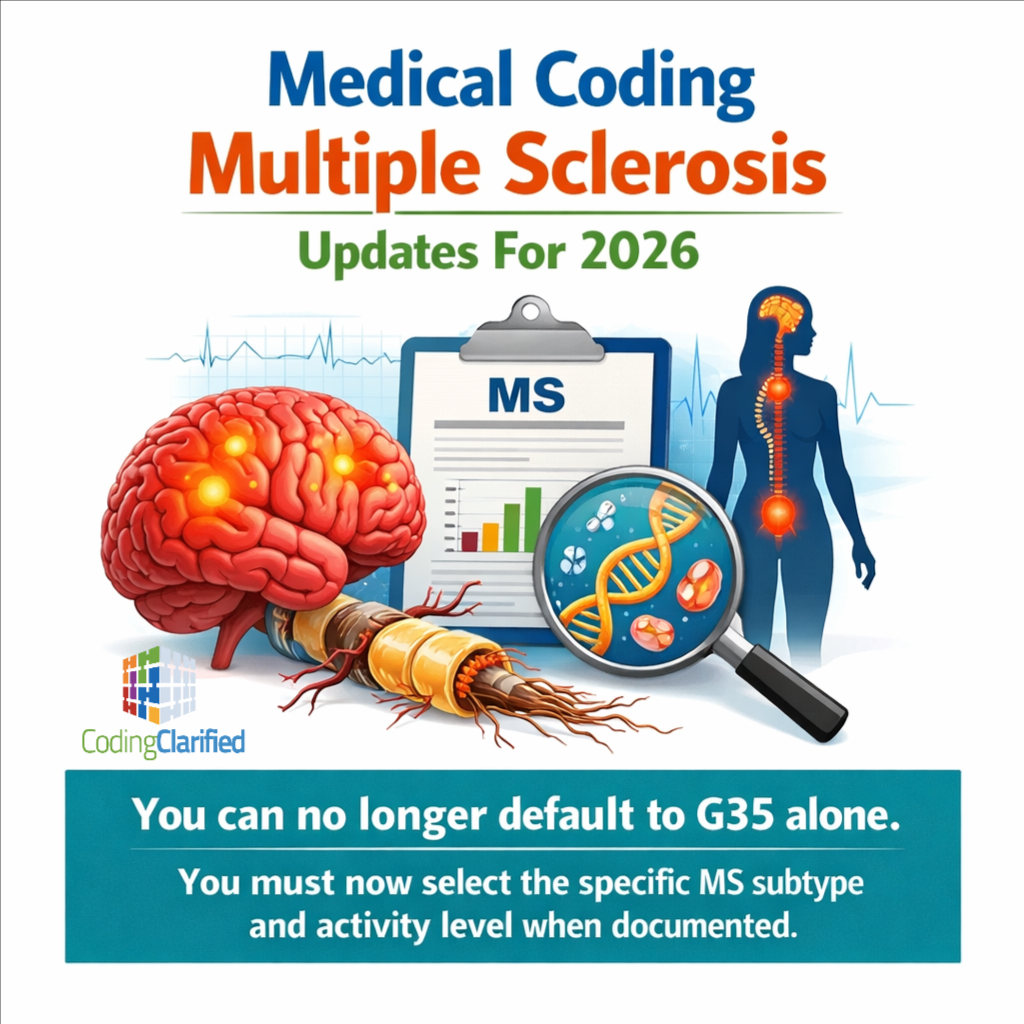
You can no longer default to G35 alone.
You must now select the specific MS subtype and activity level when documented.
Formatting Note
Some references display codes without a decimal (example: G35A).
Official ICD-10-CM formatting places the decimal after the third character (example: G35.A).
They refer to the same code set.
New MS Code Set (FY 2026 ICD-10-CM)
Relapsing-Remitting
-
G35.A — Relapsing-remitting multiple sclerosis
Primary Progressive
-
G35.B0 — Primary progressive MS, unspecified activity
-
G35.B1 — Primary progressive MS, active
-
G35.B2 — Primary progressive MS, non-active
Secondary Progressive
-
G35.C0 — Secondary progressive MS, unspecified activity
-
G35.C1 — Secondary progressive MS, active
-
G35.C2 — Secondary progressive MS, non-active
Unspecified MS
-
G35.D — Multiple sclerosis, unspecified
“Coder Brain” Rules: How to Select the Correct MS Code
Identify the Phenotype
Look for explicit provider documentation:
-
“Relapsing-remitting MS” → G35.A
-
“Primary progressive MS” → G35.B series
-
“Secondary progressive MS” → G35.C series
-
“MS” with no phenotype documented → G35.D
For Progressive MS, Confirm Activity Status
Determine whether the provider documents:
-
Active
-
Non-active
If activity is not stated, select the unspecified activity option (B0 or C0).
Query When Documentation Is Ambiguous
Common query scenarios:
-
Note says “progressive MS” but does not specify primary vs secondary
-
RRMS documented in one section, SPMS in another
-
Visit is for a flare but phenotype/activity not clearly stated
The new structure rewards clear documentation — and exposes vague problem lists quickly.
Documentation Phrases That Make Coding Easy
When educating providers, encourage precise language such as:
-
“Relapsing-remitting MS”
-
“Primary progressive MS, active.”
-
“Primary progressive MS, non-activ.e.”
-
“Secondary progressive MS, active.e”
-
“Secondary progressive MS, non-activ.”
ICD-10-CM 2026 Update: Major Multiple Sclerosis (MS) Coding Overhaul
What’s Changing on October 1, 2025 (FY 2026 ICD-10-CM)
For nearly a decade, coders have used the single ICD-10-CM code G35 to report Multiple Sclerosis (MS) on claims and medical records. As of October 1, 2025, that changes dramatically:
-
G35 is deleted and is no longer a valid code for services on/after October 1.
-
It becomes a “parent” category with detailed subcodes that capture both the MS phenotype and disease activity.
-
The update introduces eight (8) new MS codes in Chapter 6 (Diseases of the Nervous System).
New MS ICD-10-CM Codes
| New Code | Descriptor |
|---|---|
| G35.A | Relapsing-remitting multiple sclerosis |
| G35.B0 | Primary progressive MS, unspecified |
| G35.B1 | Active primary progressive MS |
| G35.B2 | Non-active primary progressive MS |
| G35.C0 | Secondary progressive MS, unspecified |
| G35.C1 | Active secondary progressive MS |
| G35.C2 | Non-active secondary progressive MS |
| G35.D | Multiple sclerosis, unspecified |
This restructure replaces the one-size-fits-all MS code with specific codes that support better clinical detail, outcome tracking, and epidemiology.
Why This Matters
Clinical Precision & Data Quality
MS is a complex disease with several well-recognized subtypes:
-
Relapsing-remitting
-
Primary progressive
-
Secondary progressive
These disease courses often have distinct treatment approaches and prognosis. The new codes allow documentation and reporting that reflect the clinical reality.
Claims Support and Reimbursement
Claims using the old G35 after the cutoff date will be rejected because the code is no longer valid on or after October 1.
Authorization and Quality Metrics
Accurate, detailed diagnosis codes:
-
Reduce authorization delays
-
Improve analytics for payors and providers
-
Support quality measurement and registry data
Official Coding Guidelines & Implications
Documentation Must Match Coding
To assign the correct MS code:
-
The medical record must explicitly state the subtype (e.g., relapsing-remitting, primary progressive).
-
Documentation should indicate whether the disease is active vs. non-active when applicable.
If documentation lacks subtype information:
-
Query the provider for specificity.
-
If subtype remains unknown or undocumented, assign G35.D (MS, unspecified) — but only when justified.
Coding Tips & Best Practices
Educate Providers Early
Clinical documentation improvement (CDI) is essential. Ask providers to include:
-
MS phenotype
-
Activity status (e.g., active, non-active)
-
Recent assessment or evidence of relapse activity
This prevents unnecessary follow-ups and claim rejections.
Audit Old Records Before October 1
Run reports for patients with G35 assigned before the update. For encounters on/after October 1:
-
Review documentation for the specific phenotype
-
Update diagnoses to the appropriate G35 subcode
-
Resubmit claims if needed
This proactive step avoids denials and undercoding.
Update Systems and Tools
Ensure:
-
EHR templates include fields to capture MS subtype
-
Encoder tools and reference files are updated with the new MS codes
-
Billing and claims software validate against the FY 2026 ICD-10-CM code set
Understand Active vs. Non-Active
For progressive types (primary and secondary):
-
Active typically indicates documented disease activity (clinical relapse, imaging evidence, symptom progression).
-
Non-active is used when stable, without recent activity.
-
Documentation must clarify this distinction.
Use of Unspecified (G35.D)
Assign G35.D only when:
-
No subtype is documented
-
A reasonable clinical explanation exists for the lack of detail
Unspecified codes may be appropriate for initial encounters or early diagnostic uncertainty — but coders should still attempt to get specificity.
Common Pitfalls to Avoid
-
Using the old G35 after September 30, 2025, claims will be invalid.
-
Assuming “MS” alone is enough — it’s insufficient without subtype and disease activity
-
Ignoring updates in encoder software or EHR workflows
-
Not querying providers for missing details
Quick Reference Summary
Effective Date: October 1, 2025
Old Code Removed: G35
New MS Code Family: G35.A, G35.B0-B2, G35.C0-C2, G35.D
Key Requirement: Document MS subtype and activity status