

New to medical coding? See how our CPC Training gets you certified.
Mammography Medical Coding Guidelines 2026: CPT Codes, ICD-10-CM, 3D Imaging, Medicare & Billing
Updated October 2026
Key Takeaways
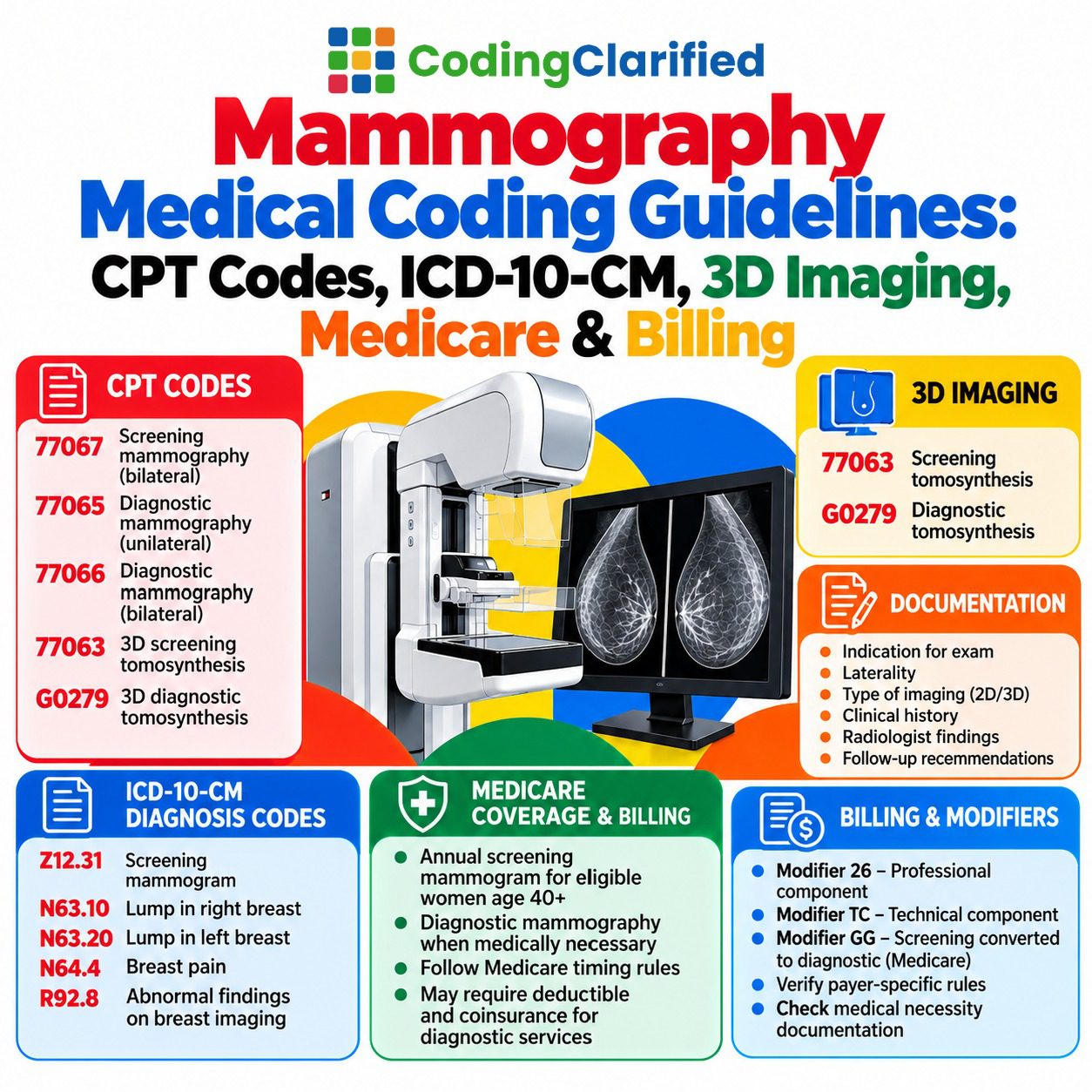
- Screening mammography: Report CPT 77067 for a routine bilateral screening mammogram.
- Diagnostic mammography: Use CPT 77065 for unilateral imaging or 77066 for bilateral imaging.
- 3D mammography: Report 77063 with screening mammography or HCPCS G0279 with diagnostic mammography when appropriate.
- Screening diagnosis: ICD-10-CM Z12.31 identifies an encounter for a screening mammogram.
- Medicare coverage: Medicare Part B generally covers annual screening mammography for eligible women age 40 and older.
- Documentation matters: Confirm the reason for the examination, laterality, imaging performed, and radiologist’s findings.
- 2026 coding tip: Verify current CPT, HCPCS Level II, ICD-10-CM, Medicare, and payer guidelines before submitting claims.
Understanding Mammography Medical Coding in 2026
Mammography plays an important role in breast cancer screening and diagnosis. However, accurate medical coding requires more than selecting a code for a breast X-ray. Coders must identify why the provider ordered the examination, which breast received imaging, and whether the service included digital breast tomosynthesis.
In 2026, healthcare organizations continue to use digital mammography and three-dimensional imaging. Therefore, medical coders must understand how traditional mammography codes work with additional imaging services. Furthermore, correct diagnosis coding helps establish medical necessity and prevent avoidable claim denials.
This guide explains the most common mammography CPT codes, ICD-10-CM diagnoses, Medicare billing rules, documentation requirements, and practical coding examples.
What Is the Difference Between Screening and Diagnostic Mammography?
The first step in mammography coding involves identifying the purpose of the examination. Although both services use breast imaging, screening and diagnostic mammography have different coding and billing requirements.
Screening Mammography
Screening mammography helps detect breast cancer in patients who do not have symptoms or a known suspicious finding requiring diagnostic evaluation.
Providers generally order screening examinations as part of routine preventive care. Additionally, screening schedules depend on age, medical history, risk factors, and clinical recommendations.
Primary CPT code: 77067
CPT 77067 describes bilateral screening mammography, including computer-aided detection (CAD) when performed.
Primary ICD-10-CM code: Z12.31
ICD-10-CM Z12.31 identifies an encounter for screening mammography for malignant neoplasm of the breast.
Diagnostic Mammography
Diagnostic mammography evaluates a specific breast concern, abnormal screening result, or documented clinical indication.
For example, a provider may order diagnostic imaging because a patient reports a breast lump, nipple discharge, or persistent breast pain. Similarly, a radiologist may recommend additional diagnostic views after identifying an abnormality on screening.
Primary diagnostic CPT codes:
- 77065: Unilateral diagnostic mammography.
- 77066: Bilateral diagnostic mammography.
The coder must select the appropriate code based on the documented examination rather than the patient’s symptoms alone.
Important: A diagnostic mammogram does not automatically indicate breast cancer. Instead, diagnosis coding must reflect the confirmed findings, documented symptoms, or reason for the examination.
Mammography CPT Codes for 2026
The following codes form the foundation of mammography coding.
| CPT/HCPCS Code | Service | Coding Guidance |
|---|---|---|
| 77067 | Bilateral screening mammography | Routine screening |
| 77065 | Unilateral diagnostic mammography | Diagnostic examination of one breast |
| 77066 | Bilateral diagnostic mammography | Diagnostic examination of both breasts |
| 77063 | Screening digital breast tomosynthesis | Add-on for bilateral screening mammography |
| G0279 | Diagnostic digital breast tomosynthesis | Add-on for unilateral or bilateral diagnostic mammography |
These codes follow the mammography reporting structure outlined in the CMS Medicare Claims Processing Manual.
Is Computer-Aided Detection Billed Separately?
No. CPT 77065, 77066, and 77067 include CAD when performed.
Therefore, coders should not report an additional CAD service simply because the radiologist used computer-assisted interpretation. Instead, verify the procedure documentation and select the correct mammography code.
How Do You Code 3D Mammography and Digital Breast Tomosynthesis?
Digital breast tomosynthesis (DBT), commonly called 3D mammography, produces multiple breast images from different angles. Consequently, radiologists can examine breast tissue in greater detail.
For coding purposes, DBT generally requires an additional code when performed with a qualifying mammography examination.
Screening 3D Mammography
Report:
- 77067: Bilateral screening mammography.
- 77063: Screening digital breast tomosynthesis.
Example: A patient undergoes routine bilateral screening mammography with 3D imaging.
Correct codes: 77067 + 77063
Diagnostic 3D Mammography
Report the applicable diagnostic mammography code with HCPCS G0279.
Example: A patient undergoes unilateral diagnostic mammography with tomosynthesis for a documented breast lump.
Correct codes: 77065 + G0279
However, do not substitute 77063 for G0279 when coding diagnostic tomosynthesis. These codes represent different screening and diagnostic services.
Additionally, review payer-specific requirements because coverage and claim processing rules may differ.
ICD-10-CM Diagnosis Codes for Mammography
Accurate ICD-10-CM coding explains why the patient received breast imaging. Moreover, diagnosis selection helps payers determine whether the service meets coverage requirements.
Common Mammography Diagnosis Codes
| ICD-10-CM Code | Description |
|---|---|
| Z12.31 | Encounter for screening mammogram for malignant neoplasm of breast |
| N63.10 | Unspecified lump in right breast, unspecified quadrant |
| N63.20 | Unspecified lump in left breast, unspecified quadrant |
| N64.4 | Mastodynia (breast pain) |
| N64.52 | Nipple discharge |
| R92.1 | Mammographic calcification found on diagnostic imaging of breast |
| R92.8 | Other abnormal and inconclusive findings on diagnostic imaging of breast |
| Z80.3 | Family history of malignant neoplasm of breast |
| Z85.3 | Personal history of malignant neoplasm of breast |
Coding reminder: Use the most specific available diagnosis code supported by the documentation. For example, when the provider identifies the quadrant of a breast lump, select the appropriate site-specific code rather than an unspecified code.
Can You Code Suspected Breast Cancer as Confirmed?
Generally, no. Outpatient coding guidelines prohibit coding diagnoses documented only as probable, suspected, questionable, or rule out as though they were confirmed.
Instead, report the documented signs, symptoms, or abnormal findings that explain the examination.
For example, a patient with a suspicious breast mass does not automatically receive an ICD-10-CM code from category C50. The documentation must support an established malignancy diagnosis.
Medicare Mammography Coverage and Billing Guidelines for 2026
Medicare Part B covers eligible screening mammography services. However, coders must distinguish preventive screening benefits from medically necessary diagnostic imaging.
Medicare Screening Mammography
Medicare generally covers:
- One baseline screening mammogram for eligible women ages 35–39.
- One screening mammogram every 12 months for eligible women age 40 and older, subject to Medicare’s timing rules.
- Screening services without patient deductible or coinsurance when applicable Medicare requirements are met and the provider accepts assignment.
Medicare’s screening frequency rules differ from simply counting 365 days. Therefore, billing teams should verify the patient’s eligibility and the applicable Medicare timing requirements.
Medicare Diagnostic Mammography
Medicare may cover diagnostic mammography when the examination is medically necessary.
Unlike qualifying preventive screening services, diagnostic mammography generally follows applicable Part B deductible and coinsurance rules.
Additionally, a patient’s prior imaging results, symptoms, and medical history may help support the diagnostic service.
For official coverage information, review Medicare’s mammogram coverage guidance and the applicable Medicare Administrative Contractor (MAC) policies.
Does Medicare Cover More Frequent Mammograms?
Medicare may cover additional diagnostic imaging when medical necessity supports the service. However, a patient’s increased risk does not automatically remove screening frequency limitations.
Coders should distinguish an additional diagnostic examination from another routine screening study. Furthermore, payer-specific policies may affect authorization, patient responsibility, and reimbursement.
Mammography Modifiers: 26, TC, and GG
Modifiers help identify how a mammography service was performed or billed. Consequently, incorrect modifier use can cause denials, duplicate payments, or compliance concerns.
Modifier 26: Professional Component
Modifier 26 identifies the physician’s professional interpretation when separately reportable.
For example, a radiologist who interprets a mammogram but does not bill for the equipment or technical resources may report the appropriate mammography code with modifier 26.
Modifier TC: Technical Component
Modifier TC identifies the technical portion of a diagnostic test when separately billable.
This component generally includes equipment, technical personnel, and other resources required to perform the examination.
However, facilities and providers must follow the applicable payment setting and payer requirements.
Modifier GG: Screening Converted to Diagnostic
Modifier GG applies under Medicare rules when a screening mammogram and a diagnostic mammogram occur on the same day and the diagnostic examination meets the applicable requirements.
For example, the radiologist may identify an abnormality during screening and order additional diagnostic views.
In this situation, Medicare may allow both services when documentation supports the examination and modifier GG appears on the diagnostic mammography claim line.
Important: Do not automatically append GG whenever a patient receives additional images. Instead, confirm that the documentation and payer rules support separate screening and diagnostic services.
Mammography Documentation Requirements
Complete documentation supports accurate coding, medical necessity, and reimbursement.
Before assigning codes, verify the following information:
- Reason for examination: Screening, symptoms, abnormal findings, or follow-up.
- Laterality: Right breast, left breast, or bilateral examination.
- Type of imaging: Standard mammography, tomosynthesis, or both.
- Clinical history: Relevant symptoms, previous imaging, and known conditions.
- Radiologist interpretation: Findings and final impression.
- Diagnostic recommendations: Additional imaging or follow-up when documented.
- Billing components: Professional, technical, or global service, as appropriate.
Additionally, the medical record should contain a formal imaging report that identifies the examination and communicates the findings.
For more guidance, review the CMS Breast Imaging Billing and Coding Article.
Mammography Coding Examples and Case Studies
Case Study 1: Routine Screening Mammogram
Scenario: A 52-year-old asymptomatic patient receives a routine bilateral screening mammogram.
CPT: 77067
ICD-10-CM: Z12.31
Explanation: The patient has no documented breast symptoms. Therefore, the screening mammography code and screening diagnosis apply.
Case Study 2: Diagnostic Mammogram for Breast Pain
Scenario: A patient reports persistent pain in the left breast. The physician orders a unilateral diagnostic mammogram.
CPT: 77065
ICD-10-CM: N64.4
Explanation: The patient has a documented symptom requiring diagnostic evaluation. Consequently, a screening mammography code would not accurately represent the service.
Case Study 3: Bilateral Screening With 3D Imaging
Scenario: A 60-year-old patient receives routine bilateral screening mammography with digital breast tomosynthesis.
CPT: 77067 and 77063
ICD-10-CM: Z12.31
Explanation: The examination includes both screening mammography and screening tomosynthesis. Therefore, report the appropriate primary and add-on codes.
Case Study 4: Abnormal Screening Followed by Diagnostic Imaging
Scenario: A screening mammogram identifies a suspicious area. The radiologist orders additional diagnostic mammographic views during the same visit.
Coding approach: Review the screening and diagnostic reports, confirm the services performed, and determine whether Medicare modifier GG applies.
Explanation: Documentation must support the separate services. Additionally, the diagnostic examination requires an appropriate diagnosis based on the documented findings.
Common Mammography Coding Mistakes to Avoid
Even experienced coders can make errors when selecting mammography codes. However, a consistent review process helps prevent common problems.
1. Confusing screening and diagnostic services
Always identify the reason for the examination before selecting the CPT code.
2. Using the wrong tomosynthesis add-on code
Report 77063 for qualifying screening DBT and G0279 for qualifying diagnostic DBT.
3. Billing CAD separately
Current mammography CPT codes already include CAD when performed.
4. Selecting an unspecified diagnosis unnecessarily
Review the documentation for breast laterality, location, and specific findings.
5. Coding suspected cancer as confirmed
Follow outpatient ICD-10-CM rules and code documented symptoms or findings when malignancy remains unconfirmed.
6. Ignoring Medicare frequency requirements
Check previous screening dates, eligibility, and applicable coverage policies.
7. Applying modifiers incorrectly
Verify whether modifier 26, TC, or GG applies before submitting the claim.
8. Reporting services without adequate documentation
Confirm that the imaging report supports the CPT codes, diagnoses, and services billed.
CPC Exam Tips for Mammography Coding
Mammography questions may appear within the radiology portion of the Certified Professional Coder (CPC) exam. Therefore, students should understand the difference between screening and diagnostic services rather than simply memorizing codes.
Tip 1: Identify the purpose first. Determine whether the patient received preventive screening or diagnostic evaluation.
Tip 2: Look for laterality. A unilateral diagnostic study uses 77065, while a bilateral diagnostic study uses 77066.
Tip 3: Recognize add-on codes. Remember that 77063 applies to screening tomosynthesis, while G0279 applies to diagnostic tomosynthesis.
Tip 4: Read the full scenario. A breast lump, pain, or abnormal imaging finding may change the coding approach.
Tip 5: Practice diagnosis selection. Distinguish screening diagnosis Z12.31 from symptom-based and abnormal-finding diagnoses.
Tip 6: Check the current codebook. Use the official code descriptors, parenthetical instructions, and applicable guidelines instead of relying only on memorization.
CPC Practice Question
A patient undergoes routine bilateral screening mammography with digital breast tomosynthesis. Which codes should the coder report?
A. 77065 and G0279
B. 77066 and 77063
C. 77067 and 77063
D. 77067 and G0279
Correct answer: C — 77067 and 77063
The patient receives bilateral screening mammography with screening tomosynthesis. Therefore, the screening mammography code and its appropriate add-on code apply.
Related Medical Coding Resources
Continue building your radiology, diagnosis coding, and billing knowledge with these additional guides:
- Radiology Medical Coding and Billing Guidelines 2026 — Explore radiology CPT codes, modifiers, and imaging billing principles.
- Breast Cancer Coding — Review breast cancer coding concepts and the importance of confirmed diagnoses.
- Outpatient Medical Coding Guidelines — Learn how outpatient diagnosis rules affect coding decisions.
- Medical Record Abstraction in 2026 — Improve documentation review and code selection.
- Medical Coding Resources for 2026 — Find coding education, exam preparation, and career resources.
Final Thoughts
Accurate mammography coding starts with understanding the clinical purpose of the examination. Furthermore, coders must select the correct CPT code, identify the appropriate ICD-10-CM diagnosis, and follow payer-specific billing requirements.
In 2026, digital breast tomosynthesis, Medicare coverage rules, and proper modifier use remain important areas for medical coding professionals. Therefore, regular education and careful documentation review can help reduce denials and improve coding accuracy.
Whether you are preparing for the CPC exam or working in radiology billing, mastering mammography coding provides a valuable foundation for accurate outpatient medical coding.
Frequently Asked Questions About Mammography Medical Coding
1. What is the CPT code for a screening mammogram in 2026?
CPT 77067 identifies bilateral screening mammography, including CAD when performed. Additionally, report 77063 when qualifying screening digital breast tomosynthesis is performed.
2. What is the difference between CPT 77065 and 77066?
CPT 77065 describes unilateral diagnostic mammography, while 77066 describes bilateral diagnostic mammography. Therefore, coders must review the documented laterality before selecting the code.
3. What ICD-10-CM code is used for screening mammography?
ICD-10-CM Z12.31 identifies an encounter for a screening mammogram for malignant neoplasm of the breast. However, diagnostic examinations require diagnosis coding that reflects the clinical indication or documented findings.
4. How do you code 3D mammography in 2026?
For screening tomosynthesis, report 77063 with the appropriate screening mammography code. For diagnostic tomosynthesis, report G0279 with the applicable diagnostic mammography code. Additionally, confirm the payer’s current billing instructions.
5. Does Medicare cover screening mammograms every year?
Medicare Part B generally covers one screening mammogram every 12 months for eligible women age 40 and older, using Medicare’s applicable timing rules. Furthermore, Medicare may cover one baseline screening mammogram for eligible women ages 35–39.
6. Can screening and diagnostic mammography be billed on the same day?
Yes, Medicare may allow both services when the examination begins as screening and additional diagnostic imaging becomes necessary. However, documentation must support the services, and modifier GG may be required on the diagnostic claim line.
7. Can a medical coder report breast cancer when the mammogram shows a suspicious mass?
Not automatically. Outpatient coding rules generally prohibit coding suspected malignancy as confirmed. Instead, report the appropriate documented symptom or imaging finding until the provider establishes a definitive diagnosis.
8. What should CPC students memorize about mammography coding?
Students should understand 77067 for screening, 77065 and 77066 for diagnostic mammography, 77063 for screening tomosynthesis, and G0279 for diagnostic tomosynthesis. Additionally, remember screening diagnosis Z12.31 and the importance of laterality and documentation.
Ready to code like this for a living?
Coding Clarified’s AAPC licensed CPC program takes you from beginner to certified, with an internship and a job board for graduates.
You may qualify for WIOA funding in 30+ states. Check your eligibility.