Medical Coding Guidelines and Tips for Lower Extremity Revascularization (2026 Updates)
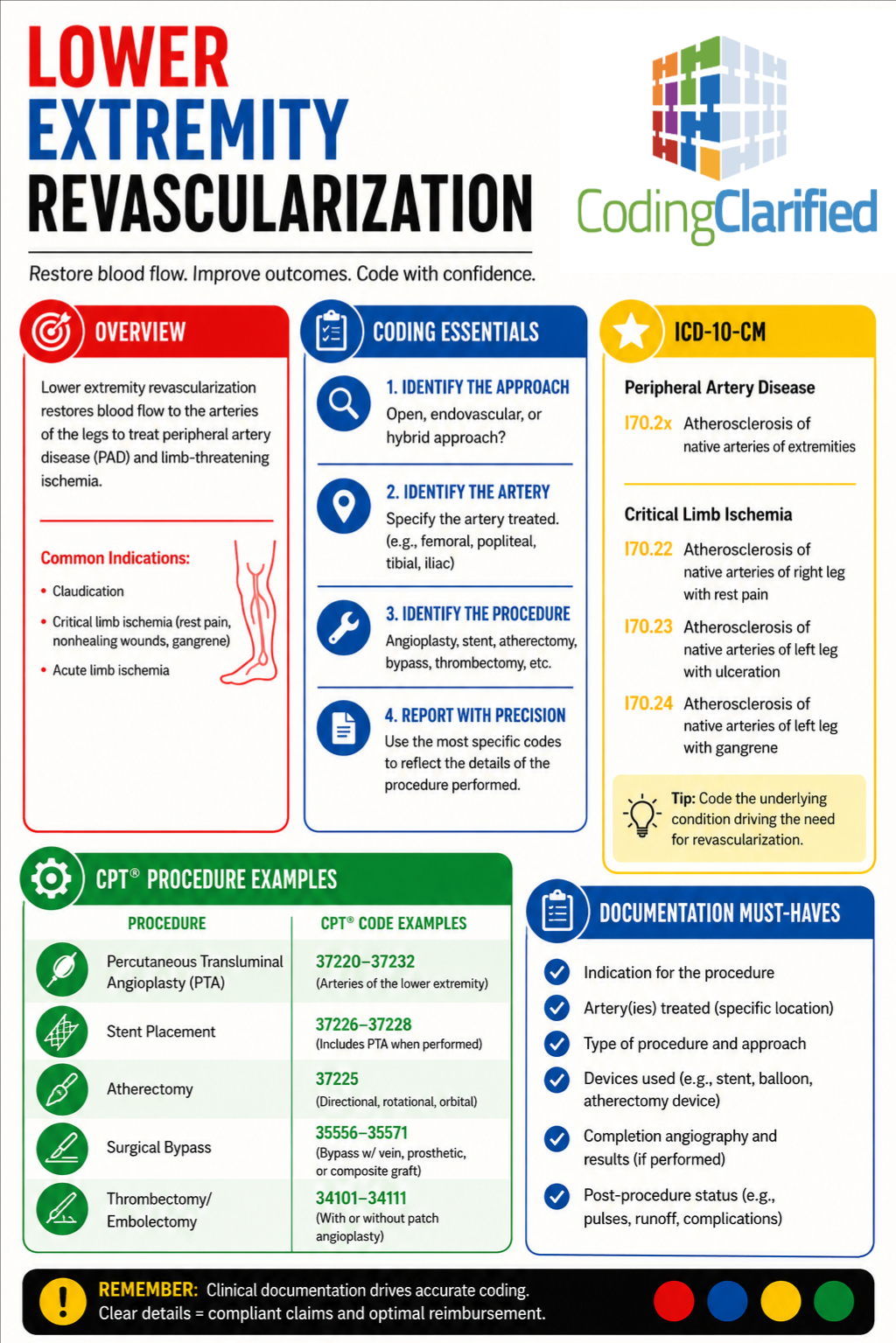
Lower extremity revascularization procedures are performed to restore blood flow in patients with peripheral artery disease (PAD) and other vascular conditions. These procedures are highly technical and are most often reported using CPT® codes. For 2026, the American Medical Association (AMA) has announced one of the most significant restructurings in years for these services, creating major changes for medical coders, documentation specialists, and healthcare organizations.
Understanding these new rules is critical to ensure clean claims, accurate reimbursement, and compliance.
Major 2026 CPT® Changes: Complete Code Family Overhaul
Effective in 2026, the long-standing CPT® code family 37220 – 37235 will be deleted. These codes historically captured most lower extremity endovascular revascularization services.
They are being replaced by approximately 46 new CPT® codes in the new 37Xxx series, organized by vascular territory, rather than grouped by broad procedure type.
New Code Structure by Vascular Territory
The new codes will be organized into these clearly defined anatomical regions:
-
Iliac vessels
-
Femoral and popliteal vessels (femoropopliteal)
-
Tibial and peroneal vessels (tibial-peroneal)
-
Inframalleolar vessels
Each code will now better define:
-
The exact territory treated
-
The intervention performed
-
The technique used
This redesign improves accuracy but requires more detailed documentation and coder expertise.
Why This Change Matters for Providers and Coders
This restructuring represents one of the largest vascular and interventional radiology coding updates in years. While the intent is to clarify reporting, it also increases the level of coding complexity.
Key Impacts for Practices
-
Existing codes 37220–37235 will no longer be valid after 2025
-
Billing systems must be updated to accept the new 37Xxx code structure
-
Clinical documentation must be more detailed
-
Pre-authorization and payer rules will need revision
-
Coding teams will require retraining for the new system
Failure to prepare could result in:
-
Denials
-
Delayed payments
-
Compliance risk
-
Revenue cycle disruption
Documentation Requirements for 2026 and Beyond
Proper documentation is the foundation of correct code selection under the new system.
Providers should clearly document:
-
Which specific vessels were treated
-
Example: “Right superficial femoral artery” instead of “leg artery”
-
-
Approach used
-
Open
-
Endovascular
-
-
Techniques performed
-
Balloon angioplasty
-
Stent placement
-
Atherectomy
-
Mechanical thrombectomy (when applicable)
-
-
Imaging guidance
-
Type of imaging used
-
Whether imaging was diagnostic or guidance
-
Incomplete documentation will make accurate code assignment impossible under the new structure.
Coding Tips for Lower Extremity Revascularization (2026)
Code by Vascular Territory
Do not code by vague anatomical descriptions. The new codes are territory-driven, so specificity is critical.
Identify the Exact Technique
Coders must distinguish between:
-
Angioplasty alone
-
Stent placement
-
Atherectomy
-
Combined procedures
Each may map to different codes in the new family.
Confirm Imaging Details
Coders must determine whether imaging is:
-
Bundled
-
Separately reportable
-
Diagnostic vs. procedural guidance
This will depend on the final AMA CPT® code definitions for 2026.
Watch for Deleted Code Usage
Claims submitted with deleted codes 37220–37235 for 2026 dates of service will be rejected.
Operational Preparation Checklist for Practices
To avoid disruptions, practices should prepare early.
Recommended action steps:
-
Update EHR templates to capture:
-
Vascular territory
-
Technique
-
Devices used
-
Imaging modality
-
-
Update:
-
Charge masters
-
Billing rules
-
Prior authorization workflows
-
-
Train:
-
Physicians
-
Clinical staff
-
Coding and billing staff
-
-
Perform internal:
-
Mock audits
-
Test claims
-
Gap analysis
-
Compliance Risk and Revenue Cycle Protection
Because this is a major structural change, auditors and payers are likely to scrutinize these claims more closely in 2026.
Well-prepared organizations will benefit from:
-
Faster claims processing
-
Lower denial rates
-
Cleaner audits
-
Better revenue stability
The 2026 overhaul of lower extremity revascularization coding represents a major shift in vascular and interventional radiology reporting. With the deletion of 37220–37235 and the introduction of 37Xxx series codes, success in 2026 will depend on:
-
Precise documentation
-
Strong coder education
-
Updated systems
-
Proactive training
Practices that prepare early will minimize risk and maximize compliance and reimbursement accuracy
Medical Coding And The Revenue Cycle
AMA releases CPT 2026 code set