
Medical Coding for Lesions: Guidelines and Tips
Lesions are abnormal changes in tissue that may appear on the skin, internal organs, or mucous membranes. They can be benign, premalignant, or malignant and are commonly treated in outpatient clinics, dermatology practices, and surgical settings. Accurate coding for lesion services is essential for proper reimbursement, compliance, and clean claims.
Common Types of Lesions Coders Encounter
Medical coders may see documentation for several types of lesions, including:
-
Benign skin lesions (e.g., skin tags, seborrheic keratoses)
-
Premalignant lesions (e.g., actinic keratosis)
-
Malignant lesions (e.g., basal cell carcinoma, squamous cell carcinoma)
-
Viral lesions (e.g., warts)
-
Suspicious or changing moles (nevi)
Each lesion type directly impacts the diagnosis and procedure codes assigned.
How to Measure a Lesion for Coding Purposes
Correct measurement is critical because CPT® codes for lesion excisions are based on size, not complexity.
Step-by-Step: Measuring a Lesion
-
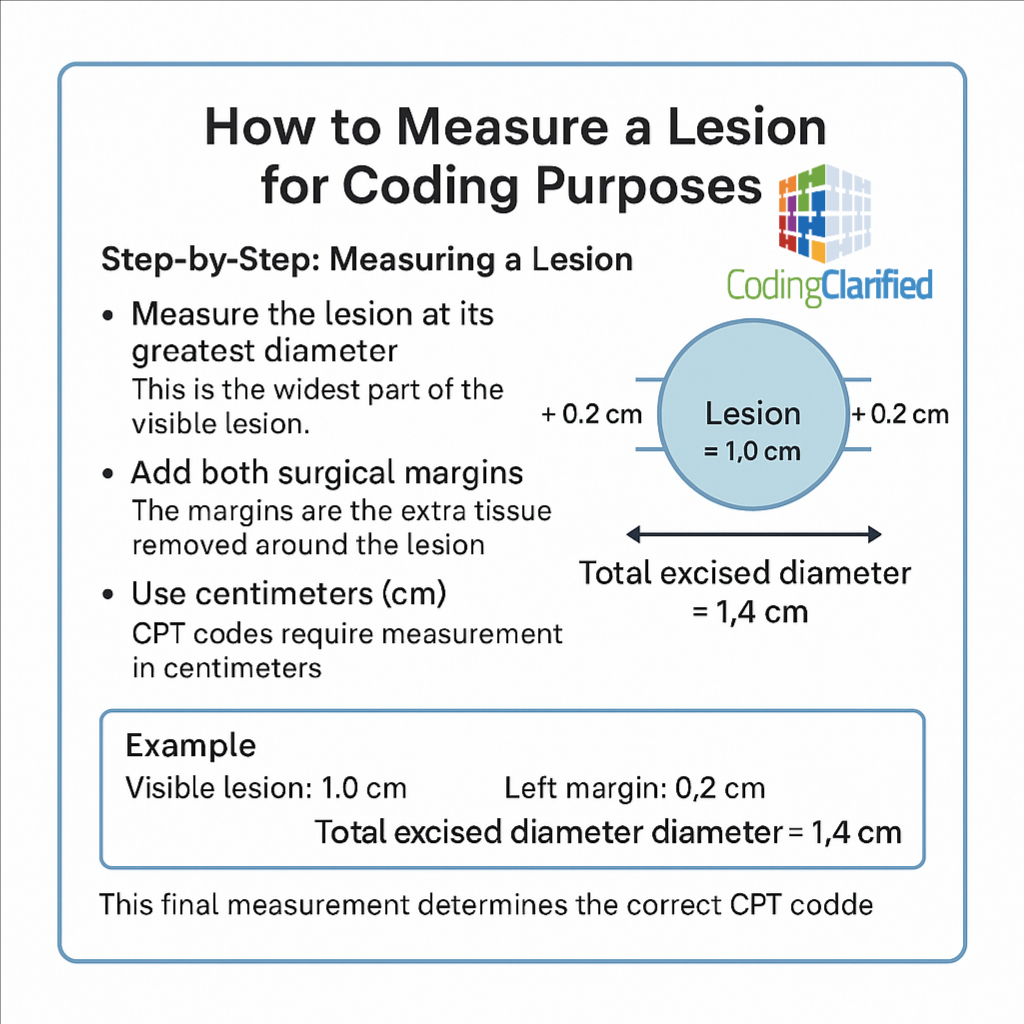
Measure the lesion at its greatest diameter
This is the widest part of the visible lesion. -
Add both surgical margins
The margins are the extra tissue the provider removes around the lesion to ensure complete removal.Formula:
Lesion size + left margin + right margin = excised diameter -
Use centimeters (cm)
CPT® codes require measurement in centimeters, not millimeters.
Example
-
Visible lesion: 1.0 cm
-
Left margin: 0.2 cm
-
Right margin: 0.2 cm
Total excised diameter = 1.4 cm
This final measurement (1.4 cm) determines the correct CPT® code.
What NOT to Measure
Coders should not use:
-
The length of the incision
-
The length of the sutured wound
-
The size of the final scar
Only the excised diameter is used for code selection.
Destruction vs. Excision Measurements
-
Excision procedures: Use the excised diameter (lesion + margins)
-
Destruction procedures (cryotherapy, laser, electrosurgery): Use the visible lesion size only, without adding margins
Coding Tip: If margins are not documented, query the provider before assigning a code.
ICD-10-CM Coding for Lesions
Diagnosis codes for lesions typically come from:
-
L00–L99: Diseases of the skin and subcutaneous tissue
-
D00–D49: Neoplasms (benign, in situ, malignant, or uncertain behavior)
Key documentation elements needed for accurate ICD-10-CM coding:
-
Type of lesion
-
Anatomic location
-
Laterality
-
Behavior (benign, in situ, malignant, uncertain)
CPT® Coding for Lesion Procedures
Destruction of Lesions
-
17000–17004: Actinic keratosis destruction
-
17110–17111: Destruction of benign lesions
Code selection depends on:
-
Number of lesions
-
Type of lesion
-
Method of destruction
Excision of Lesions
-
11400–11446: Excision of benign lesions
-
11600–11646: Excision of malignant lesions
Codes are selected based on:
-
Anatomical site
-
Excised diameter (lesion + margins)
Pathology and Laboratory Coding
If specimens are sent for pathology:
-
Use appropriate 88300–88399 CPT® codes
-
Follow payer rules for bundling and global services
Documentation Requirements for Accurate Coding
Look for:
-
Lesion size in centimeters
-
Margin sizes
-
Exact location and laterality
-
Number of lesions
-
Technique used
-
Pathology confirmation when applicable
Common Coding Mistakes to Avoid
-
Using closure length instead of excised diameter
-
Coding excision when only destruction was performed
-
Assigning malignant codes without pathology confirmation
-
Not querying providers when margins are missing
Quick Reference: Lesion Measurement & Coding Tips
-
Measure the lesion at its widest point
-
Add both margins for excisions
-
Do not measure the closure or scar
-
Use centimeters
-
Query the provider if the documentation is incomplete
Best Practices for Lesion Coding
-
Always wait for pathology when coding suspicious lesions
-
Verify whether the procedure is bundled with other services
-
Follow National Correct Coding Initiative (NCCI) edits
-
Double-check payer policies for global surgical packages
Quick Reference: Lesion Coding Tips
-
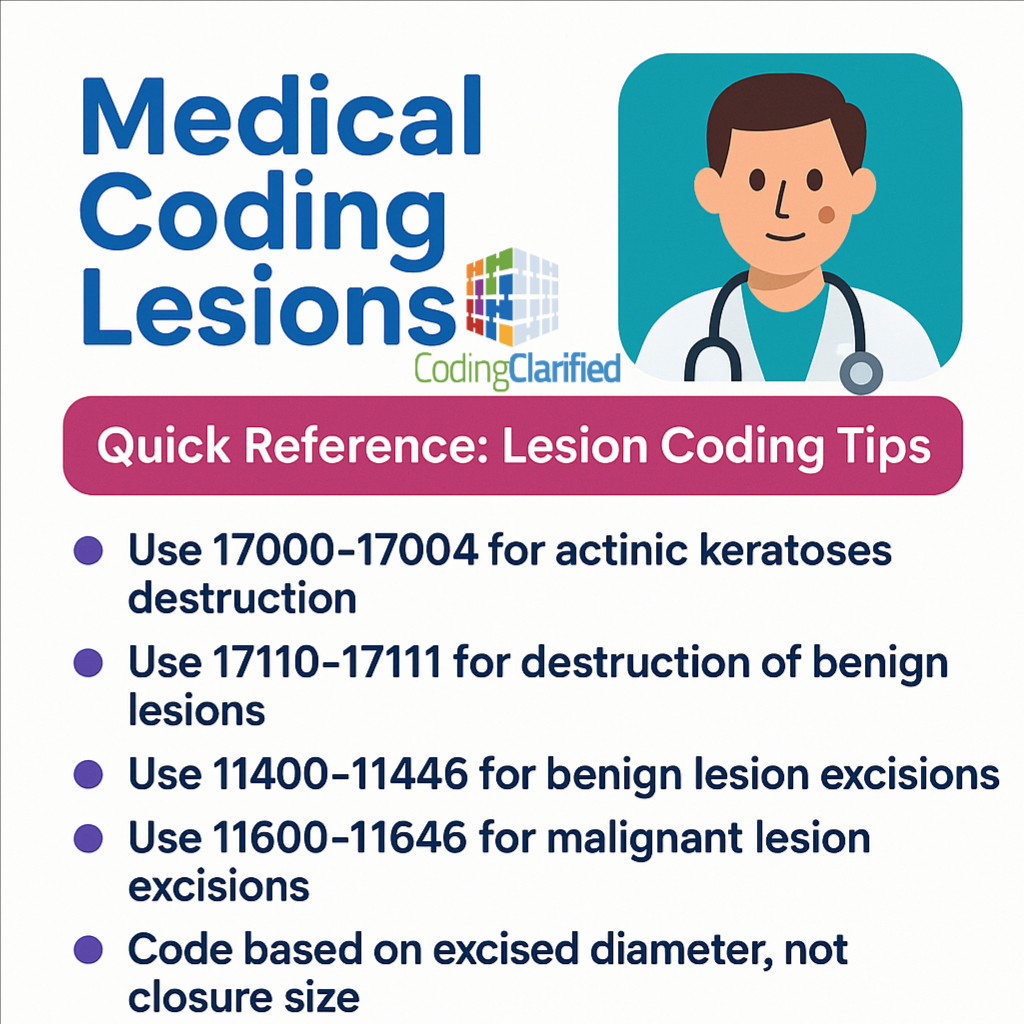
Use 17000–17004 for actinic keratoses destruction
-
Use 17110–17111 for the destruction of benign lesions
-
Use 11400–11446 for benign lesion excisions
-
Use 11600–11646 for malignant lesion excisions
-
Code based on excised diameter, not closure size