
Medical Coding Percutaneous Coronary Intervention (PCI)
Percutaneous Coronary Intervention (PCI) is a common cardiovascular procedure used to treat coronary artery disease by restoring blood flow through narrowed or blocked coronary arteries. For medical coders and CPC students, PCI coding requires strong attention to documentation details, coronary anatomy, and CPT hierarchy rules.
What is PCI?
PCI includes minimally invasive techniques such as:
- Balloon angioplasty
- Stent placement (drug-eluting or bare metal)
- Atherectomy (plaque removal)
These procedures are typically performed during cardiac catheterization.
Key CPT Codes for PCI
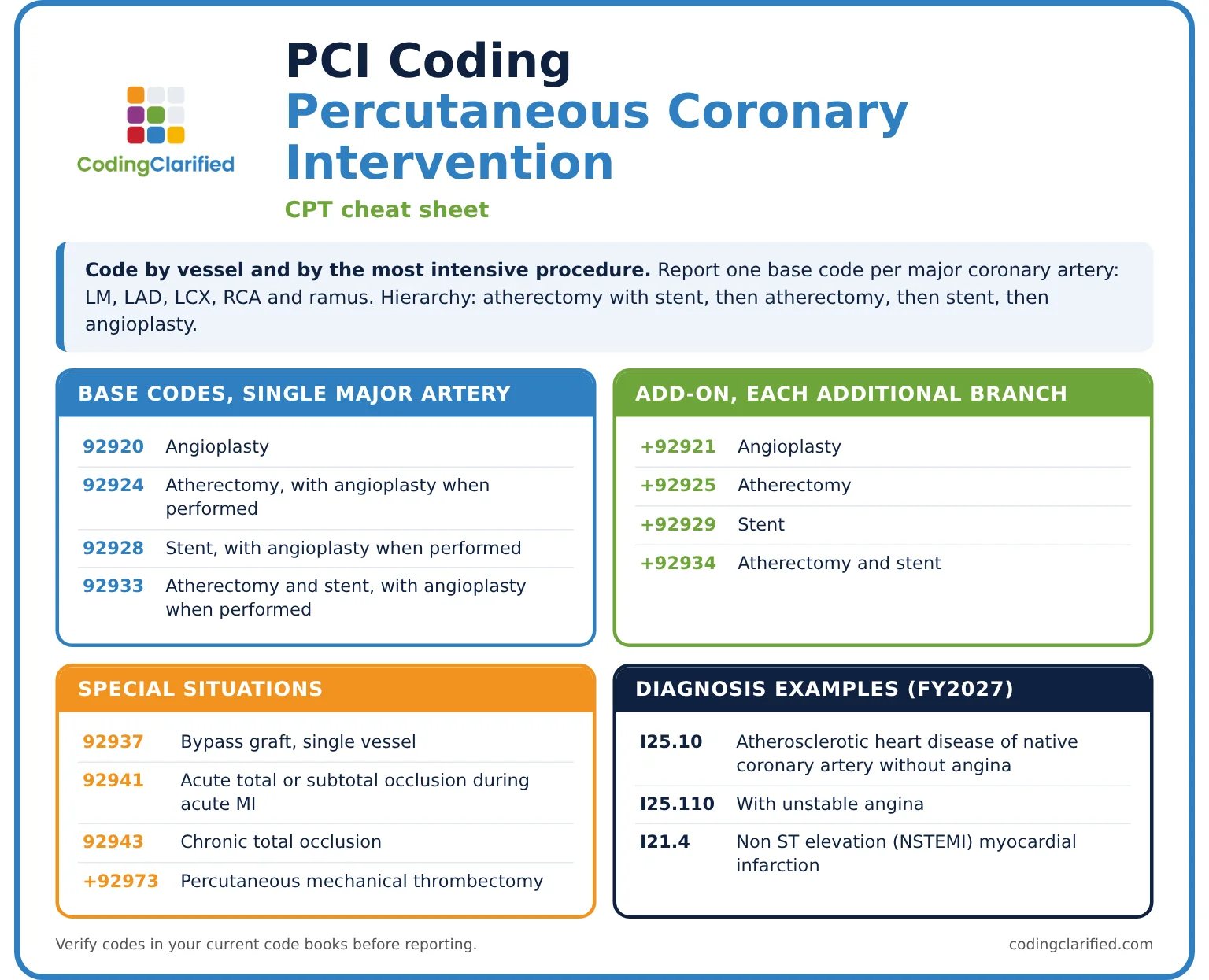
PCI coding falls within CPT range 92920–92944, and is based on:
Type of Intervention
- 92920 – Balloon angioplasty (no stent)
- 92928 – Coronary stent placement
- 92924 / 92933 – Atherectomy (with or without stent)
Number of Major Coronary Arteries Treated
Each major coronary artery is coded separately:
- Left Anterior Descending (LAD)
- Left Circumflex (LCX)
- Right Coronary Artery (RCA)
Use add-on codes for additional arteries:
- 92921, 92929, 92925, 92934
Combination Procedures
- If stent + angioplasty are performed in the same artery → code the stent only
- If atherectomy + stent → code the more comprehensive service
ICD-10-CM Diagnosis Coding
Common diagnoses linked to PCI include:
- I25.10 – Atherosclerotic heart disease without angina
- I21.3 – ST elevation myocardial infarction (STEMI)
- I20.9 – Angina pectoris, unspecified
Always code:
- Underlying coronary artery disease
- Type of angina (if documented)
Coding Guidelines & Tips
Code by Coronary Artery — NOT by Lesion
Even if multiple lesions are treated in one artery:
- Only report one code per artery
Identify the Highest-Level Service
Hierarchy matters:
Atherectomy > Stent > Angioplasty
Always code the most complex intervention performed in that artery.
Documentation is Everything
Your provider documentation should clearly state:
- Coronary artery treated
- Type of intervention (balloon, stent, atherectomy)
- Number of vessels treated
- Approach (percutaneous)
- Devices used
Watch for Bundling Rules
- PCI includes radiological supervision & interpretation (S&I)
- Do NOT separately code:
- Catheter placement (in most cases)
- Imaging guidance
Modifier Usage
- Modifier -59 or -XS may apply when procedures are performed on separate arteries (payer-dependent)
- Always verify payer policy before appending modifiers
Common CPC Exam Pitfalls
Confusing Vessels vs. Lesions
- CPC exams often try to trick you here
- Remember: 1 artery = 1 code
Missing Combination Rules
- If both angioplasty and stent are done → do NOT code both
Not Reading the Full Operative Report
- The procedure title is NOT enough
- Always code from the body of the report
Forgetting Add-On Codes
- Additional arteries require add-on CPT codes
- These cannot be reported alone
Real-World Coding Scenario
Scenario:
Patient undergoes PCI with:
- Stent placement in LAD
- Balloon angioplasty in RCA
Coding:
- 92928 – Stent placement (LAD)
- 92921 – Angioplasty, additional artery (RCA)
Final Tips for CPC Students
- Always follow the CPT Index → Tabular → Guidelines
- Focus on artery-based coding logic
- Know the PCI hierarchy rules cold
- Practice identifying interventions quickly under time pressure
Bottom Line
Percutaneous Coronary Intervention coding is highly testable on the CPC exam and commonly seen in real-world cardiology coding. Success comes down to:
- Understanding coronary anatomy
- Applying CPT hierarchy correctly
- Reading documentation thoroughly
- Following bundling and add-on rules
American College of Cardiology