
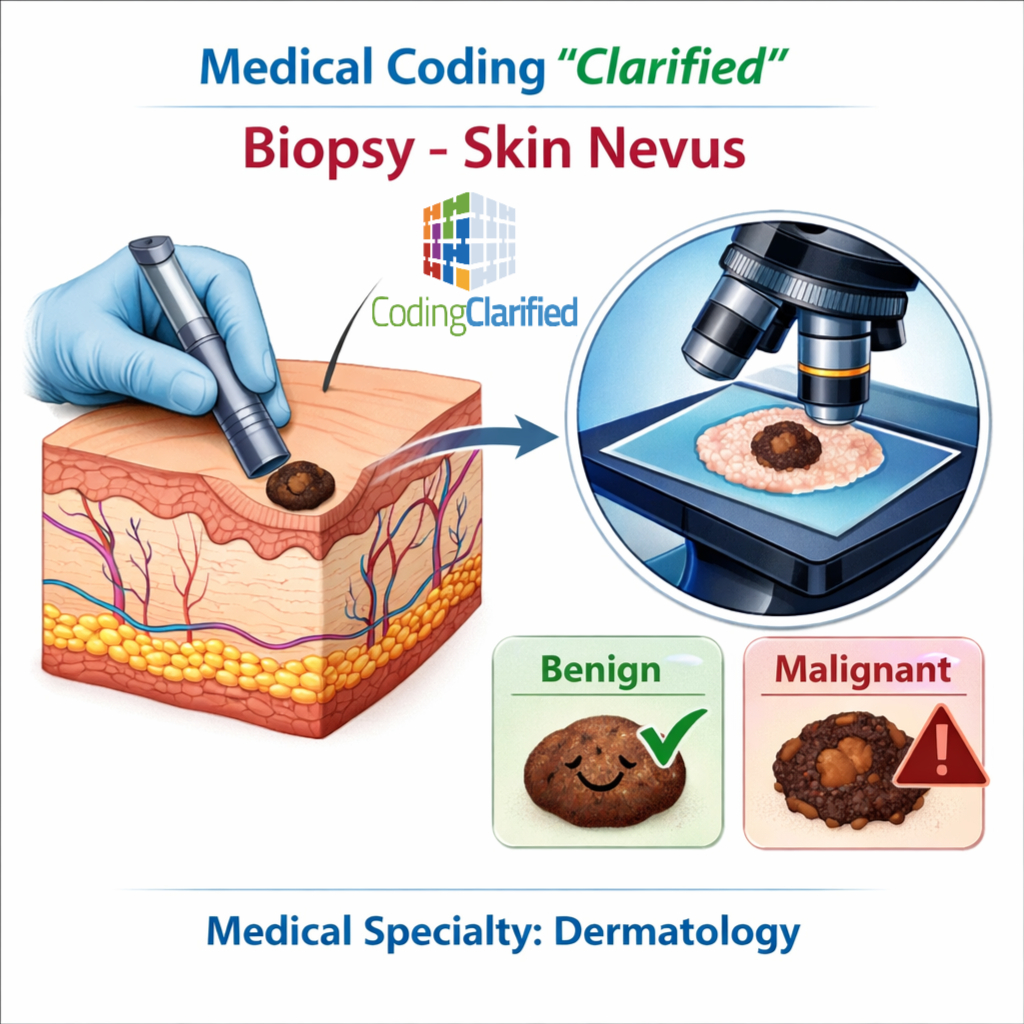
Biopsy – Skin Nevus Medical Specialty: Dermatology
Description:
Excisional biopsy of skin nevus and two-layer plastic closure. Trichloroacetic acid treatment to left lateral nasal skin 2.5 cm to treat actinic keratosis.
PREOPERATIVE DIAGNOSES:
- Left back skin nevus2 cm.
- Right mid back skin nevus1 cm.
- Right shoulder skin nevus2.5 cm.
- Actinic keratosis left lateral nasal skin2.5 cm.
POSTOPERATIVE DIAGNOSES:
- Left back skin nevus 2 cm.
- Right mid back skin nevus 1 cm.
- Right shoulder skin nevus 2.5 cm.
- Actinic keratosis, left lateralnasal skin, 2.5 cm.
PATHOLOGY: Pending.
TITLE OF PROCEDURES:
- Excisional biopsy of left back skin nevus 2 cm, two-layer plastic closure.
- Excisional biopsy of mid-back skin nevus 1 cm, one-layer plastic closure.
- Excisional biopsy of right shoulder skin nevus 2.5 cm, one-layer plastic closure.
- Trichloroacetic acid treatment to left lateral nasal skin 2.5 cmto treat actinic keratosis.
ANESTHESIA:
Xylocaine 1% with 1:100,000 dilution of epinephrine totaling 8 mL.
BLOOD LOSS:
Actinic keratosis, left lateral nasal skin, 2.5 cm.
COMPLICATIONS:
None.
PROCEDURE:
Consent was obtained. The areas were prepped and draped and localized in the usual manner. First attention was drawn to the left back. An elliptical incision was made with a 15-blade scalpel. The skin ellipse was then grasped with a Bishop forceps, and curved Iris scissors were used to dissect the skin ellipse. After dissection, the skin was undermined. Radiofrequency cautery was used for hemostasis, and using a 5-0 undyed Vicryl skin suture, the skin was closed in the subcuticular plane, and then the skin was closed at the level of the skin with a 4-0 nylon interrupted suture.
Next, attention was drawn to the mid back. The skin was incised with a vertical elliptical incision with a 15-blade scalpel, and then the mass was grasped with a Bishop forceps and excised with curved Iris scissors. Afterwards, the skin was approximated using 4-0 nylon interrupted sutures. Next, attention was drawn to the shoulder lesion. It was previously marked, and a 15-blade scalpel was used to make an elliptical incision into the skin.
Next, the skin was grasped with a small Bishop forceps, and curved Iris scissors were used to dissect the skin ellipse and remove the skin. The skin was undermined with the curved Iris scissors, and then radio frequency treatment was used for hemostasis.
Next, the subcuticular plain was closed with 5-0 undyed Vicryl interrupted suture. Skin was closed with 4-0 nylon suture, interrupted. Lastly, a trichloroacetic acid chemical peel treatment to the left lateral nasal skin was performed. Please refer to the separate operative report for details. The patient tolerated this procedure very well, and we will follow up next week for postoperative re-evaluation or sooner if there are any problems.
Excisional Biopsy – Skin Nevus with Chemical Treatment
Identify the Procedures Performed
From the operative report, the physician performed:
- Excision of left back nevus (2 cm) with two-layer closure
- Excision of right mid-back nevus (1 cm) with simple closure
- Excision of right shoulder nevus (2.5 cm) with two-layer closure
- Trichloroacetic acid chemical destruction of actinic keratosis on the left lateral nose
Key guideline for students:
- When a lesion is completely removed, code excision of lesion, not biopsy.
- Simple closure is included in excision codes.
- Intermediate repair may be separately reported when layered closure is performed.
CPT Coding
Excision of Benign Lesions
Nevus lesions are benign and located on the trunk or upper extremity, so use CPT codes 11400–11406.
Left Back Nevus – 2 cm
Location: Trunk
11402
Excision of a benign lesion, including margins, trunk/arms/legs 1.1–2.0 cm
Two-layer closure documented → intermediate repair eligible.
Right Mid-Back Nevus – 1 cm
Location: Trunk
11401
Excision of a benign lesion on the trunk/arms/legs 0.6–1.0 cm
Closure is described as one layer, which is a simple closure and is included in the excision code.
Right Shoulder Nevus – 2.5 cm
Location: Upper extremity (shoulder)
11403
Excision of a benign lesion on the trunk/arms/legs 2.1–3.0 cm
Layered closure documented → intermediate repair eligible.
Intermediate Repair (Layered Closure)
Layered closures are described for:
- Left back lesion
• Right shoulder lesion
Intermediate repair codes for trunk/extremities come from 12031–12037.
Total repair length:
Left back: 2 cm
Right shoulder: 2.5 cm
Total layered closure length: 4.5 cm
12032
Intermediate repair of wounds, trunk/extremities 2.6–7.5 cm
(Guideline: repairs of the same classification and anatomical group are summed.)
Actinic Keratosis Treatment
The physician performed chemical destruction using trichloroacetic acid.
This is coded as destruction of a premalignant lesion.
17000
Destruction of the premalignant lesion (eg cryosurgery, chemosurgery, etc) first lesion
Only one lesion treated.
ICD-10-CM
Skin Nevus (Melanocytic Nevus)
Back lesions:
D22.5
Melanocytic nevi of the trunk
Shoulder lesion:
D22.6
Melanocytic nevi of the upper limb, including the shoulder
Actinic Keratosis
L57.0
Actinic keratosis
HCPCS
No separately reportable HCPCS codes are supported.
Local anesthetic (Xylocaine with epinephrine) is bundled into the procedure.
Final Codes
CPT
11402
11401
11403
12032
17000
ICD-10-CM
D22.5
D22.6
L57.0
HCPCS
None
Key Points
- Excision vs biopsy
- If the lesion is fully removed, report excision codes, even if the report says “biopsy.”
- Lesion size determines CPT
- Measured by excised diameter, including margins.
- Simple closure is included
- Do not code simple repairs separately.
- Intermediate repairs may be reported
- When a layered closure is documented.
- Repairs of the same classification and anatomical group are added together.
- Chemical destruction counts as lesion destruction
- Trichloroacetic acid qualifies for CPT 17000 when treating actinic keratosis.