
Medical Coding for Robotic-Assisted Procedures
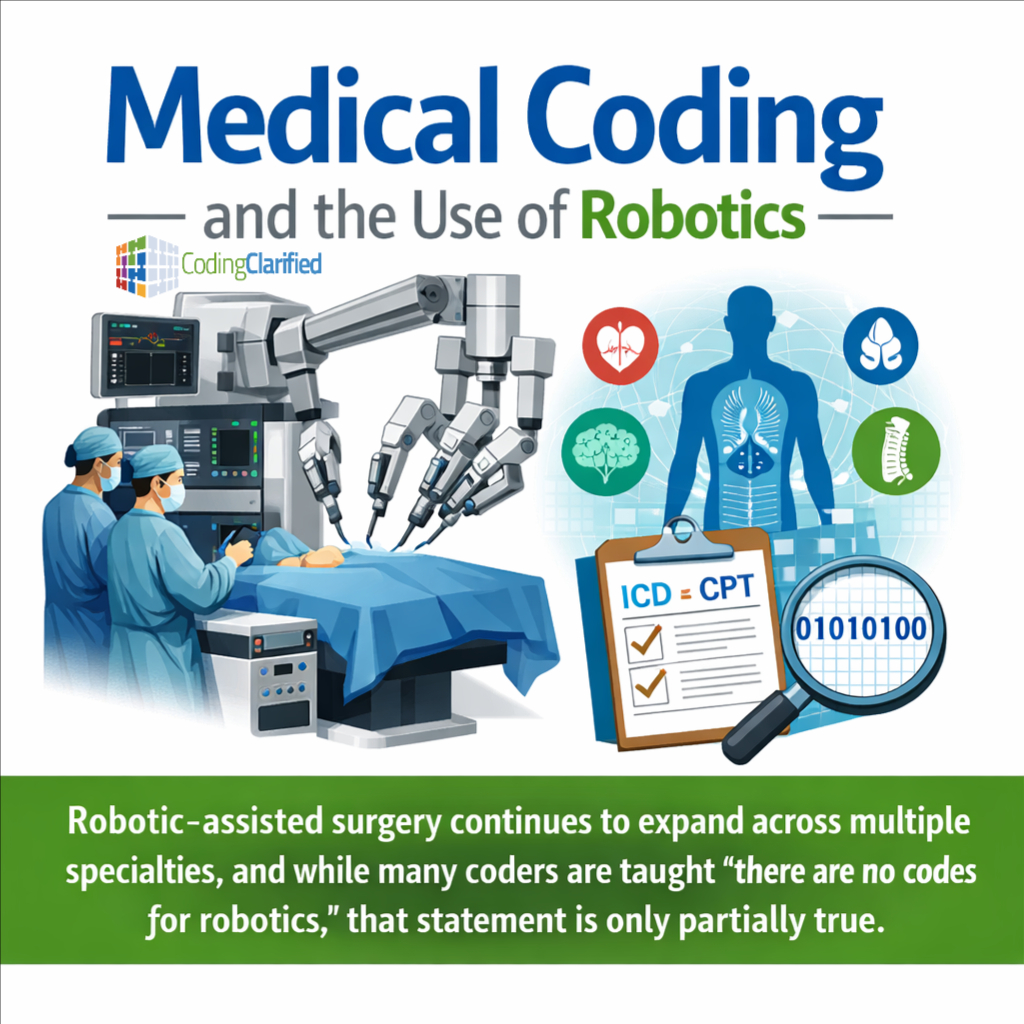
Robotic-assisted surgery continues to expand across multiple specialties, and while many coders are taught “there are no codes for robotics,” that statement is only partially true.
The reality is:
- CPT (physician coding): no true payable robotic code
- HCPCS: tracking code exists (non-payable)
- ICD-10-PCS (facility coding): YES—there ARE robotic codes
Understanding this distinction is critical for accurate coding and billing.
CPT Coding (Professional Services)
Key Rule: No Separate CPT Code for Robotics
There is NO CPT code that represents robotic assistance.
You must:
- Code the primary procedure only
- Ignore the robotic technology when selecting CPT
Example:
- Robotic laparoscopic hysterectomy → Code laparoscopic hysterectomy CPT
- Do NOT add a robotic CPT code
HCPCS Code for Robotic Assistance
There IS a HCPCS code:
- S2900 – Surgical techniques requiring use of robotic surgical system
Important Billing Facts:
- Not payable by Medicare
- No RVUs assigned
- Used mainly for:
- Tracking robotic usage
- Internal reporting
- Some commercial payer consideration
Key Tip:
Use S2900 only if payer policy allows—it is often denied or ignored.
ICD-10-PCS Codes (Facility Coding — THIS IS WHERE ROBOTICS IS CODED)
Unlike CPT, ICD-10-PCS DOES capture robotic assistance.
How It Works:
You must code:
- The primary procedure
- A separate robotic assistance code (8E0 section)
This means robotic procedures require TWO codes in ICD-10-PCS.
Common ICD-10-PCS Robotic Codes
Here are REAL examples used in coding:
Trunk Region
- 8E0W4CZ – Robotic-assisted procedure, trunk, percutaneous endoscopic
- 8E0W8CZ – Robotic-assisted procedure, trunk, via natural opening endoscopic
Upper Extremity
- 8E0X0CZ – Robotic-assisted procedure, upper extremity, open
Lower Extremity
- 8E0Y0CZ – Robotic-assisted procedure, lower extremity, open
Head & Neck
- 8E09XCZ – Robotic-assisted procedure, head and neck
What These Codes Represent
These codes come from:
- Section 8 – Other Procedures
- Device value = C (robotic assistance)
They describe:
- The use of robotic technology
- NOT the actual surgical procedure
Example (Real Coding Scenario)
Procedure:
Robotic-assisted laparoscopic hysterectomy
Correct ICD-10-PCS Coding:
- Primary procedure (e.g., hysterectomy code)
-
- 8E0W4CZ (robotic assistance)
This confirms:
- What was done
- AND that robotics was used
Critical Coding Guidelines
Always Code the Primary Procedure First
Robotic codes are never standalone
Robotics Is NOT the Approach
Do NOT confuse:
- Approach (open, percutaneous, endoscopic)
- Technology (robotic)
Approach is still coded separately and must follow PCS definitions.
Two-Code Rule for PCS
- Procedure code
-
- Robotic assistance code
This is a requirement, not optional
Documentation Must Support Robotics
Look for:
- “Robot-assisted”
- “Computer-assisted navigation”
- System used (e.g., console, robotic arms)
No Extra Payment (Most Cases)
Even though ICD-10-PCS captures robotics:
- It usually does NOT increase reimbursement
- It is primarily for:
- Data tracking
- Outcomes analysis
- Quality reporting
Common Coding Mistakes
- Saying “there are no robotic codes” (incorrect for PCS)
- Adding robotic CPT codes (they don’t exist)
- Forgetting the 8E0 code in inpatient coding
- Coding robotics as the approach
- Using S2900 incorrectly for all payers
Pro Tips for Coders
- Always code from the operative report body
- Identify:
- Procedure performed
- Approach used
- Body system
- Then determine if robotics is documented
- Apply PCS robotic code ONLY when supported
Coding Clarified Final Takeaway
The most accurate way to teach this topic is:
- CPT: No robotic code
- HCPCS: S2900 (tracking only, not reimbursed)
- ICD-10-PCS: YES—robotic assistance codes (8E0 series)
This distinction is essential for:
- Exam success (CPC, CCS)
- Real-world coding accuracy
- Audit protection