
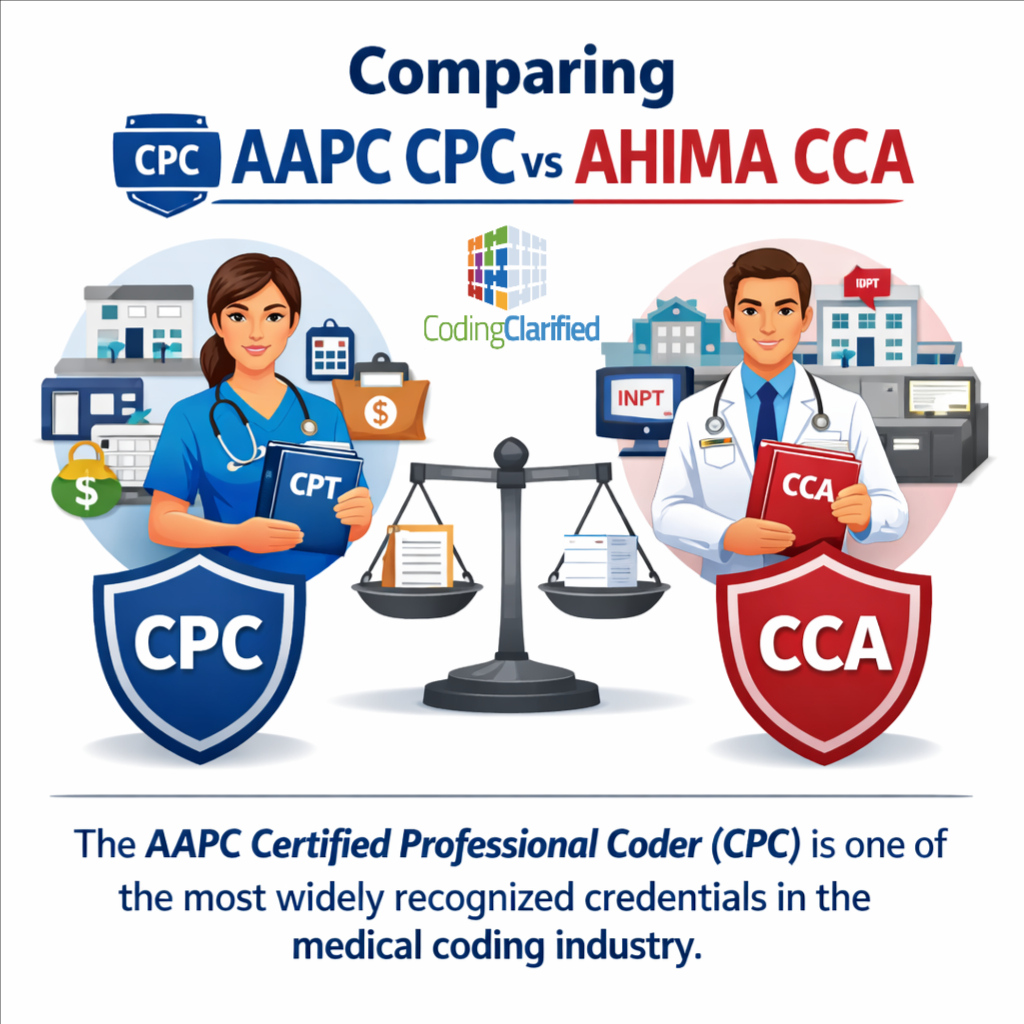
Why the AAPC CPC Is Often Recommended Over the AHIMA CCA for New Medical Coders
When individuals begin researching medical coding certifications, two entry-level options often come up: the American Academy of Professional Coders (AAPC) Certified Professional Coder (CPC) and the American Health Information Management Association (AHIMA) Certified Coding Associate (CCA).
Both certifications demonstrate coding knowledge, but in many situations, the CPC credential is more widely recommended for individuals pursuing a career specifically in physician-based medical coding.
Below are several reasons why the CPC is often the preferred starting point.
The CPC Is the Most Recognized Credential for Physician Coding
The Certified Professional Coder (CPC) is one of the most widely recognized credentials in the medical coding industry.
Students using AAPC preparatory courses have the highest success rates, and some licensed education partners like Coding Clarified have reported high, even 100% pass rates.
It focuses specifically on professional (physician and outpatient) coding, which represents a large portion of coding jobs in healthcare, including:
-
Physician offices
-
Specialty clinics
-
Ambulatory surgery centers
-
Telehealth services
-
Revenue cycle companies
Because of this focus, many employers list CPC as a required or preferred credential in job postings for entry-level coding positions.
CPC Training Aligns Directly With Real Coding Work
The CPC certification exam tests the skills coders use daily in real practice, including:
-
CPT procedure coding
-
ICD-10-CM diagnosis coding
-
HCPCS Level II supply and service coding
-
Medical terminology
-
Anatomy and physiology
-
Coding guidelines and compliance
-
Modifiers and medical necessity
Students preparing for the CPC exam learn how to interpret medical documentation and apply coding guidelines, which mirrors the work performed by coders in physician practices.
The CPC Is Designed Around the Coding Manuals Used in Practice
The CPC exam requires coders to use the same three manuals used in real coding environments:
-
CPT
-
ICD-10-CM
-
HCPCS Level II
During the exam, candidates must navigate these manuals efficiently to locate and confirm the correct codes. This approach reinforces the same workflow coders use on the job.
The CPC Has a Large Professional Community
The American Academy of Professional Coders has one of the largest coding communities in the industry.
Members benefit from:
-
Local chapter meetings
-
Continuing education opportunities
-
Networking with experienced coders
-
Job boards and career resources
This professional network can be especially valuable for new coders entering the field.
The CPC Is Frequently Requested by Employers
In many job postings for physician-based coding roles, employers specifically request:
-
CPC
-
CPC-A (apprentice status)
-
CPC with experience
Because of this, students often pursue the CPC certification first to align with the expectations of employers hiring outpatient coders.
Where the AHIMA CCA Fits
The Certified Coding Associate (CCA) offered by the American Health Information Management Association is also an entry-level credential.
It validates proficiency in ICD-10-CM, ICD-10-PCS, and CPT coding systems. The exam requires a high school diploma and demonstrates competency in clinical classification, reimbursement, and compliance.
-
- Requirements: A high school diploma or equivalent is required to sit for the exam. AHIMA also recommends six months of coding experience or completion of an approved coding program.
- Exam Format: The exam consists of 90–115 multiple-choice questions, with two hours allowed for completion
.
- Pass Rate: The first-time pass rate for the CCA exam is 74%.
- Preparation: Candidates are advised to study ICD-10-CM, ICD-10-PCS, and CPT coding manuals.
- Recertification: CCA holders must recertify, with fees varying based on membership status ($100 for members; $218 for non-members as of March 2026)
However, AHIMA certifications are often more closely associated with:
-
Health information management roles
-
Hospital coding environments
-
Inpatient coding pathways that lead toward credentials like the Certified Coding Specialist (CCS)
Because of this focus, many individuals pursuing physician or outpatient coding careers begin with the CPC.
The AHIMA Certified Coding Associate (CCA®)
Choosing the Right Certification
Both certifications have value, but the best choice depends on your career goals.
Many new coders choose the CPC because it:
-
Focuses on physician-based coding
-
Is widely recognized by employers
-
Uses the coding manuals used in real coding work
-
Provides access to a large professional coding community
For students who want to work in physician practices, outpatient clinics, or revenue cycle companies, the CPC is often the most direct path into the profession.
Coding Clarified can train you for the CPC, as we are an AAPC-approved education provider. You may even qualify for a scholarship/grant!
Coding Clarified’s Medical Coding course includes the following:
80-clock-hour self-paced course
100% remote studies
Access to the AAPC online medical coding course
CPT, ICD10, HCPC and Textbook
Instructor video/audio files to implement notes into your books
1:1 time with instructor as needed
AAPC Membership (Assigned at completion of course)
CPC Exam Voucher x2 (Assigned at completion of course)
CPC Practice Exam Bundle x3 (Upon completion of course)
CPC Study Guide (Electronic)
CPC Exam Online Review (Upon completion of the course)
Practicode (Upon becoming certified as CPC)
Online HCC Internship (Once completed with Practicode)
Professionally written resume (Upon completion of internship)
Job placement assistance/resources (Once certified or completed with Internship)
Coding Clarified Purchase Options
Coding Clarified Scholarship/Grant
What It Means to Be an AAPC Education Provider
Ultimate Medical Coding AAPC CPC Certification Guide
Medical Coding – Job Growth – CPC Certification – Job Search Strategy and Salary