
Medical Coding Clarified: How to Interpret NCV Reports (Nerve Conduction Velocity) for Accurate Coding
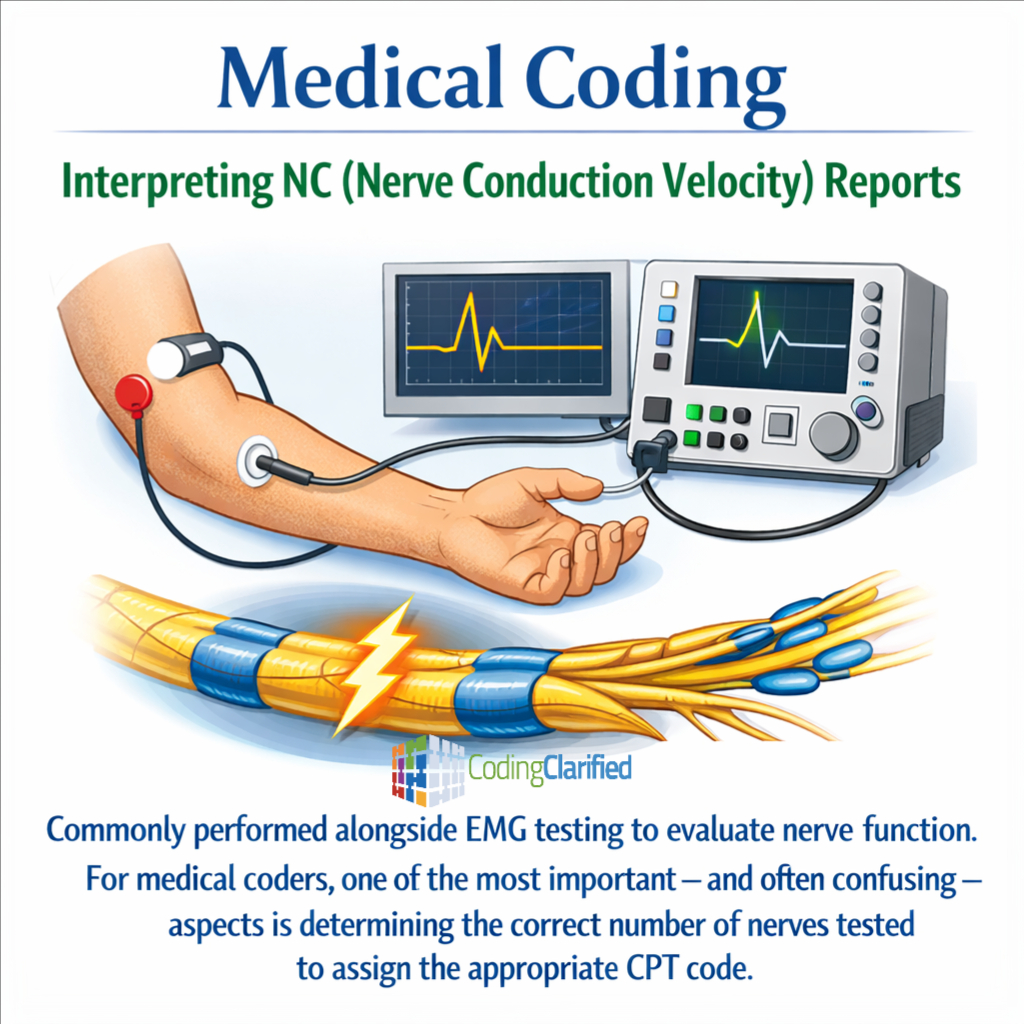
Nerve Conduction Velocity (NCV) studies are commonly performed alongside EMG testing to evaluate nerve function. For medical coders, one of the most important — and often confusing — aspects is determining the correct number of nerves tested to assign the appropriate CPT® code.
Understanding how to interpret the report correctly ensures accurate coding, proper reimbursement, and compliance.
What Is an NCV Study?
An NCV study measures how quickly electrical impulses travel through a nerve. It evaluates:
- Sensory nerves
- Motor nerves
- Mixed nerves
Each distinct nerve tested is counted for CPT® coding — not each stimulation site.
Key CPT® Code Ranges for NCV
NCV codes are selected based on the total number of nerves tested:
- 95907 → 1–2 nerves
- 95908 → 3–4 nerves
- 95909 → 5–6 nerves
- 95910 → 7–8 nerves
- 95911 → 9–10 nerves
- 95912 → 11–12 nerves
- 95913 → 13 or more nerves
Important: These codes are not per nerve — they are based on the total count.
How to Count Nerves Correctly
Count Each Nerve Only Once
Even if a nerve is tested multiple times (different sites or segments), it is still one nerve.
Example:
- Median nerve tested at wrist and elbow = 1 nerve, not 2
Sensory and Motor = Same Nerve
If both sensory and motor components of the same nerve are tested:
- Count it as one nerve total
Left and Right Count Separately
Each side of the body is counted independently.
Example:
- Left median nerve = 1
- Right median nerve = 1
- Total = 2 nerves
Different Named Nerves = Separate Counts
Each distinct nerve counts individually.
Common examples:
- Median nerve
- Ulnar nerve
- Radial nerve
- Peroneal nerve
- Tibial nerve
- Sural nerve
How to Read the NCV Report
When reviewing documentation, focus on:
Nerve Names
Look for clearly documented nerves (not muscles or sites).
Test Type
You may see:
- Motor conduction
- Sensory conduction
- F-wave or H-reflex
These do not increase the nerve count — they are part of the same nerve evaluation.
Multiple Sites vs. Multiple Nerves
Do not confuse:
- Stimulation sites (wrist, elbow, ankle)
with - Distinct nerves
Only the nerve itself counts.
Common Coding Mistakes
Overcounting Nerves
Counting each stimulation site as a separate nerve
Double Counting Sensory + Motor
Counting them separately instead of one nerve
Missing Bilateral Counts
Forgetting to count the left and right sides individually
Counting Muscles Instead of Nerves
Muscles are relevant for EMG, not NCV nerve count
NCV + EMG Combination Coding
NCV studies are often performed with EMG:
- NCV = codes 95907–95913
- EMG = separate CPT® codes (e.g., 95860–95870 range)
Important:
- Do not bundle incorrectly
- Ensure documentation supports both services
Documentation Tips for Coders
To code accurately, the report should include:
- Specific nerve names tested
- Laterality (left/right)
- Type of study (motor/sensory)
- Clear results tied to each nerve
If documentation is unclear, query the provider.
Pro Coding Tips
- Always list out each nerve manually before selecting the CPT® code
- Use a quick tally method while reviewing the report
- Watch for duplicate nerve entries across sections
- Follow CPT® guidelines — not assumptions from the report layout
Coding Clarified Takeaway
Accurate NCV coding comes down to one key rule:
You are counting nerves — not test sites, not waveforms, and not muscles.
When in doubt:
- Identify the nerve
- Confirm it is distinct
- Count it once per side
This approach will keep your coding accurate, compliant, and audit-ready.
American Association of Neurological Surgeons