
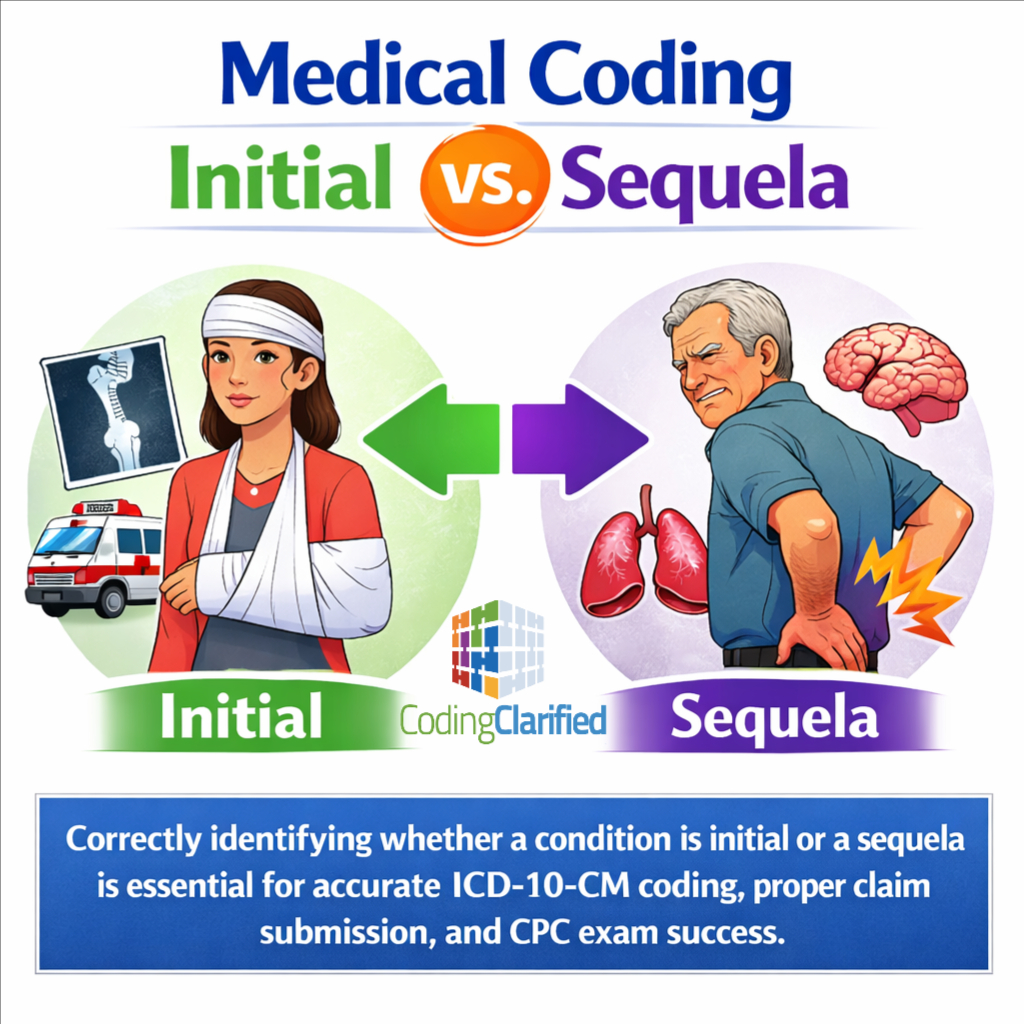
Initial vs. Sequela ICD-10-CM Coding: Guidelines, Differences, and Tips for Medical Coders
Correctly identifying whether a condition is initial or a sequela is essential for accurate ICD-10-CM coding, proper claim submission, and CPC exam success. These terms are commonly tested and frequently misunderstood—especially when coding injuries, fractures, and other conditions with long-term effects.
This blog breaks down the official guidelines, explains the key differences, and provides practical coding tips every medical coder should know.
What Does “Initial Encounter” Mean in ICD-10-CM?
An initial encounter refers to the period when a patient is receiving active treatment for a condition.
Key Guideline
-
Initial encounter ≠ first visit
-
It applies as long as active treatment is being provided
Examples of Active Treatment
-
Surgical treatment
-
Emergency department services
-
Evaluation and treatment by a new physician
-
Casting, splinting, or other active interventions
Coding Tip
If the provider is actively treating the condition—even if it’s the patient’s third or fourth visit—use the initial encounter character.
What Does “Sequela” Mean in ICD-10-CM?
A sequela is a residual condition that remains after the acute phase of an illness or injury has ended.
Common Sequela Examples
-
Scar formation after a burn
-
Chronic pain after a fracture has healed
-
Limited range of motion following an injury
-
Nerve damage resulting from trauma
Key Guideline
-
A sequela is not the injury itself, but the condition caused by the injury
How to Code a Sequela Correctly
Sequela coding follows a specific sequencing rule:
Sequencing Rules
-
Code first the residual condition (what the patient currently has)
-
Code the cause of the sequela second, with the sequela character
Example
-
Patient has chronic wrist pain due to a healed fracture:
-
Code chronic wrist pain first
-
Code the old fracture with the sequela character second
-
Coding Tip
The original injury does not need to be active to be reported as a sequela.
Key Differences: Initial Encounter vs. Sequela
| Initial Encounter | Sequela |
|---|---|
| Active treatment is ongoing | Acute condition has ended |
| Applies beyond the first visit | Applies to long-term effects |
| Focuses on treating the condition | Focuses on residual effects |
| Used during surgery, ER care, or new evaluation | Used for complications or lasting impairments |
Common Coding Mistakes to Avoid
-
Assuming initial encounter only applies to the first visit
-
Coding the original injury before the residual condition in sequela cases
-
Forgetting that sequela coding requires two codes
-
Using sequela characters for symptoms that are part of normal healing
CPC Exam Tips for Initial vs. Sequela Coding
-
Always read the full ICD-10-CM guideline, not just the code description
-
Look for wording like “due to,” “resulting from,” or “secondary to”
-
Ask yourself:
-
Is the provider actively treating the condition?
-
Or is this a long-term effect of a past condition?
-
-
Remember: Guidelines override assumptions and memory
Understanding the difference between initial encounters and sequelae is critical for:
-
ICD-10-CM compliance
-
Accurate reimbursement
-
CPC exam success
When in doubt, follow this rule:
-
Active treatment = Initial
-
Residual effect = Sequela
Mastering this concept will significantly improve your coding accuracy and confidence.