
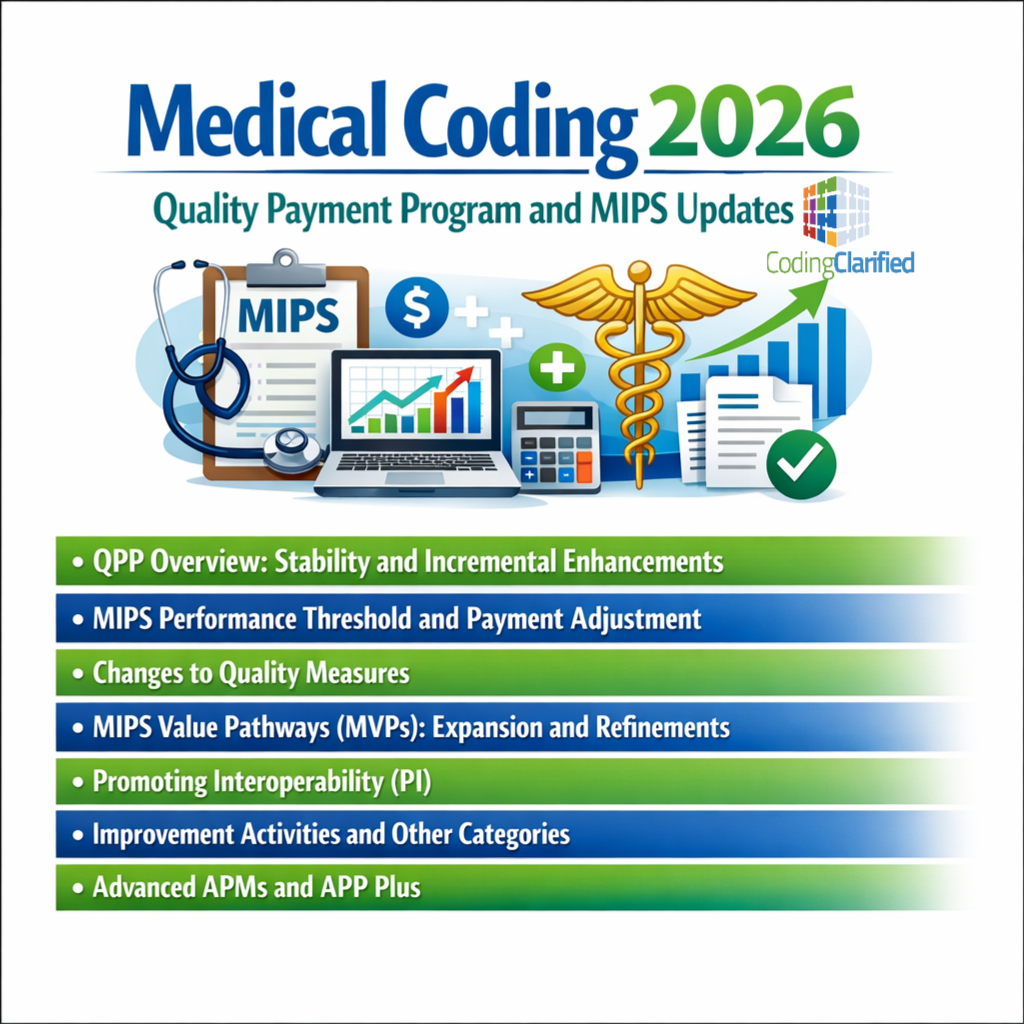
2026 Quality Payment Program (QPP) and MIPS Updates: What Medical Coders Need to Know
The Quality Payment Program (QPP) under the Medicare Access and CHIP Reauthorization Act (MACRA) continues to evolve for the 2026 performance year. CMS released the Calendar Year (CY) 2026 Medicare Physician Fee Schedule (PFS) Final Rule, which includes updates to the Quality Payment Program and MIPS Updates (Merit-based Incentive Payment System) that affect reporting requirements, performance thresholds, quality measures, and payment adjustments. Here’s a detailed breakdown of the key changes and what they mean for coding, reporting, and practice operations.
QPP Overview: Stability and Incremental Enhancements
The 2026 QPP final rule emphasizes continuity and stability while gradually shifting toward more clinically meaningful reporting. CMS has limited the number of sweeping structural changes in favor of consistent scoring criteria and gradual evolution of measures.
Key Components of QPP for 2026:
-
MIPS (Merit-based Incentive Payment System)
-
MIPS Value Pathways (MVPs)
-
Advanced Alternative Payment Models (APMs)
-
APM Performance Pathway (APP) for ACOs and other APM entities
MIPS Performance Threshold and Payment Adjustments
Performance Threshold
To avoid negative payment adjustments, clinicians must meet a performance threshold score, which remains set at 75 points for the 2026 performance year (affecting payment adjustments in subsequent years). CMS has committed to maintaining this threshold through the 2028 performance period, providing predictability for practices.
Payment Adjustments for 2026
Payment adjustments in 2026 are based on 2024 MIPS performance data. Clinicians, groups, or virtual groups should check their final score on the QPP website to determine whether they will receive a positive, negative, or neutral payment adjustment to Medicare Part B reimbursements.
Changes to Quality Measures
CMS finalized updates that alter the structure and inventory of quality measures:
-
5 new quality measures added
-
30 existing measures substantively changed
-
10 measures removed from the MIPS inventory
These revisions aim to keep the measure set clinically relevant and aligned with current standards of care.
Scoring Refinements
CMS has also aligned certain administrative claims quality measure scoring methods with cost measure methodologies to improve fairness and comparability.
MIPS Value Pathways (MVPs): Expansion and Refinements
MVPs remain an optional reporting pathway in 2026, offering more clinically focused measures relevant to specific specialties. CMS finalized 6 new MVPs, including:
-
Diagnostic Radiology
-
Interventional Radiology
-
Neuropsychology
-
Pathology
-
Podiatry
-
Vascular Surgery
Important MVP reporting changes:
-
Groups must now attest to being single specialty or multispecialty during registration.
-
Multispecialty groups that do not qualify as “small practices” must register as subgroups, individuals, or APM entities to report MVPs; small practices retain optional group reporting.
These steps help ensure MVPs reflect true specialty expertise and meaningful clinical quality benchmarks.
QPP MIPS Value Pathways (MVPs)
Promoting Interoperability (PI)
CMS made technical updates to the PI category to support improved data security and reporting flexibility. One key policy:
-
Electronic Case Reporting (eCR) measure will be suppressed for the 2025 performance year (affecting the 2027 payment year) due to onboarding delays by public health agencies.
This means clinicians must still report eCR but will receive maximum points for this measure, mitigating reporting burden in light of operational challenges.
Cost Performance Category
The cost category remains largely stable, with no new cost measures adopted and none removed for 2026. CMS finalized a two-year informational feedback period for new cost measures. During this period, clinicians can see performance data but the new cost measures do not count toward final scores.
Improvement Activities and Other Categories
CMS finalized updates to the Improvement Activities inventory:
-
3 new improvement activities added
-
Modifications to existing activities
-
8 removed activities
These changes reflect shifts in clinical focus and priorities, such as the inclusion of activities related to patient safety and technology use.
Advanced APMs and APP Plus
CMS also updated policies for Advanced APMs and the APP:
-
QP (Qualifying APM Participant) determinations can now be made at both the clinician and APM entity levels.
-
The calculation of QP status now includes all covered professional services, not just E/M services.
For ACOs participating in the Medicare Shared Savings Program, CMS also refined quality reporting methods and survey approaches beginning in future years.
Practical Tips for Coders and Practice Administrators
Stay ahead of the submission window:
CMS is accepting MIPS submissions for the 2025 performance year through 8 p.m. ET March 31, 2026, providing time to finalize and troubleshoot reporting.
Review measure changes early:
Understand which quality measures are new, substantially revised, or removed to avoid reporting gaps that could impact scores.
Evaluate MVP participation:
Clinicians in specialties with new MVPs should consider whether MVP reporting better aligns with clinical practice and quality improvement strategies.
Monitor performance feedback:
Use CMS feedback reports and QPP resources to identify areas for quality care enhancement and coding accuracy.
The 2026 QPP and MIPS updates reflect CMS’s intent to balance program stability with meaningful clinical evolution. While there are no dramatic overhauls, incremental changes to quality measures, MVP pathways, performance scoring, and reporting flexibility will impact how clinicians and federalregister.gov/…/medicare-and-medicaid-programs-cy-2026-payment-policies-under-the-physician-fee-schedule-and-otherpractices approach quality reporting and Medicare reimbursement strategy in 2026 and beyond.
Staying informed and proactive remains essential for successful participation and optimized payment adjustments under the QPP framework.